IMMUNOPATHOLOGIE
- Intro see first dia
1. IMMUNOLOGY OF ASTHMA
▪ When you can’t breath
o Inflammation and narrowing of the airways
o Wheezing, Shortness of breath, coughing
o Caused by allergens, cold air, perfumes, moist air, exercise
o Not curable: medication alleviate symptoms
(People who can not breath normally → Due to an inflamation in the airways
Conduct the air a long the lung
Normal= veyr open allow the air free
Asthma → diameter is much smaller/ narrow → wheezing sound when they are breathing
Bcs in the airways → a lot of inflammation
A lot of coughing bcs of mucus production try to get away the mucus=> Caused by allergen=
huisstofmijt, pollen→ Exposed to cold air = just in the winter
Heavy perfumes or moist air
Excercise → excercising in cold air= deathly
= not curely
Puffer release the symptoms)
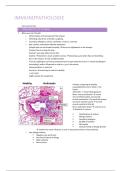
Airways comparing to healthy
Lung epithelium and in white = the
lumen
Asthmatic -> many things going on
Blue= mucus production → mucus
A lot of inflammation and smooth
muscle contraction → around the airway
you have smooth muscle → normal
muscle contract a little bit
But in asthmatic attack → contract a lot
→ diameter is narrow
▪ Classification of asthma
o Allergic asthma
▪ Caused by allergens
• 60-90% of children
• 50% adults
▪ Clinical/ family of allergy (Family
→ mother has more influence so one or two parents have to have asthma)
o Non allergic asthma
▪ Negative skin prick tests
▪ No clinical history of allergy
▪ Older patients
▪ More severe
, ▪ Type 2 (T2)
o Interleukin 4 (IL-4), Interleukin 5 (IL-5), and Interleukin 13 (IL-13) are key cytokines in this
pathway.
o Typically associated with allergic asthma.
o Increased eosinophils in the airway, which contribute to inflammation and symptoms.
o Often linked to atopy (genetic predisposition to develop allergic reactions).
▪ Non-Type 2 (Non-T2) Asthma:
o Cytokines Involved: Instead, they may have other cytokines and inflammatory mediators,
such as IL-17, IL-8, or tumor necrosis factor (TNF).
o Often associated with neutrophilic inflammation rather than eosinophilic.
o Can present with more severe symptoms and may be less responsive to typical asthma
medications (like corticosteroids).
ALLERGEN SENSITIZATION IS LINKED TO THE RISK OF DEVELOPING ASTHMA
o Indoor allergens
▪ House dust mite
▪ Domestic pets
▪ Cockroach
▪ Molds
o Outdoor allergens
▪ Pollen
▪ Fungal spores
EPITHELIAL CELLS ARE THE FIRST PINT OF CONTACT WITH ALLERGENS
o Bcs immunesystem starts to do some strange
, Nose and lungs epithelial cells= are the problem
Allarming the immunesystem
Allergen= harmless
Cytokines actived dc
Induce swelling of lymphnode in your lungs so you dont feel that you have an immunerespons
Produce il4, il5, il13 → IgE→ the problem in allergie→ really bad in allergie
▪
o Activate dentritic cells and innate LC —> IL4,5,13 —> IgE —> bad in allergies
IL-33 ACTIVATES ILC2 IN ALLERGIC INFLAMMATION
o Il-33 derived from epithelial cells is central to allergic sensitization Il-33 activates ILC2 in
allergic inflammation
TH2 (activated by il-33) —> in response IL5,13 are made =>IL5: activating eosinophils: very
destructive —> a lot of granules —> destroy lung epithelials cells and tissue,
IL13: induces mucus production in epithelial cells + structural changes in the airways -_> limits
airflow and produces coughing —> also GM-CSF —> DC act
DENDRITIC CELLS: BRIDGING INNATE AND ADAPTIVE IMMUNITY IN EOSINOPHILIC ASTHMA
o When dc capture antigen → trough lymph nodes and activate t cells
so innate recognition and activate adaptive
, ▪ Airways DCs capture inhaled FITC-labeled OVA and bring it to the draining mediastinal nodes (see dia
13)
DENDRITIC CELLS: DIFFERENT SUBSETS IN THE LUNG IN STEADY STATE
Special → express monocyt marker → cd64=
receptor for immunoglobulin
DENDRITIC CELLS DETERMINE THE
OUTCOME OF THE IMMUNE RESPONSE
Th1 Cells:
• Inducing Antigens: Primarily induced in response to viral and certain bacterial infections.
• Prototypical Cytokine: Interleukin-12 (IL-12) is the key cytokine that drives Th1 differentiation.
• Function: Th1 cells are crucial for cell-mediated immunity, activating macrophages and promoting
cytotoxic T cell responses.
• Th1 Cells:
• Inducing Antigens: Primarily induced in response to viral and certain bacterial infections.
Th1 Cells:
o prototypical Cytokine: Interleukin-12 (IL-
12) is the key cytokine that drives Th1
differentiation.
o Function: Th1 cells are crucial for cell-
mediated immunity, activating macrophages
and promoting cytotoxic T cell responses.
Th2 Cells
o Inducing Antigens: Induced by allergens
and parasitic infections.
o Prototypical Cytokine: Interleukin-4 (IL-4)
is the hallmark cytokine that promotes Th2
differentiation.
o Function: Th2 cells are important for humoral immunity and play a central role in allergic
responses and defense against helminths by promoting B cell class switching to produce IgE.
Th17 Cells:
o Inducing Antigens: Induced by fungal infections and some bacterial infections.
o Key Cytokines: Interleukin-6 (IL-6), Interleukin-1 (IL-1), and Interleukin-23 (IL-23) are important for
Th17 differentiation.
- Intro see first dia
1. IMMUNOLOGY OF ASTHMA
▪ When you can’t breath
o Inflammation and narrowing of the airways
o Wheezing, Shortness of breath, coughing
o Caused by allergens, cold air, perfumes, moist air, exercise
o Not curable: medication alleviate symptoms
(People who can not breath normally → Due to an inflamation in the airways
Conduct the air a long the lung
Normal= veyr open allow the air free
Asthma → diameter is much smaller/ narrow → wheezing sound when they are breathing
Bcs in the airways → a lot of inflammation
A lot of coughing bcs of mucus production try to get away the mucus=> Caused by allergen=
huisstofmijt, pollen→ Exposed to cold air = just in the winter
Heavy perfumes or moist air
Excercise → excercising in cold air= deathly
= not curely
Puffer release the symptoms)
Airways comparing to healthy
Lung epithelium and in white = the
lumen
Asthmatic -> many things going on
Blue= mucus production → mucus
A lot of inflammation and smooth
muscle contraction → around the airway
you have smooth muscle → normal
muscle contract a little bit
But in asthmatic attack → contract a lot
→ diameter is narrow
▪ Classification of asthma
o Allergic asthma
▪ Caused by allergens
• 60-90% of children
• 50% adults
▪ Clinical/ family of allergy (Family
→ mother has more influence so one or two parents have to have asthma)
o Non allergic asthma
▪ Negative skin prick tests
▪ No clinical history of allergy
▪ Older patients
▪ More severe
, ▪ Type 2 (T2)
o Interleukin 4 (IL-4), Interleukin 5 (IL-5), and Interleukin 13 (IL-13) are key cytokines in this
pathway.
o Typically associated with allergic asthma.
o Increased eosinophils in the airway, which contribute to inflammation and symptoms.
o Often linked to atopy (genetic predisposition to develop allergic reactions).
▪ Non-Type 2 (Non-T2) Asthma:
o Cytokines Involved: Instead, they may have other cytokines and inflammatory mediators,
such as IL-17, IL-8, or tumor necrosis factor (TNF).
o Often associated with neutrophilic inflammation rather than eosinophilic.
o Can present with more severe symptoms and may be less responsive to typical asthma
medications (like corticosteroids).
ALLERGEN SENSITIZATION IS LINKED TO THE RISK OF DEVELOPING ASTHMA
o Indoor allergens
▪ House dust mite
▪ Domestic pets
▪ Cockroach
▪ Molds
o Outdoor allergens
▪ Pollen
▪ Fungal spores
EPITHELIAL CELLS ARE THE FIRST PINT OF CONTACT WITH ALLERGENS
o Bcs immunesystem starts to do some strange
, Nose and lungs epithelial cells= are the problem
Allarming the immunesystem
Allergen= harmless
Cytokines actived dc
Induce swelling of lymphnode in your lungs so you dont feel that you have an immunerespons
Produce il4, il5, il13 → IgE→ the problem in allergie→ really bad in allergie
▪
o Activate dentritic cells and innate LC —> IL4,5,13 —> IgE —> bad in allergies
IL-33 ACTIVATES ILC2 IN ALLERGIC INFLAMMATION
o Il-33 derived from epithelial cells is central to allergic sensitization Il-33 activates ILC2 in
allergic inflammation
TH2 (activated by il-33) —> in response IL5,13 are made =>IL5: activating eosinophils: very
destructive —> a lot of granules —> destroy lung epithelials cells and tissue,
IL13: induces mucus production in epithelial cells + structural changes in the airways -_> limits
airflow and produces coughing —> also GM-CSF —> DC act
DENDRITIC CELLS: BRIDGING INNATE AND ADAPTIVE IMMUNITY IN EOSINOPHILIC ASTHMA
o When dc capture antigen → trough lymph nodes and activate t cells
so innate recognition and activate adaptive
, ▪ Airways DCs capture inhaled FITC-labeled OVA and bring it to the draining mediastinal nodes (see dia
13)
DENDRITIC CELLS: DIFFERENT SUBSETS IN THE LUNG IN STEADY STATE
Special → express monocyt marker → cd64=
receptor for immunoglobulin
DENDRITIC CELLS DETERMINE THE
OUTCOME OF THE IMMUNE RESPONSE
Th1 Cells:
• Inducing Antigens: Primarily induced in response to viral and certain bacterial infections.
• Prototypical Cytokine: Interleukin-12 (IL-12) is the key cytokine that drives Th1 differentiation.
• Function: Th1 cells are crucial for cell-mediated immunity, activating macrophages and promoting
cytotoxic T cell responses.
• Th1 Cells:
• Inducing Antigens: Primarily induced in response to viral and certain bacterial infections.
Th1 Cells:
o prototypical Cytokine: Interleukin-12 (IL-
12) is the key cytokine that drives Th1
differentiation.
o Function: Th1 cells are crucial for cell-
mediated immunity, activating macrophages
and promoting cytotoxic T cell responses.
Th2 Cells
o Inducing Antigens: Induced by allergens
and parasitic infections.
o Prototypical Cytokine: Interleukin-4 (IL-4)
is the hallmark cytokine that promotes Th2
differentiation.
o Function: Th2 cells are important for humoral immunity and play a central role in allergic
responses and defense against helminths by promoting B cell class switching to produce IgE.
Th17 Cells:
o Inducing Antigens: Induced by fungal infections and some bacterial infections.
o Key Cytokines: Interleukin-6 (IL-6), Interleukin-1 (IL-1), and Interleukin-23 (IL-23) are important for
Th17 differentiation.