Anatomy and Physiology 1 Exam 1
Study online at https://quizlet.com/_1eqh7z
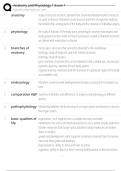
1. anatomy study of structure and form; derived from Greek word Anatome which means to
cut apart or dissect; Anatomists study structure and form of organims studying
the relationships among parts of the body and the structure of individual organs
2. physiology the study of function of the body parts; physiologists examine how organs and
body systems function under normal circumstances as well as how their functions
are altered with medication or disease
3. branches of microscopic- structures that cannot be observed to the unaided eye
anatomy (cytology- study of body cells and their internal structure;
histology- study of tissues)
gross anatomy- structures that can be observed to the unaided eye,; macroscopic
(systemic anatomy- anatomy of each body system;
regional anatomy- examines all of the structures in a particular region of the body
as a complete unit)
4. embryology discipline concerned with developmental changes occuring from conception to
birth
5. comparative A&P examines similarities and differences of anatomy and physiology of different
species
6. pathophysiology relationship between the functioning of an organ system and disease or injury to
that organ system
7. basic qualities of organization- each organism has a complex structure and order
life metabolism- the sum of all chemical reactions to occur within a body; anabolism
(smaller molecules form larger) and catabolism (larger molecules are broken
down to smaller)
growth and development- each organism assimilates materials from its environ-
ment and often grows and develops
responsiveness- ability to sense and react to stimuli
regulation- ability to adjust or direct internal bodily function in the face of envi-
, Anatomy and Physiology 1 Exam 1
Study online at https://quizlet.com/_1eqh7z
ronmental changes- homeostasis- ability of an organism to maintain a consistent
internal environment
8. organization of chemical level- consists of atoms, molecules, macromolecules, and organelles
the human body cell level- consists of cells, made up of structures and molecules from chemical
level
tissue level- made up of tissues which are made of cells
organ level- made up of organs made up of 2-3 tissue types that work together
for specific, complex functions
organ system level- organs that work together to coordinate activities and acheive
a common function
9. anterior in front of
10. posterior in back of
11. dorsal on the backside of the human body
12. ventral on the belly side of the human body
13. superior closer to the head
14. inferior closer to the feet
15. deep on the inside
16. superficial on the outside
17. homeostasis refers to the ability of an organism to maintain a consistent internal environment
or "steady state"; for example if the body gets hot due to external temperature,
the body maintains a steady state by circulating more blood toward the surface to
facilitate heat loss; nervous system regulating blood pressure when you get out
of bed in the morning
receptor- detects changes in variable; either substance or process stimulus
Study online at https://quizlet.com/_1eqh7z
1. anatomy study of structure and form; derived from Greek word Anatome which means to
cut apart or dissect; Anatomists study structure and form of organims studying
the relationships among parts of the body and the structure of individual organs
2. physiology the study of function of the body parts; physiologists examine how organs and
body systems function under normal circumstances as well as how their functions
are altered with medication or disease
3. branches of microscopic- structures that cannot be observed to the unaided eye
anatomy (cytology- study of body cells and their internal structure;
histology- study of tissues)
gross anatomy- structures that can be observed to the unaided eye,; macroscopic
(systemic anatomy- anatomy of each body system;
regional anatomy- examines all of the structures in a particular region of the body
as a complete unit)
4. embryology discipline concerned with developmental changes occuring from conception to
birth
5. comparative A&P examines similarities and differences of anatomy and physiology of different
species
6. pathophysiology relationship between the functioning of an organ system and disease or injury to
that organ system
7. basic qualities of organization- each organism has a complex structure and order
life metabolism- the sum of all chemical reactions to occur within a body; anabolism
(smaller molecules form larger) and catabolism (larger molecules are broken
down to smaller)
growth and development- each organism assimilates materials from its environ-
ment and often grows and develops
responsiveness- ability to sense and react to stimuli
regulation- ability to adjust or direct internal bodily function in the face of envi-
, Anatomy and Physiology 1 Exam 1
Study online at https://quizlet.com/_1eqh7z
ronmental changes- homeostasis- ability of an organism to maintain a consistent
internal environment
8. organization of chemical level- consists of atoms, molecules, macromolecules, and organelles
the human body cell level- consists of cells, made up of structures and molecules from chemical
level
tissue level- made up of tissues which are made of cells
organ level- made up of organs made up of 2-3 tissue types that work together
for specific, complex functions
organ system level- organs that work together to coordinate activities and acheive
a common function
9. anterior in front of
10. posterior in back of
11. dorsal on the backside of the human body
12. ventral on the belly side of the human body
13. superior closer to the head
14. inferior closer to the feet
15. deep on the inside
16. superficial on the outside
17. homeostasis refers to the ability of an organism to maintain a consistent internal environment
or "steady state"; for example if the body gets hot due to external temperature,
the body maintains a steady state by circulating more blood toward the surface to
facilitate heat loss; nervous system regulating blood pressure when you get out
of bed in the morning
receptor- detects changes in variable; either substance or process stimulus