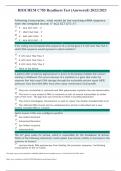
APHR EXAM 2025/2026 WITH 100% ACCURATE
ANSWERS
1. Which form of training prepares employees to perform their jobs effectively,
learn about the organization, and establish work relationships?
benchmarking
sensitivity training
orientation
bumping
conditioning
2. What are the three components of the Shared Service Model in human
resource management?
Employee rights, job analysis, and diversity
Centers of expertise, service centers, and business partners
Labor force projections, legal standards, and objectives
Performance evaluation, mentoring, and job design
3. If an employee is injured on the job and is unable to work for an extended
period, which category of workers' compensation benefits would they
primarily rely on?
Rehabilitative services
Medical care
Disability income
,Death benefits
,4. What is the primary pay system commonly utilized in union environments?
Seniority System
Commission-Based Pay
Flat Rate Pay
Merit-Based Pay
5. What is the first determinant of procedural justice?
Correctability
Consistency
Information Accuracy
Bias Suppression
6. What is the primary goal of job enrichment in human resource
management?
Providing more training opportunities for employees
Reducing the number of tasks assigned to employees
Increasing the salary of employees
Empowering workers by adding more decision-making authority
to jobs
7. Executive search firms:
find new jobs almost exclusively for high-level, unemployed
executives.
help organizations in on-campus recruiting.
, serve as a buffer, providing confidentiality between the employer
and the recruit.
help only entry-level and inexperienced employees to find jobs.
are agencies administered by the federal government or
governmental organizations.
8. Describe the significance of bias suppression in procedural justice.
Bias suppression focuses on gathering diverse opinions to inform
decision-making.
Bias suppression ensures that procedures are applied by
individuals without vested interests or prior prejudices, promoting
fairness.
Bias suppression is primarily concerned with the ethical implications
of decisions.
Bias suppression allows for flexibility in applying procedures based
on individual circumstances.
9. Describe how leniency rating error can impact performance evaluations in
an organization.
Leniency rating error helps identify the best performers in an
organization.
Leniency rating error has no significant impact on employee morale
or performance.
Leniency rating error ensures all employees are treated equally
regardless of performance.
Leniency rating error can lead to inflated performance
evaluations, which may result in unfair promotions and a lack of
accountability.
ANSWERS
1. Which form of training prepares employees to perform their jobs effectively,
learn about the organization, and establish work relationships?
benchmarking
sensitivity training
orientation
bumping
conditioning
2. What are the three components of the Shared Service Model in human
resource management?
Employee rights, job analysis, and diversity
Centers of expertise, service centers, and business partners
Labor force projections, legal standards, and objectives
Performance evaluation, mentoring, and job design
3. If an employee is injured on the job and is unable to work for an extended
period, which category of workers' compensation benefits would they
primarily rely on?
Rehabilitative services
Medical care
Disability income
,Death benefits
,4. What is the primary pay system commonly utilized in union environments?
Seniority System
Commission-Based Pay
Flat Rate Pay
Merit-Based Pay
5. What is the first determinant of procedural justice?
Correctability
Consistency
Information Accuracy
Bias Suppression
6. What is the primary goal of job enrichment in human resource
management?
Providing more training opportunities for employees
Reducing the number of tasks assigned to employees
Increasing the salary of employees
Empowering workers by adding more decision-making authority
to jobs
7. Executive search firms:
find new jobs almost exclusively for high-level, unemployed
executives.
help organizations in on-campus recruiting.
, serve as a buffer, providing confidentiality between the employer
and the recruit.
help only entry-level and inexperienced employees to find jobs.
are agencies administered by the federal government or
governmental organizations.
8. Describe the significance of bias suppression in procedural justice.
Bias suppression focuses on gathering diverse opinions to inform
decision-making.
Bias suppression ensures that procedures are applied by
individuals without vested interests or prior prejudices, promoting
fairness.
Bias suppression is primarily concerned with the ethical implications
of decisions.
Bias suppression allows for flexibility in applying procedures based
on individual circumstances.
9. Describe how leniency rating error can impact performance evaluations in
an organization.
Leniency rating error helps identify the best performers in an
organization.
Leniency rating error has no significant impact on employee morale
or performance.
Leniency rating error ensures all employees are treated equally
regardless of performance.
Leniency rating error can lead to inflated performance
evaluations, which may result in unfair promotions and a lack of
accountability.