Microlecture: Introduction to the McGuire Matrix
Assumptions of persuasive communication:
1. Starting point of the message is the receiver
2. We require a proper message to persuade
Guaranteed persuasion is nonexistent so our best bet is using scientific knowledge to increase
the chance of creating persuasive messages
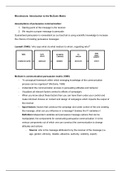
Laswell (1948): “who says what via what medium to whom, regarding who?”
McGuire’s communication-persuasion matrix (1989)
- “A conceptual framework within which emerging knowledge of the communication
process can be organized” (McGuire, 1985)
- Understand the communication process in persuading attitudes and behavior.
- Visualizes all relevant factors central to effects of campaigns
- When you know about these factors then you can have them under your control and
make informed choices on content and design of campaigns which impacts the output of
the receiver
- Input factors: factors that construct the campaign and under control of the one creating
the message, what can you influence in a message? (lowkey the IV variables) //
Definition:independent variables and persuasive message options that can be
manipulated, the components for constructing persuasive communication. It is the
various components out of which one can construct the communication to change
attitudes and actions
- Source: who is the message attributed to by the receiver of the message (i.e.
age, gender, ethnicity, reliable, attractive, authority, celebrity, expert)
, - Characteristics of the perceived communicator to who the message is
attributed, their demographics (age, socioeconomic status, gender,
ethnicity, credibility, attractiveness, and power)
- Persuasive impact is affected by whether or not the audience is aware of
the sources persuasive intent
- Content/Message factors:
- Structure of the message: length, repetition, number of arguments,
argument quality, implicit (you decide) vs explicit (buy our brand)
conclusion etc.
- Nature of the message: humor, fear, instrumental vs vocal music,
positive/negative frame, heuristics, design aspects, etc.
- Recipient/Receiver factors: you cannot impact the recipient directly but as the
creator you can decide who are trying to target so therefore Q: what are
persuasive effects for a specific target group in general?
- Demographics (age, gender, education, ethnicity), intelligence,
personality, cognitive factors, life-style, norms and values, emotion/mood
present before seeing the message
- Channel: Q: what medium can be used for what type of effect?
- Media (channels, sensory modalities) through which persuasive
messages are transmitted include variables such as audio visual versus
both, written vs spoken words
- Complex messages, print ad might be better
- Media modality: compare audio, visual, spoken, context, with(out)
background noise, (non-)verbally, person/voiceover, TV, social media,
radio, print.
- Interpersonal (face-to-face) vs via mass media
- Media multitasking
- Creative vs traditional medium
- Destination factors: variables having to do with the type of target behavior at
which the communication is aimed (e.g. immediate vs long-term change, change
on a specific issue vs across a whole ideological system)
- Output factors: the campaign's effects on the receiver (the outcome of the blackbox)
(lowkey the dependent variables) - Q: what effects does the input factor have?
, - Definition: the successive information-processing behavioural substeps that the
communication must evoke in the target person for the persuasive impact to occur// they
are successive response substeps
Output based on Week 1 Van der Lee (1999)
1. Attention
a. Primary attention
b. Secondary attention
2. Interest
3. Comprehension
4. Elaboration
5. Retrieving from memory
6. Behavioural intention
7. Behavior
Using the matrix model to avoid common comm78-unication errors
1. Attenuated-effects fallacy
2. Distant-measure fallacy
3. The neglected-mediator fallacy
4. The compensatory principle
5. The golden mean principle
6. The situational-weighting principle
Variants of and Alternatives to the Communication/Persuasion Matrix
1. Alternative-routes variants of the input/output model
2. Persuasion from within - self-persuasion theory
Assumptions of persuasive communication:
1. Starting point of the message is the receiver
2. We require a proper message to persuade
Guaranteed persuasion is nonexistent so our best bet is using scientific knowledge to increase
the chance of creating persuasive messages
Laswell (1948): “who says what via what medium to whom, regarding who?”
McGuire’s communication-persuasion matrix (1989)
- “A conceptual framework within which emerging knowledge of the communication
process can be organized” (McGuire, 1985)
- Understand the communication process in persuading attitudes and behavior.
- Visualizes all relevant factors central to effects of campaigns
- When you know about these factors then you can have them under your control and
make informed choices on content and design of campaigns which impacts the output of
the receiver
- Input factors: factors that construct the campaign and under control of the one creating
the message, what can you influence in a message? (lowkey the IV variables) //
Definition:independent variables and persuasive message options that can be
manipulated, the components for constructing persuasive communication. It is the
various components out of which one can construct the communication to change
attitudes and actions
- Source: who is the message attributed to by the receiver of the message (i.e.
age, gender, ethnicity, reliable, attractive, authority, celebrity, expert)
, - Characteristics of the perceived communicator to who the message is
attributed, their demographics (age, socioeconomic status, gender,
ethnicity, credibility, attractiveness, and power)
- Persuasive impact is affected by whether or not the audience is aware of
the sources persuasive intent
- Content/Message factors:
- Structure of the message: length, repetition, number of arguments,
argument quality, implicit (you decide) vs explicit (buy our brand)
conclusion etc.
- Nature of the message: humor, fear, instrumental vs vocal music,
positive/negative frame, heuristics, design aspects, etc.
- Recipient/Receiver factors: you cannot impact the recipient directly but as the
creator you can decide who are trying to target so therefore Q: what are
persuasive effects for a specific target group in general?
- Demographics (age, gender, education, ethnicity), intelligence,
personality, cognitive factors, life-style, norms and values, emotion/mood
present before seeing the message
- Channel: Q: what medium can be used for what type of effect?
- Media (channels, sensory modalities) through which persuasive
messages are transmitted include variables such as audio visual versus
both, written vs spoken words
- Complex messages, print ad might be better
- Media modality: compare audio, visual, spoken, context, with(out)
background noise, (non-)verbally, person/voiceover, TV, social media,
radio, print.
- Interpersonal (face-to-face) vs via mass media
- Media multitasking
- Creative vs traditional medium
- Destination factors: variables having to do with the type of target behavior at
which the communication is aimed (e.g. immediate vs long-term change, change
on a specific issue vs across a whole ideological system)
- Output factors: the campaign's effects on the receiver (the outcome of the blackbox)
(lowkey the dependent variables) - Q: what effects does the input factor have?
, - Definition: the successive information-processing behavioural substeps that the
communication must evoke in the target person for the persuasive impact to occur// they
are successive response substeps
Output based on Week 1 Van der Lee (1999)
1. Attention
a. Primary attention
b. Secondary attention
2. Interest
3. Comprehension
4. Elaboration
5. Retrieving from memory
6. Behavioural intention
7. Behavior
Using the matrix model to avoid common comm78-unication errors
1. Attenuated-effects fallacy
2. Distant-measure fallacy
3. The neglected-mediator fallacy
4. The compensatory principle
5. The golden mean principle
6. The situational-weighting principle
Variants of and Alternatives to the Communication/Persuasion Matrix
1. Alternative-routes variants of the input/output model
2. Persuasion from within - self-persuasion theory