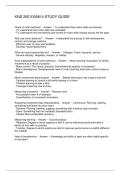
KNS 200 EXAM 4 STUDY GUIDE
Goals of motor behavior - Answer -- To understand how motor skills are learned
- To understand how motor skills are controlled
- To understand how the learning and control of motor skills change across the life span
Why use motor behavior? - Answer -- Understand the process of skill development,
control, and change overtime
- Effective uses of cues and feedback
- Develop "expert performers"
What do motor behaviorists do? - Answer -- Colleges: Teach, research, service
- Service industry: Hospitals, industry, or military
three subdisciplines of motor behavior - Answer -- Motor learning: Acquisition of skilled
movement as a result of practice
- Motor control: The neural, physical, and behavioral aspects of movement
- Motor development: Developmental view of motor learning and motor control across a
lifespan
Motor movements beyond sport - Answer -- Babies learning to use a spoon and fork
- Dentists learning to control a drill while looking in a mirror
- Children learning to ride a bike
- Teenagers learning how to drive
Measuring movement - Answer -- Reaction time
- # successful trials/ # of attempts
- Quantification of movement kinematics
Assessing movement task characteristics - Answer -- Continuous: Running, walking;
something that flows into each other
- Discrete: Pitching, bowling, juggling; something with a distinct stop and start
- Open: Something that has variability (baseball pitch)
- Closed: More predictable (archery)
Measuring learning - Answer -- Goal of practice
- Retention: Degree to which aspects of skill A can be effectively performed after a
period of time with no practice
- Transfer: Degree to which practice on skill A improves performance on skill B (different
but related)
Note of transference - Answer -- Knowledge and skills of sport are often highly specific
to that sport
Goals of motor behavior - Answer -- To understand how motor skills are learned
- To understand how motor skills are controlled
- To understand how the learning and control of motor skills change across the life span
Why use motor behavior? - Answer -- Understand the process of skill development,
control, and change overtime
- Effective uses of cues and feedback
- Develop "expert performers"
What do motor behaviorists do? - Answer -- Colleges: Teach, research, service
- Service industry: Hospitals, industry, or military
three subdisciplines of motor behavior - Answer -- Motor learning: Acquisition of skilled
movement as a result of practice
- Motor control: The neural, physical, and behavioral aspects of movement
- Motor development: Developmental view of motor learning and motor control across a
lifespan
Motor movements beyond sport - Answer -- Babies learning to use a spoon and fork
- Dentists learning to control a drill while looking in a mirror
- Children learning to ride a bike
- Teenagers learning how to drive
Measuring movement - Answer -- Reaction time
- # successful trials/ # of attempts
- Quantification of movement kinematics
Assessing movement task characteristics - Answer -- Continuous: Running, walking;
something that flows into each other
- Discrete: Pitching, bowling, juggling; something with a distinct stop and start
- Open: Something that has variability (baseball pitch)
- Closed: More predictable (archery)
Measuring learning - Answer -- Goal of practice
- Retention: Degree to which aspects of skill A can be effectively performed after a
period of time with no practice
- Transfer: Degree to which practice on skill A improves performance on skill B (different
but related)
Note of transference - Answer -- Knowledge and skills of sport are often highly specific
to that sport