Theme 1 Thinking before doing
Overview
- Mental representations
- How is knowledge stored in our mind?
- Impulsive versus reflective behaviour
- Understanding priming effects
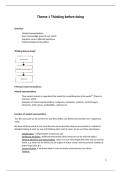
Thinking before doing?
Mental representations
Mental representations
- “Any mental content or operation that stands for something else in the world”” (Payne &
Cameron, 2013)
- Examples of mental representations: categories, exemplars, symbols, mental images,
memories, truth values, probabilities, schemas etc.
Function of mental representation
“For the most part we do not first see and then define, but define first and then see” (Lippmann,
1922)
We have all these words in our mind that we use to describe what we see around us. Instead of
detailed looking at what we see and thinking what could it mean. So we use these stereotypes.
- Classification / categorization of what you see
- Additional attributes, additional information about what we can do with the object
- Steering attention and interpretation, what is on our mind might affect the way we see the
world, e.g. when we are thirsty we see a glass of water sooner and we perceive a bottle of
water larger than it is
- Communication, if we know what it is we can easily communicate it to others
- Thinking
1
,Availability & Accessibility
- Availability: mental representations or knowledge stored in our brain, not necessarily
accessible to us
- Accessibility: mental representations that are accessible and thus can be used in that very
moment, only if its relevant to you its accessible
Activation of mental representation
“Accessibility can be defined as the activation potential of available knowledge” (Higgings, 1996,
p.134)
Women were asked to either put on make-up or eat with chopsticks, the idea is that different mental
representations were going to be accessible. After watching a video of a someone who either put on
make-up or was eating with chopsticks, they did a lexical decision task (different words who had to be
categorized in women relating words vs Chinese relating words). All the information was available but
depending on the group the different kinds of information were accessible.
How is knowledge stored in our mind?
How is knowledge stored?
1. Associative network models
2. Schema models
3. (Predictive coding)
4. Connectionist models
5. Multiple format models
6. Embodied cognition
7. Situated cognition
Associative network models
2
, - Thicker lines represent a stronger association
- Our brain works likes a computer, when it sees something it activates all kinds of associations
- e.g. if you think of coffee or smell coffee, all kinds of associations get unlocked
Schema models
- Perceivers “go beyond the information given” (Bruner, 1957)
If you think about coffee, it might be very different in the different situations that you
are in. e.g. thinking about coffee in the morning is different than thinking of coffee at
university or at a coffee place, difference between making it or ordering it
- Schemas operate as a lens
- Directs attention, memory and judgement
Predictive coding
- Relates to schema models, it argues that we
have priors, such a prior might be a lens that
we use, an expectation that we have about the
outside world, and we use this prior in making
decisions
e.g. drinking a cup of coffee in the
morning you make yourself you know
what it tastes like but you don’t know
how the cup of coffee you order is
going to taste
- The difference in the prior (expectation) and the sensory evidence (what it was actually like)
results in a new prior which is called the posterior and you update your prior
- Bayesian processes:
Priors affect perception
Posterior (“comparison between perception and prior”)
Connectionist models
- Not often used in social psychology
- We have a lot of nodes that are
connected in some way to each other
- Relate to associative network models
3
, - More complex and abstract than other models
Connectionism: parallel distribution processing
- Nodes, don’t have complete information but only subparts, e.g. each node is 1 letter and
together they have a meaning/make a word
- Facilitative and inhibitive links, in the connectionist way of thinking it can also inhibit
activation of other nodes instead of only facilitating
- Concepts exist by means of dynamic interplay of distributed elements
- Input, connection weights (hidden), and output elements
Multiple format models
- The picture is the memory system
model, an example of a multiple format
model
- Our mind is learning about the world in
different ways, connected to different
brain locations and different outcomes
- How information is stored and activated and relates to different types of behaviour
- Affective memory system:
Related to prejudice, learning about other affective stimuli
e.g. spiders or things that you like or dislike
Amygdala plays an important role in learning about this and this affects our
behaviour such as approach and avoidance behaviours
- Semantic memory system:
More high level thinking such as stereotyping cognitive processes
Other brain areas are related to this, we learn in a different way about stereotypes
and we also behave differently
Embodied cognition
Argues that we learn about the world in different ways and we store information with different
sensory inputs. E.g. if you think about coffee you already experience some sensory inputs by only
thinking about it, you re-experience previous situations (embodied cognition)
Do mental representations extend outside the mind, both to the body and to the external
environment?
- Representations are modality-specific
4
Overview
- Mental representations
- How is knowledge stored in our mind?
- Impulsive versus reflective behaviour
- Understanding priming effects
Thinking before doing?
Mental representations
Mental representations
- “Any mental content or operation that stands for something else in the world”” (Payne &
Cameron, 2013)
- Examples of mental representations: categories, exemplars, symbols, mental images,
memories, truth values, probabilities, schemas etc.
Function of mental representation
“For the most part we do not first see and then define, but define first and then see” (Lippmann,
1922)
We have all these words in our mind that we use to describe what we see around us. Instead of
detailed looking at what we see and thinking what could it mean. So we use these stereotypes.
- Classification / categorization of what you see
- Additional attributes, additional information about what we can do with the object
- Steering attention and interpretation, what is on our mind might affect the way we see the
world, e.g. when we are thirsty we see a glass of water sooner and we perceive a bottle of
water larger than it is
- Communication, if we know what it is we can easily communicate it to others
- Thinking
1
,Availability & Accessibility
- Availability: mental representations or knowledge stored in our brain, not necessarily
accessible to us
- Accessibility: mental representations that are accessible and thus can be used in that very
moment, only if its relevant to you its accessible
Activation of mental representation
“Accessibility can be defined as the activation potential of available knowledge” (Higgings, 1996,
p.134)
Women were asked to either put on make-up or eat with chopsticks, the idea is that different mental
representations were going to be accessible. After watching a video of a someone who either put on
make-up or was eating with chopsticks, they did a lexical decision task (different words who had to be
categorized in women relating words vs Chinese relating words). All the information was available but
depending on the group the different kinds of information were accessible.
How is knowledge stored in our mind?
How is knowledge stored?
1. Associative network models
2. Schema models
3. (Predictive coding)
4. Connectionist models
5. Multiple format models
6. Embodied cognition
7. Situated cognition
Associative network models
2
, - Thicker lines represent a stronger association
- Our brain works likes a computer, when it sees something it activates all kinds of associations
- e.g. if you think of coffee or smell coffee, all kinds of associations get unlocked
Schema models
- Perceivers “go beyond the information given” (Bruner, 1957)
If you think about coffee, it might be very different in the different situations that you
are in. e.g. thinking about coffee in the morning is different than thinking of coffee at
university or at a coffee place, difference between making it or ordering it
- Schemas operate as a lens
- Directs attention, memory and judgement
Predictive coding
- Relates to schema models, it argues that we
have priors, such a prior might be a lens that
we use, an expectation that we have about the
outside world, and we use this prior in making
decisions
e.g. drinking a cup of coffee in the
morning you make yourself you know
what it tastes like but you don’t know
how the cup of coffee you order is
going to taste
- The difference in the prior (expectation) and the sensory evidence (what it was actually like)
results in a new prior which is called the posterior and you update your prior
- Bayesian processes:
Priors affect perception
Posterior (“comparison between perception and prior”)
Connectionist models
- Not often used in social psychology
- We have a lot of nodes that are
connected in some way to each other
- Relate to associative network models
3
, - More complex and abstract than other models
Connectionism: parallel distribution processing
- Nodes, don’t have complete information but only subparts, e.g. each node is 1 letter and
together they have a meaning/make a word
- Facilitative and inhibitive links, in the connectionist way of thinking it can also inhibit
activation of other nodes instead of only facilitating
- Concepts exist by means of dynamic interplay of distributed elements
- Input, connection weights (hidden), and output elements
Multiple format models
- The picture is the memory system
model, an example of a multiple format
model
- Our mind is learning about the world in
different ways, connected to different
brain locations and different outcomes
- How information is stored and activated and relates to different types of behaviour
- Affective memory system:
Related to prejudice, learning about other affective stimuli
e.g. spiders or things that you like or dislike
Amygdala plays an important role in learning about this and this affects our
behaviour such as approach and avoidance behaviours
- Semantic memory system:
More high level thinking such as stereotyping cognitive processes
Other brain areas are related to this, we learn in a different way about stereotypes
and we also behave differently
Embodied cognition
Argues that we learn about the world in different ways and we store information with different
sensory inputs. E.g. if you think about coffee you already experience some sensory inputs by only
thinking about it, you re-experience previous situations (embodied cognition)
Do mental representations extend outside the mind, both to the body and to the external
environment?
- Representations are modality-specific
4