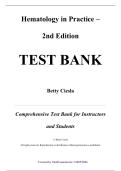
STHematology in Practice –
UV
IA_ 2nd Edition
AP
TEST BANK PR
O VE
Betty Ciesla
D?
Comprehensive Test Bank for Instructors
and Students
© Betty Ciesla
All rights reserved. Reproduction or distribution without permission is prohibited.
Created by MedConnoisseur ©2025/2026
,ST
TABLE OF CONTENTS
UV
Hematology in Practice – 2nd Edition
Betty Ciesla
IA_
Part I: Basic Hematology Principles
AP
1. Introduction to Hematology and Basic Laboratory Practice
2. From Hematopoiesis to the Complete Blood Count
3. Red Blood Cell Production, Function, and Relevant Red Cell
PR
Morphology
4. Hemoglobin Function and Principles of Hemolysis
Part II: Red Blood Cell Disorders
O
5. The Microcytic Anemias
6. The Macrocytic Anemias
VE
7. Normochromic Anemias: Biochemical, Membrane, and Miscellaneous Red
Blood Cell Disorders
8. The Normochromic Anemias Caused by Hemoglobinopathies D?
Part III: White Blood Cell Disorders
9. Leukopoiesis, WBC Differential, and Lymphocyte Function
10. Abnormalities of White Blood Cells: Quantitative, Qualitative, and Storage
Diseases
11. Acute Leukemias
12. Myeloproliferative Neoplasms
13. Lymphoproliferative Disorders and Plasma Cell Disorders
14. The Myelodysplastic Syndromes
Part IV: Hemostasis and Disorders of Coagulation
15. Overview of Hemostasis and Platelet Physiology
16. Quantitative & Qualitative Platelet Disorders
17. Defects of Plasma Clotting Factors
18. Fibrinogen, Thrombin, and the Fibrinolytic System
19. Introduction to Thrombosis and Anticoagulant Therapy
Part V: Hematology Automation, Flow Cytometry & Lab Procedures
20. Hematology Automation and Flow Cell Cytometry
21. Basic Procedures in a Hematology Laboratory
Created by MedConnoisseur ©2025/2026
, ST
Chapter 1: Introduction to Hematology and Basic Laboratory Practice
Multiple Choice
____
UV
Identify the choice that best completes the statement or answers the question.
1. Tube length when referring to the microscope is the:
a. Resolution power of the objective
IA_
b. Distance from the eyepiece to the objective
c. Numerical aperture
d. Magnitude of the image on the stage
____ 2. What is the most useful corrective action for the microscope when fine details cannot be visualized
AP
in immature cells?
a. Open up diaphragm for maximum light.
b. Wipe off lenses with lens cleaner.
c. Get a new slide.
____
d. Move to a lower power.
PR
3. Which of the following behaviors is a violation of standard precautions?
a. Handwashing after glove removal
b. Use of impermeable laboratory gowns
c. Use of goggles and face shields
d. Placing laboratory notebooks on laboratory work area
OV
____ 4. Standards and calibrators differ from control materials because: ED
a. An exact amount of analyte is present in a standard or calibrator
b. A variable amount of analyte is present depending on patient samples
c. Standards only need to be within a target range
d. Standards are run to the best estimate of the known value ?
____ 5. If the confidence interval for most laboratories is 95.5%, what is the acceptable range for
hemoglobin if a hemoglobin control was run with a mean of 12.5 and a standard deviation of 1.0?
a. 9.5 to 12.5
b. 10.5 to 14.5
c. 11.5 to 15.5
d. 10.0 to 13.5
____ 6. Proper mixing of samples and timely delivery of samples to the laboratory are both examples of:
a. Delta checks
b. Postanalytic variables
c. Preanalytic variables
d. Reflex testing
____ 7. A delta check is a historical reference on samples run in the laboratories. Once a sample fails a delta
check, the most obvious corrective action is to:
a. Verify the identification of the patient sample
b. Reestablish the parameters of the delta check
c. Perform reflex testing
, ST
____
d. Perform a manual method
8. Which of the following is the definition of a reference interval?
a. A solution of a known amount of analyte
UV
b. Materials analyzed concurrently with unknown samples
c. Values established for a particular analyte, given a method, instrument, or patient
population
d. Validation techniques on flagged samples
____
IA_
9. Which of the following is not considered a postanalytic variable?
a. Delta checks
b. Proper anticoagulant used
c. Specimen checked for clots
AP
d. Critical results called
____ 10. Error analysis, standard protocols, and turnaround time are all part of the:
a. Quality assurance system
b. Quality control program
c. Reference standards
d. Delta check protocol
PR
a. Mean
b. Mode
c. Median
OV
____ 11. The average of a group of data points is defined as the:
d. Modicum ED
____ 12. Safety training is part of new employee training in health care and includes:
a. Biological hazards
b. Chemical hazards ?
c. Environmental hazards
d. All of the above
____ 13. Control materials are:
a. Analyzed concurrently with the unknown samples
b. Substances with a known amount of analyte
c. Used to calibrate the method
d. All of the above
____ 14. Delta checks are used in the hematology laboratory to:
a. Compare past patient results to the current result
b. Verify control accuracy
c. Establish a target range
d. Establish reference ranges for a particular analyte
____ 15. When handwashing after a patient contact, the soap application process should last at least:
a. 5 seconds
b. 15 seconds
c. 20 seconds
UV
IA_ 2nd Edition
AP
TEST BANK PR
O VE
Betty Ciesla
D?
Comprehensive Test Bank for Instructors
and Students
© Betty Ciesla
All rights reserved. Reproduction or distribution without permission is prohibited.
Created by MedConnoisseur ©2025/2026
,ST
TABLE OF CONTENTS
UV
Hematology in Practice – 2nd Edition
Betty Ciesla
IA_
Part I: Basic Hematology Principles
AP
1. Introduction to Hematology and Basic Laboratory Practice
2. From Hematopoiesis to the Complete Blood Count
3. Red Blood Cell Production, Function, and Relevant Red Cell
PR
Morphology
4. Hemoglobin Function and Principles of Hemolysis
Part II: Red Blood Cell Disorders
O
5. The Microcytic Anemias
6. The Macrocytic Anemias
VE
7. Normochromic Anemias: Biochemical, Membrane, and Miscellaneous Red
Blood Cell Disorders
8. The Normochromic Anemias Caused by Hemoglobinopathies D?
Part III: White Blood Cell Disorders
9. Leukopoiesis, WBC Differential, and Lymphocyte Function
10. Abnormalities of White Blood Cells: Quantitative, Qualitative, and Storage
Diseases
11. Acute Leukemias
12. Myeloproliferative Neoplasms
13. Lymphoproliferative Disorders and Plasma Cell Disorders
14. The Myelodysplastic Syndromes
Part IV: Hemostasis and Disorders of Coagulation
15. Overview of Hemostasis and Platelet Physiology
16. Quantitative & Qualitative Platelet Disorders
17. Defects of Plasma Clotting Factors
18. Fibrinogen, Thrombin, and the Fibrinolytic System
19. Introduction to Thrombosis and Anticoagulant Therapy
Part V: Hematology Automation, Flow Cytometry & Lab Procedures
20. Hematology Automation and Flow Cell Cytometry
21. Basic Procedures in a Hematology Laboratory
Created by MedConnoisseur ©2025/2026
, ST
Chapter 1: Introduction to Hematology and Basic Laboratory Practice
Multiple Choice
____
UV
Identify the choice that best completes the statement or answers the question.
1. Tube length when referring to the microscope is the:
a. Resolution power of the objective
IA_
b. Distance from the eyepiece to the objective
c. Numerical aperture
d. Magnitude of the image on the stage
____ 2. What is the most useful corrective action for the microscope when fine details cannot be visualized
AP
in immature cells?
a. Open up diaphragm for maximum light.
b. Wipe off lenses with lens cleaner.
c. Get a new slide.
____
d. Move to a lower power.
PR
3. Which of the following behaviors is a violation of standard precautions?
a. Handwashing after glove removal
b. Use of impermeable laboratory gowns
c. Use of goggles and face shields
d. Placing laboratory notebooks on laboratory work area
OV
____ 4. Standards and calibrators differ from control materials because: ED
a. An exact amount of analyte is present in a standard or calibrator
b. A variable amount of analyte is present depending on patient samples
c. Standards only need to be within a target range
d. Standards are run to the best estimate of the known value ?
____ 5. If the confidence interval for most laboratories is 95.5%, what is the acceptable range for
hemoglobin if a hemoglobin control was run with a mean of 12.5 and a standard deviation of 1.0?
a. 9.5 to 12.5
b. 10.5 to 14.5
c. 11.5 to 15.5
d. 10.0 to 13.5
____ 6. Proper mixing of samples and timely delivery of samples to the laboratory are both examples of:
a. Delta checks
b. Postanalytic variables
c. Preanalytic variables
d. Reflex testing
____ 7. A delta check is a historical reference on samples run in the laboratories. Once a sample fails a delta
check, the most obvious corrective action is to:
a. Verify the identification of the patient sample
b. Reestablish the parameters of the delta check
c. Perform reflex testing
, ST
____
d. Perform a manual method
8. Which of the following is the definition of a reference interval?
a. A solution of a known amount of analyte
UV
b. Materials analyzed concurrently with unknown samples
c. Values established for a particular analyte, given a method, instrument, or patient
population
d. Validation techniques on flagged samples
____
IA_
9. Which of the following is not considered a postanalytic variable?
a. Delta checks
b. Proper anticoagulant used
c. Specimen checked for clots
AP
d. Critical results called
____ 10. Error analysis, standard protocols, and turnaround time are all part of the:
a. Quality assurance system
b. Quality control program
c. Reference standards
d. Delta check protocol
PR
a. Mean
b. Mode
c. Median
OV
____ 11. The average of a group of data points is defined as the:
d. Modicum ED
____ 12. Safety training is part of new employee training in health care and includes:
a. Biological hazards
b. Chemical hazards ?
c. Environmental hazards
d. All of the above
____ 13. Control materials are:
a. Analyzed concurrently with the unknown samples
b. Substances with a known amount of analyte
c. Used to calibrate the method
d. All of the above
____ 14. Delta checks are used in the hematology laboratory to:
a. Compare past patient results to the current result
b. Verify control accuracy
c. Establish a target range
d. Establish reference ranges for a particular analyte
____ 15. When handwashing after a patient contact, the soap application process should last at least:
a. 5 seconds
b. 15 seconds
c. 20 seconds