Biology 102 Chapter 10 - Reading DNA
Genes and Proteins
Genes code for proteins
Gene expression: When a gene is active, the
protein is being produced.
2-step process:
1. Transcription: DNA → RNA
Transcription occurs in the nucleus.
2. Translation: RNA → protein
Translation occurs in the cytoplasm.
Transcription
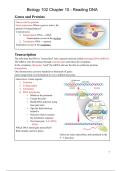
The info from the DNA is "transcribed" into a special molecule called messenger RNA (mRNA).
The mRNA exits the nucleus through a nuclear pore and enters the cytoplasm.
In the cytoplasm, ribosomes "read" the mRNA and use the info to synthesize proteins
(translation).
One chromosome can have hundreds to thousands of genes
Genes range from several hundred to over a million base pairs.
Genes have 3 main regions:
1. Promotor
2. Coding region
3. Terminator
● RNA polymerase
○ Blinds to the promotor
○ Unzips the helix
○ Builds RNA polymer using
base pair rules
○ Zips the helix back up
behind it
○ Releases when it reaches
the terminator sequence
○ New base pair: A-U (DNA
– RNA)
Which DNA strand gets transcribed?
Both strands can have genes.
Genes are read, transcribed, and translated in the
5' 3' direction.
1
, Biology 102 Chapter 10 - Reading DNA
Messenger RNA processing
Before the mRNA is ready for. Translation: "cap" - modified nucleotide
1. A "cap" is added to the 5' end ● Helps initiate translation
2. A "tail" is added to the 3' end. "tail" - polyadenine
3. RNA splicing ● Stabilizes mRNA
RNA Splicing Mature mRNA
The primary RNA transcript contains introns ● Mature mRNA-RNA that has a cap
and exons. and tail, and introns removed
Introns (non-coding sequences) are removed ● Will leave the nucleus and get picked
by splicing. up by a ribosome for translation
Exons contain the protein-coding sequence.
Regulation of Gene The genetic code
Expression Universal: shared by all organisms
Redundant: 64 possible triplets:
Regulatory Sequences: Not all genes can be
● 61 code for amino acids
active all the time
○ but only 20 types of amino
● Waste of energy and resources
acids
Special regulatory proteins (transcription
● 3 codons are stops
factors) can control gene expression:
Unambiguous: each codon codes for 1 thing
● On/off
only
● Speed up/slow down
Proteins Prokaryotes
At its most basic, protein is a chain of amino ● No nuclear envelope separates
acids. transcription from the ribosomes.
The chain must fold to become functional. ● No processing required
● Translation can begin before
transcription is complete!
2
Genes and Proteins
Genes code for proteins
Gene expression: When a gene is active, the
protein is being produced.
2-step process:
1. Transcription: DNA → RNA
Transcription occurs in the nucleus.
2. Translation: RNA → protein
Translation occurs in the cytoplasm.
Transcription
The info from the DNA is "transcribed" into a special molecule called messenger RNA (mRNA).
The mRNA exits the nucleus through a nuclear pore and enters the cytoplasm.
In the cytoplasm, ribosomes "read" the mRNA and use the info to synthesize proteins
(translation).
One chromosome can have hundreds to thousands of genes
Genes range from several hundred to over a million base pairs.
Genes have 3 main regions:
1. Promotor
2. Coding region
3. Terminator
● RNA polymerase
○ Blinds to the promotor
○ Unzips the helix
○ Builds RNA polymer using
base pair rules
○ Zips the helix back up
behind it
○ Releases when it reaches
the terminator sequence
○ New base pair: A-U (DNA
– RNA)
Which DNA strand gets transcribed?
Both strands can have genes.
Genes are read, transcribed, and translated in the
5' 3' direction.
1
, Biology 102 Chapter 10 - Reading DNA
Messenger RNA processing
Before the mRNA is ready for. Translation: "cap" - modified nucleotide
1. A "cap" is added to the 5' end ● Helps initiate translation
2. A "tail" is added to the 3' end. "tail" - polyadenine
3. RNA splicing ● Stabilizes mRNA
RNA Splicing Mature mRNA
The primary RNA transcript contains introns ● Mature mRNA-RNA that has a cap
and exons. and tail, and introns removed
Introns (non-coding sequences) are removed ● Will leave the nucleus and get picked
by splicing. up by a ribosome for translation
Exons contain the protein-coding sequence.
Regulation of Gene The genetic code
Expression Universal: shared by all organisms
Redundant: 64 possible triplets:
Regulatory Sequences: Not all genes can be
● 61 code for amino acids
active all the time
○ but only 20 types of amino
● Waste of energy and resources
acids
Special regulatory proteins (transcription
● 3 codons are stops
factors) can control gene expression:
Unambiguous: each codon codes for 1 thing
● On/off
only
● Speed up/slow down
Proteins Prokaryotes
At its most basic, protein is a chain of amino ● No nuclear envelope separates
acids. transcription from the ribosomes.
The chain must fold to become functional. ● No processing required
● Translation can begin before
transcription is complete!
2