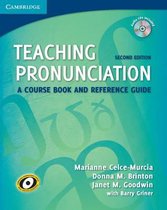
Chapter 1 – Teaching Pronunciation
Two types of approaches:
Intuitive-Imitative Approaches: Depends on learner's ability to listen and
imitate without explicit information. (done by records: first phonograph, then
tape, then audio-/videocassettes and last CD/DVD)
Analytic-Linguistic Approaches: Utilizes information and tools (phonetic
alphabet/charts, supplement listening, imitation and production. It focuses on
sounds and rhythm of the target language. This was made to complement and
not replace the Intuitive-Imitative Approach.
The Direct Method and more recent naturalistic approaches
Direct method late 1800s-early 1900s. Pronunciation was thought through intuition and
imitation. The teacher says something and children repeat it. First listen and then speak -->
Opportunity to internalize the sound and takes away the pressure of speaking. (just like Total
Physical Response and the Natural Approach)
Believed that errors were part of natural acquisition and would disappear when students
gained communicative proficiency.
The Reform Movement
First contribution to the teaching of pronunciation came in 1890s as a part of the Reform
Movement. Phonetics such as Henry Sweet, Wilhelm Viëtor and Paul Passy who formed the
International Phonetic Association and then developed the International Phonetic
Alphabet (IPA). Now there was a written symbol and a sound that represented it.
The findings of phonetics should be applied to language teaching.
Teachers must have solid training in phonetics.
Learners should be given phonetic training to establish good speech
habits.
The 1940s and 1950s
The Reform Movement played a role in the development of:
Audiolingualism (US) / Oral Approach (GB): Just as in Direct Method, the teacher
demonstrates and students repeat but here they also look at IPA or articulation charts.
For this, these usually use minimal-pair drills.
The 1960s
The Cognitive Approach focused on grammar and vocabulary because:
1. Nativelike pronunciation was unrealistic / unachievable.
2. Time is better spend on teachable objectives like grammatical
structures/words.
The 1970s
Approaches that ignored pronunciation: Grammar Translation, Reading-Based Approach,
Cognitive Approach
Teaching pronunciation through listening and imitation: Direct Method
Teaching pronunciation through imitation supported by linguistic
information: Audiolingualism
Two new methods:
Silent way: Just as in Audiolingualism it pays attention on accuracy of
production of both sounds and structures. They need to learn how to combine
words in phrases (blending, stress, intonation). The difference between the Silent
, Way and Audiolingualism is that the Silent Way focuses on the sound system
without the phonetic alphabet/explicit linguistic information.
How does it work?
The teacher talks as little as possible and works with gestures. They use a sound-color-
chart represents vowel and consonant sounds of eight color-
coded Fidel charts and Cuisenaire rods (beams in a particular color).
Community Language Learning: You sit around a table. Teacher stands
behind a student. Teacher asks every student to say something in their L1 that
they would like to know the translation of in the target language. The teacher
gives the translation. The students repeats it and records it. Then the teacher
writes down a transcription of the students' utterances and they match it with
the new target language.
The teacher can continue this activity and the teacher is a human computer who
gives sentences for the student to mimic and who will repeat it until the students
does it right.
It is intuitive just like the Direct Method but it is more learner/client guided than
teacher/textbook guided (since the learner chooses how many times it will be
repeated or recorded).
Pronunciation Teaching Today
Communicative Approach (also called Communicative Language Teaching, CLT) too hold in
the 1890s but is currently used and it has a minimum level that should be reached. If you are
below that, no grammatical or vocabulary control can influence that.
There are four groups who needs special assistance when it comes to pronunciation since
there level should be high:
Foreign teaching assistants in colleges/universities in English-speaking
countries.
Foreign-born born technical, business and professional employees in
English-speaking countries.
International diplomats/businesspeople who use English as their lingua
franca. (gemeenschappelijke communicatiemiddel)
Refugees who want to live in English-speaking countries.
Add to categories:
Teachers of English (source of input) whose L1 is not English and teach is
to students.
People in non-English-speaking countries who deal with visitors who do
not speak the countries language.
The goal is not to sound like a native but that their pronunciation will not detract (be
disadvantageous to) from their ability to communicate.
Now, how to teach it? Look at previous methods!
Listen and imitate: Direct method through recordings/the teacher
Phonetic training: Use articulatory descriptions as in the Reform
Movement --> involve phonetic transcription
Minimal-pair drills: Audiolingualism to distinguish two words that differ in
one sound.
Contextualized minimal pairs: To make minimal-pair drills responsive to
Cognitive Approach.
Example: I go to Zeeland by ship/sheep.
Two types of approaches:
Intuitive-Imitative Approaches: Depends on learner's ability to listen and
imitate without explicit information. (done by records: first phonograph, then
tape, then audio-/videocassettes and last CD/DVD)
Analytic-Linguistic Approaches: Utilizes information and tools (phonetic
alphabet/charts, supplement listening, imitation and production. It focuses on
sounds and rhythm of the target language. This was made to complement and
not replace the Intuitive-Imitative Approach.
The Direct Method and more recent naturalistic approaches
Direct method late 1800s-early 1900s. Pronunciation was thought through intuition and
imitation. The teacher says something and children repeat it. First listen and then speak -->
Opportunity to internalize the sound and takes away the pressure of speaking. (just like Total
Physical Response and the Natural Approach)
Believed that errors were part of natural acquisition and would disappear when students
gained communicative proficiency.
The Reform Movement
First contribution to the teaching of pronunciation came in 1890s as a part of the Reform
Movement. Phonetics such as Henry Sweet, Wilhelm Viëtor and Paul Passy who formed the
International Phonetic Association and then developed the International Phonetic
Alphabet (IPA). Now there was a written symbol and a sound that represented it.
The findings of phonetics should be applied to language teaching.
Teachers must have solid training in phonetics.
Learners should be given phonetic training to establish good speech
habits.
The 1940s and 1950s
The Reform Movement played a role in the development of:
Audiolingualism (US) / Oral Approach (GB): Just as in Direct Method, the teacher
demonstrates and students repeat but here they also look at IPA or articulation charts.
For this, these usually use minimal-pair drills.
The 1960s
The Cognitive Approach focused on grammar and vocabulary because:
1. Nativelike pronunciation was unrealistic / unachievable.
2. Time is better spend on teachable objectives like grammatical
structures/words.
The 1970s
Approaches that ignored pronunciation: Grammar Translation, Reading-Based Approach,
Cognitive Approach
Teaching pronunciation through listening and imitation: Direct Method
Teaching pronunciation through imitation supported by linguistic
information: Audiolingualism
Two new methods:
Silent way: Just as in Audiolingualism it pays attention on accuracy of
production of both sounds and structures. They need to learn how to combine
words in phrases (blending, stress, intonation). The difference between the Silent
, Way and Audiolingualism is that the Silent Way focuses on the sound system
without the phonetic alphabet/explicit linguistic information.
How does it work?
The teacher talks as little as possible and works with gestures. They use a sound-color-
chart represents vowel and consonant sounds of eight color-
coded Fidel charts and Cuisenaire rods (beams in a particular color).
Community Language Learning: You sit around a table. Teacher stands
behind a student. Teacher asks every student to say something in their L1 that
they would like to know the translation of in the target language. The teacher
gives the translation. The students repeats it and records it. Then the teacher
writes down a transcription of the students' utterances and they match it with
the new target language.
The teacher can continue this activity and the teacher is a human computer who
gives sentences for the student to mimic and who will repeat it until the students
does it right.
It is intuitive just like the Direct Method but it is more learner/client guided than
teacher/textbook guided (since the learner chooses how many times it will be
repeated or recorded).
Pronunciation Teaching Today
Communicative Approach (also called Communicative Language Teaching, CLT) too hold in
the 1890s but is currently used and it has a minimum level that should be reached. If you are
below that, no grammatical or vocabulary control can influence that.
There are four groups who needs special assistance when it comes to pronunciation since
there level should be high:
Foreign teaching assistants in colleges/universities in English-speaking
countries.
Foreign-born born technical, business and professional employees in
English-speaking countries.
International diplomats/businesspeople who use English as their lingua
franca. (gemeenschappelijke communicatiemiddel)
Refugees who want to live in English-speaking countries.
Add to categories:
Teachers of English (source of input) whose L1 is not English and teach is
to students.
People in non-English-speaking countries who deal with visitors who do
not speak the countries language.
The goal is not to sound like a native but that their pronunciation will not detract (be
disadvantageous to) from their ability to communicate.
Now, how to teach it? Look at previous methods!
Listen and imitate: Direct method through recordings/the teacher
Phonetic training: Use articulatory descriptions as in the Reform
Movement --> involve phonetic transcription
Minimal-pair drills: Audiolingualism to distinguish two words that differ in
one sound.
Contextualized minimal pairs: To make minimal-pair drills responsive to
Cognitive Approach.
Example: I go to Zeeland by ship/sheep.