Audit and assurance
Section A
External audit: An external audit is a type of assurance engagement that is carried out by an
auditor to give an independent opinion on a set of financial statements.
Stewardship: Stewardship refers to the duty and obligations of a person who manages the
other persons property.
Agency: Shareholders entrusting the directors to manage the running of the business
Expectations gap: Public thinks auditor gives a guarantee, an auditor never gives absolute
assurance he instead gives reasonable assurance (80-85%) this difference between public
perception and reality is called expectation gap.
Inherent limitations of audit
.) Auditors are humans so there is always a chance of human error
.) Not all items in a financial statement are tested as audit is done on a sampling basis rather
than population basis. (not everything is tested)
.) Sometimes management is involved in fraud and it is very difficult to catch management
fraud
.) Financial statements are based on estimates and estimates can be incorrect (provisions
etc)
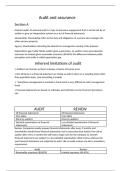
AUDIT REVIEW
Of financial statements Of financial statements
Fees taken Fees taken
Done by auditors Done by auditors
Detailed examinations of financial Less detailed examination of financial
statements statements
Review: Companies usually prepare financial statements after every 3 months and
shareholders doubt those financial statements, but to overcome their doubt if we call an
auditor after every 3 months this will lead to huge costs for the company so 3month
financial statements are subject to a less detailed examination called review, whereas full
year financial statements are subjected to audit. Like an audit reviews are also a mandatory
requirement.
Audit Review
Reasonable assurance (80-85%) Limited assurance (40-45%)
Section A
External audit: An external audit is a type of assurance engagement that is carried out by an
auditor to give an independent opinion on a set of financial statements.
Stewardship: Stewardship refers to the duty and obligations of a person who manages the
other persons property.
Agency: Shareholders entrusting the directors to manage the running of the business
Expectations gap: Public thinks auditor gives a guarantee, an auditor never gives absolute
assurance he instead gives reasonable assurance (80-85%) this difference between public
perception and reality is called expectation gap.
Inherent limitations of audit
.) Auditors are humans so there is always a chance of human error
.) Not all items in a financial statement are tested as audit is done on a sampling basis rather
than population basis. (not everything is tested)
.) Sometimes management is involved in fraud and it is very difficult to catch management
fraud
.) Financial statements are based on estimates and estimates can be incorrect (provisions
etc)
AUDIT REVIEW
Of financial statements Of financial statements
Fees taken Fees taken
Done by auditors Done by auditors
Detailed examinations of financial Less detailed examination of financial
statements statements
Review: Companies usually prepare financial statements after every 3 months and
shareholders doubt those financial statements, but to overcome their doubt if we call an
auditor after every 3 months this will lead to huge costs for the company so 3month
financial statements are subject to a less detailed examination called review, whereas full
year financial statements are subjected to audit. Like an audit reviews are also a mandatory
requirement.
Audit Review
Reasonable assurance (80-85%) Limited assurance (40-45%)