Quiz 1: may 15th 9:00pm
Readings: Chapter 1 and 3
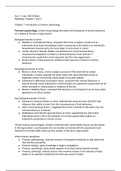
Chapter 1: introduction to forensic psychology
Forensic psychology: a field of psychology that deals with all aspects of human behaviour
as it relates to the law or legal system
Biological theories of crime
● Sheldon’s constitutional theory: proposed that crime is largely a product of an
individual's body build (somatotype) which is assumed to be linked to an individual's
temperament (mesomorphs are more likely to be involved in crime)
● Jacobs, Brunton, Melville, Brittain and McClemont’s chromosomal theory:
chromosomal irregularity is linked to criminal behaviour (men with two Y
chromosomes made them more masculine and ths more aggressive)
● Nevin’s theory of lead exposure: childhood lead exposure is linked to criminal
behaviour
Sociological theories of crime
● Merton’s strain theory: crime is largely a product of the strain felt by certain
individuals in society (typically the lower class) who have restricted access to
legitimate means of achieving valued goals of success (status)
● Sutherland’s differential association theory: proposed that criminal behaviour is
learned through social interactions in which people are exposed to calued that can be
either favorable or unfavourable to violations of the law
● Becker’s labelling theory: proposed that deviance is not inherent to an act but a label
attached to an act by society
Psychological theories of crime
● Eyesenck’s biosocial theory of crime: believed that some are born with NZ's that
influence their ability to learn from the consequences of their behaviour
● Aker’s social learning theorY: suggested that crime is learned in the same way non
criminal behaviour is learned
● Gottfredson and Hirschi’s general theory of crime: argued that low self-control,
internalized early in life in the presence of criminal opportunities explain an
individual's propensity to commit crimes
Clinical forensic psychologists: broadly concerned with mental health issues as they pertain
to the legal system: psychologists who are broadly concerned with the assessment and
treatment of mental health issues as they pertain to the law or legal system
Other forensic disciplines
● Forensic anthropology: examine remains of deceased individuals to help determine
their identity (autopsies)
● Forensic biology: apply knowledge to legal investigations
● Forensic odontology: study dental aspects of criminal activity (dental records)
● Forensic pathology: medical doctors who examine injuries or the remains of dead
bodies in an attempt to determine the time and cause of death
, ● Forensic toxicology: study the effects of drugs and other chemicals on people within
the context of law
Experimental forensic psychologists: psychologists who are broadly concerned with the
study of human behaviour as it relates to the law or legal system
Psychology and the law: the use of psychology to examine the operation of the legal
system, considered two different systems/distinct disciplines, evaluating different
policies in the criminal justice system
Psychology in the law: the use of psychology in the legal system as that system
operates, use of psych by actors within the justice/legal system, like judge using
credibility of eyewitness
Psychology of the law: the use of psychology to examine the law itself, legal scholar,
studying law itself
Expert witness: a witness who provides the court with information that assists the court in
understanding an issue of relevance to a case
Psychology and law differ alone at least seven different dimensions (Hess)\
1. Epistemology: psychologists assume that it is possible to uncover hidden objective
truths if the appropriate experiments are conducted
2. Nature of law: goal in psych is to describe how and why people behave the way
they do, but law is prescriptive
3. Knowledge: psych: based on empiritive data collected; law: idiographic analysis of
court cases and the rational application of logic to establish the facts of a case
4. Methodology: psych: predominantly nomothetic and experimental; law: operates
on case by cases basis
5. Criterion: psych: cautious in terms of willingness to accept something as true; law:
more expedient approach where guilt is determined using various criteria established for a
particular case
6. Principles: psych: exploratory approach which encourages the consideration of
multiple explanations for research findings; law: adopt conservative approach
7. Latitude of courtroom behavior: psych: limited by the court; lawyers: fewer
restrictions on behaviour
General acceptance test: a standard for accepting expert testimony, which states that expert
testimony will be admissible in court if the basis of the testimony is generally accepted within
the relevant scientific community
Daubert criteria: an american standard for accepting expert testimony, which states that
scientific evidence is valid if the research on which it is based has been peer reviewed, is
testably, has recognized rate of error, and adheres to professional standards
Mohan criteria: a candian standard for accepting expert testimony, which states that expert
testimony will be admissible in court if it is relevant, necessary for assisting the trier fact,
does not violate any exclusionary rules and is provided by a qualified expert
, Chapter 3: the psychology of police investigations
Police interrogations: a process whereby the police interview a suspect for the purpose of
gathering evidence and obtaining a confession
Mr. Big technique: noncustodial procedure, happens outside interrogation room,
undercover police posing as member of criminal investigation who attempt to lure the
suspect to the gang and must confess crimes to get to the next level as a form of
insurance to the gang; high success rate, encourages to confess to the serious crime
in order to impress gang leader as a form of insurance, confession used in suspect’s
trial
Reid model of interrogation: a nine step model of interrogation frequently used in NA to
extract confessions from suspects
1. Suspect is immediately confronted with his or her guils
2. Psychological themes are developed to rationalize excuse of the crime
3. Interrogator interrupts statements of denial
4. Interrogator overcomes suspects objections to the charges
5. Ensures attention of suspect
6. Interrogator shows sympathy, suspect is urged to come clean
7. Suspect is offered explanations for the crime
8. Once suspect accepts responsibility, interrogator develops admission into a full
confession
9. Interrogator gets the suspect to write and sign a full confession
Minimization technique: soft sell tactics used by police interrogators that are designed to
lull the suspect into a false sense of security
Maximization techniques: scare tactics used by police interrogators that are designed to
intimidate a suspect believed to be guilty
Deception detection: detecting when someone is being deceptive
Myths about police interrogations
1. Police often use the sorts of physically coercive interrogation tactics that you see on
TV
2. Police aren’t allowed to use trickery in their interrogations for the purpose of
extracting a confession
3. There is no need for people to worry about being interrogated by the police
4. If someone confesses to a crime, that indicates that the person did in fact commit the
crime
Investigator bias: bias that can result when police officers enter an interrogation setting
already believing that the suspect is guilty
False confession: a confession that is either intentionally fabricated or is not based on
actual knowledge of the facts that form is content
Retracted confession: a confession that the confessor later declares to be false
Disputed confession: a confession that is later disputed at trial
Readings: Chapter 1 and 3
Chapter 1: introduction to forensic psychology
Forensic psychology: a field of psychology that deals with all aspects of human behaviour
as it relates to the law or legal system
Biological theories of crime
● Sheldon’s constitutional theory: proposed that crime is largely a product of an
individual's body build (somatotype) which is assumed to be linked to an individual's
temperament (mesomorphs are more likely to be involved in crime)
● Jacobs, Brunton, Melville, Brittain and McClemont’s chromosomal theory:
chromosomal irregularity is linked to criminal behaviour (men with two Y
chromosomes made them more masculine and ths more aggressive)
● Nevin’s theory of lead exposure: childhood lead exposure is linked to criminal
behaviour
Sociological theories of crime
● Merton’s strain theory: crime is largely a product of the strain felt by certain
individuals in society (typically the lower class) who have restricted access to
legitimate means of achieving valued goals of success (status)
● Sutherland’s differential association theory: proposed that criminal behaviour is
learned through social interactions in which people are exposed to calued that can be
either favorable or unfavourable to violations of the law
● Becker’s labelling theory: proposed that deviance is not inherent to an act but a label
attached to an act by society
Psychological theories of crime
● Eyesenck’s biosocial theory of crime: believed that some are born with NZ's that
influence their ability to learn from the consequences of their behaviour
● Aker’s social learning theorY: suggested that crime is learned in the same way non
criminal behaviour is learned
● Gottfredson and Hirschi’s general theory of crime: argued that low self-control,
internalized early in life in the presence of criminal opportunities explain an
individual's propensity to commit crimes
Clinical forensic psychologists: broadly concerned with mental health issues as they pertain
to the legal system: psychologists who are broadly concerned with the assessment and
treatment of mental health issues as they pertain to the law or legal system
Other forensic disciplines
● Forensic anthropology: examine remains of deceased individuals to help determine
their identity (autopsies)
● Forensic biology: apply knowledge to legal investigations
● Forensic odontology: study dental aspects of criminal activity (dental records)
● Forensic pathology: medical doctors who examine injuries or the remains of dead
bodies in an attempt to determine the time and cause of death
, ● Forensic toxicology: study the effects of drugs and other chemicals on people within
the context of law
Experimental forensic psychologists: psychologists who are broadly concerned with the
study of human behaviour as it relates to the law or legal system
Psychology and the law: the use of psychology to examine the operation of the legal
system, considered two different systems/distinct disciplines, evaluating different
policies in the criminal justice system
Psychology in the law: the use of psychology in the legal system as that system
operates, use of psych by actors within the justice/legal system, like judge using
credibility of eyewitness
Psychology of the law: the use of psychology to examine the law itself, legal scholar,
studying law itself
Expert witness: a witness who provides the court with information that assists the court in
understanding an issue of relevance to a case
Psychology and law differ alone at least seven different dimensions (Hess)\
1. Epistemology: psychologists assume that it is possible to uncover hidden objective
truths if the appropriate experiments are conducted
2. Nature of law: goal in psych is to describe how and why people behave the way
they do, but law is prescriptive
3. Knowledge: psych: based on empiritive data collected; law: idiographic analysis of
court cases and the rational application of logic to establish the facts of a case
4. Methodology: psych: predominantly nomothetic and experimental; law: operates
on case by cases basis
5. Criterion: psych: cautious in terms of willingness to accept something as true; law:
more expedient approach where guilt is determined using various criteria established for a
particular case
6. Principles: psych: exploratory approach which encourages the consideration of
multiple explanations for research findings; law: adopt conservative approach
7. Latitude of courtroom behavior: psych: limited by the court; lawyers: fewer
restrictions on behaviour
General acceptance test: a standard for accepting expert testimony, which states that expert
testimony will be admissible in court if the basis of the testimony is generally accepted within
the relevant scientific community
Daubert criteria: an american standard for accepting expert testimony, which states that
scientific evidence is valid if the research on which it is based has been peer reviewed, is
testably, has recognized rate of error, and adheres to professional standards
Mohan criteria: a candian standard for accepting expert testimony, which states that expert
testimony will be admissible in court if it is relevant, necessary for assisting the trier fact,
does not violate any exclusionary rules and is provided by a qualified expert
, Chapter 3: the psychology of police investigations
Police interrogations: a process whereby the police interview a suspect for the purpose of
gathering evidence and obtaining a confession
Mr. Big technique: noncustodial procedure, happens outside interrogation room,
undercover police posing as member of criminal investigation who attempt to lure the
suspect to the gang and must confess crimes to get to the next level as a form of
insurance to the gang; high success rate, encourages to confess to the serious crime
in order to impress gang leader as a form of insurance, confession used in suspect’s
trial
Reid model of interrogation: a nine step model of interrogation frequently used in NA to
extract confessions from suspects
1. Suspect is immediately confronted with his or her guils
2. Psychological themes are developed to rationalize excuse of the crime
3. Interrogator interrupts statements of denial
4. Interrogator overcomes suspects objections to the charges
5. Ensures attention of suspect
6. Interrogator shows sympathy, suspect is urged to come clean
7. Suspect is offered explanations for the crime
8. Once suspect accepts responsibility, interrogator develops admission into a full
confession
9. Interrogator gets the suspect to write and sign a full confession
Minimization technique: soft sell tactics used by police interrogators that are designed to
lull the suspect into a false sense of security
Maximization techniques: scare tactics used by police interrogators that are designed to
intimidate a suspect believed to be guilty
Deception detection: detecting when someone is being deceptive
Myths about police interrogations
1. Police often use the sorts of physically coercive interrogation tactics that you see on
TV
2. Police aren’t allowed to use trickery in their interrogations for the purpose of
extracting a confession
3. There is no need for people to worry about being interrogated by the police
4. If someone confesses to a crime, that indicates that the person did in fact commit the
crime
Investigator bias: bias that can result when police officers enter an interrogation setting
already believing that the suspect is guilty
False confession: a confession that is either intentionally fabricated or is not based on
actual knowledge of the facts that form is content
Retracted confession: a confession that the confessor later declares to be false
Disputed confession: a confession that is later disputed at trial