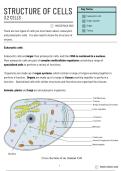
STRUCTURE OF CELLS Key Terms
3.2 CELLS Eukaryotic cell
Organ system
MISSESTRUCH 2020 Organ
There are two types of cells you must learn about: eukaryotic Tissue
and prokaryotic cells. You also need to know the structure of
viruses.
Eukaryotic cells
Eukaryotic cells are larger than prokaryotic cells, and their DNA is contained in a nucleus.
Most eukaryotic cells are part of complex multicellular organisms containing a range of
specialised cells to perform a variety of functions.
Organisms are made up of organ systems, which contain a range of organs working together to
perform a function. Organs are made up of a range of tissues working together to perform a
function. Specialised cells with similar structures and functions are organised into tissues.
Animals, plants and fungi are all eukaryotic organisms.
Nucleus
1
MISSESTRUCH 2020
,STRUCTURE OF CELLS
3.2 CELLS
Plant cell MISSESTRUCH 2020
Organelles
Eukaryotic cells contain a range of organelles. There are 10 organelles you need to know the
structure and function of:
1. Cell-surface membrane
2. Nucleus
3. Mitochondria
4. Chloroplasts
5. Golgi apparatus and Golgi vesicles
6. Lysosomes
7. Ribosomes
8. Rough endoplasmic reticulum and smooth endoplasmic reticulum
9. Cell wall
10. Cell vacuole
2
MISSESTRUCH 2020
,STRUCTURE OF CELLS Key Terms
3.2 CELLS Phospholipid bilayer
Nuclear envelope
MISSESTRUCH 2020 Nuclear pores
Cell-surface membrane Nucleolus
Structure
Found in all cells Function
Phospholipid bilayer – molecules embedded Controls the entrance and exit of
within and attached on the outside (proteins, molecules
carbohydrates, cholesterol)
Your paragraph text
Nucleus Function
Site of DNA replication and
Structure transcription (making mRNA)
Nuclear Envelope- double membrane Contains the genetic code for each cell
Nuclear Pores
Nucleoplasm –granular, jelly-like material
Chromosomes –protein-bound, linear
DNA
Nucleolus –smaller sphere in the
nucleoplasm which is the site of rRNA
production and ribosome synthesis.
3
3
MISSESTRUCH 2020
, STRUCTURE OF CELLS Key Terms
3.2 CELLS Cristae
Mitochondrial matrix
Mitochondria MISSESTRUCH 2020 Thylakoid membrane
Stroma
Structure
Double membrane Function
An inner membrane called the cristae Site of aerobic respiration and ATP
The fluid centre called the mitochondrial production
matrix
Contains 70S ribosomes and circular DNA
Chloroplast
Function
Site of photosynthesis
Structure
Surrounded by a double membrane
Contains thylakoids (folded
membranes embedded with pigment)
The fluid-filled stroma contains
enzymes for photosynthesis
Found in plants
Contains 70S ribosomes and circular
DNA
4 MISSESTRUCH 2020
3.2 CELLS Eukaryotic cell
Organ system
MISSESTRUCH 2020 Organ
There are two types of cells you must learn about: eukaryotic Tissue
and prokaryotic cells. You also need to know the structure of
viruses.
Eukaryotic cells
Eukaryotic cells are larger than prokaryotic cells, and their DNA is contained in a nucleus.
Most eukaryotic cells are part of complex multicellular organisms containing a range of
specialised cells to perform a variety of functions.
Organisms are made up of organ systems, which contain a range of organs working together to
perform a function. Organs are made up of a range of tissues working together to perform a
function. Specialised cells with similar structures and functions are organised into tissues.
Animals, plants and fungi are all eukaryotic organisms.
Nucleus
1
MISSESTRUCH 2020
,STRUCTURE OF CELLS
3.2 CELLS
Plant cell MISSESTRUCH 2020
Organelles
Eukaryotic cells contain a range of organelles. There are 10 organelles you need to know the
structure and function of:
1. Cell-surface membrane
2. Nucleus
3. Mitochondria
4. Chloroplasts
5. Golgi apparatus and Golgi vesicles
6. Lysosomes
7. Ribosomes
8. Rough endoplasmic reticulum and smooth endoplasmic reticulum
9. Cell wall
10. Cell vacuole
2
MISSESTRUCH 2020
,STRUCTURE OF CELLS Key Terms
3.2 CELLS Phospholipid bilayer
Nuclear envelope
MISSESTRUCH 2020 Nuclear pores
Cell-surface membrane Nucleolus
Structure
Found in all cells Function
Phospholipid bilayer – molecules embedded Controls the entrance and exit of
within and attached on the outside (proteins, molecules
carbohydrates, cholesterol)
Your paragraph text
Nucleus Function
Site of DNA replication and
Structure transcription (making mRNA)
Nuclear Envelope- double membrane Contains the genetic code for each cell
Nuclear Pores
Nucleoplasm –granular, jelly-like material
Chromosomes –protein-bound, linear
DNA
Nucleolus –smaller sphere in the
nucleoplasm which is the site of rRNA
production and ribosome synthesis.
3
3
MISSESTRUCH 2020
, STRUCTURE OF CELLS Key Terms
3.2 CELLS Cristae
Mitochondrial matrix
Mitochondria MISSESTRUCH 2020 Thylakoid membrane
Stroma
Structure
Double membrane Function
An inner membrane called the cristae Site of aerobic respiration and ATP
The fluid centre called the mitochondrial production
matrix
Contains 70S ribosomes and circular DNA
Chloroplast
Function
Site of photosynthesis
Structure
Surrounded by a double membrane
Contains thylakoids (folded
membranes embedded with pigment)
The fluid-filled stroma contains
enzymes for photosynthesis
Found in plants
Contains 70S ribosomes and circular
DNA
4 MISSESTRUCH 2020