NURS 3410 Exam 1 Study Guide (2020 Updated) – University of Arizona | NURS3410 Exam 1 Study Guide (2020 Updated)
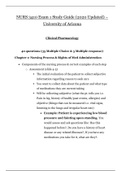
NURS 3410 Exam 1 Study Guide (2020 Updated) – University of Arizona Clinical Pharmacology 40 questions (35 Multiple Choice & 5 Multiple response) Chapter 1: Nursing Process & Rights of Med Administration • Components of the nursing process & correct examples of each step o Assessment (slide 4-5) ▪ The initial evaluation of the patient to collect subjective information regarding reason to seek care ▪ You want to collect data about the patient and what type of medications they are current taking ▪ Will be collecting subjective (what the pt. tells you i.e. Pain in leg, history of health/past events, allergies) and objective (things that can be measured i.e. vital signs, listening to the lungs and irregular heart rate) • Example: Patient is experiencing low blood pressure and fainting upon standing. You would assess and ask questions like: Has this happened before?, Do you have a history of heart disease or any related illnesses?, If you have any medications you take for it, what are they?.• Check the pt’s medical chart if been to hospital before. Look for any medication the pt has been ordered in the past or currently or contact a family member o Nursing diagnosis (slide 6-7) ▪ 3 parts • Human response (diagnose focus that is the root of the concept) • Factor related to response (with or due to something) • List of data supporting diagnosis (this is what happened or is currently happening) ▪ NANDA (North American Nursing Diagnosis Association) • List of nursing diagnosis focus recognized by profession organisms o Deficient knowledge o Risk for injury o Noncompliance o Disturbances or imbalances in bodily functions as it relates to medications o Spiritual distress ▪ Application Example: Noncompliance (NANDA) with walker (factor related to) use as evidence by multiply contusions (bruises) on left side of the body and a laceration on left elbow due to a fall (supporting data)▪ Application Example: Impaired gas exchange (NANDA) related to narrowing of airways (factor relation) as evidence by wheezing and SOB (supporting data) ▪ Application Example: Spiritual distress (NANDA) related to medication (factor) as evidence by cultural beliefs and practice (supporting diagnosis) ▪ Application Example: Disturbance or imbalances in body functions (NANDA) as it related to HR medication (factor) as evidence by patient experiencing low blood pressure and fainting upon stand o Planning/Outcome Identification ▪ Have a plan and prioritize that is most important (usually based on what the patient wants to happen) ▪ Set desired outcomes • Should be objective, measurable, realistic, and have a time frame, individualized (patient specific) • Needs to be the patients doing not the nurses (the pt. needs to be taking action) • Needs to be safe and effective regarding medication administrationo Application Example: Patient wants to have a controlled blood pressure in 1 hour when standing. ▪ Objective/Patient specific: the pt. has low blood pressure ▪ Measurable: BP can be measured by taking vitals signs/ orthostatic vitals ▪ Realistic: Is it a new Concern or is it Chronic? New Concern- No (need to figure out medication orders and why this might be happening)….. ChronicYes (possible adjustment to medication and education) ▪ Time frame: 1 hour ▪ What is this doesn’t work what other outcomes could the pt. have? (pt. continues to have uncontrolled BP and faint) o Implementation ▪ Interventions that are going to be implemented • Input with a team (consult with cardiologist,) and patient (get pt. involve will be compliant if included) • Implementation can be Independent, collaborative or dependent upon prescriber’s orders o Application Example: Nurse reads the prescription on the pts. record:Fludrocortisone once a day, PO in the morning for low blood pressure o Always check the 9 rights of medication (slide 11) o Evaluation ▪ Systematic and Ongoing • Reactions to the drug and any progress ▪ Monitor accomplishment of outcome and drug’s response • Therapeutic effect: the reason it was giving; did the problem resolve or did it help (if yes: document and call physician; if no: look for alternative (other meds ordered, document and call physician)• Adverse drug effects: Not the same as a side effect (incidental to the way the drug works i.e. taking a medication for low blood pressure but developing a dry cough, it is one of the side effects listed but not directly related to having low blood pressure). • It is an undesired occurrence that resulted from taking the medication correctly; an over exaggeration of the desired outcome o Application Example: Taking BP medication and the results were hypertension due to dosage amount, effects can be reduced by lowing dose or stopping administration of medication) Drug reactions due to Pharmacologic: extension of normal effects on body (LBP after antihypertensive) Hypersensitivity/allergic: immunoG recognizes as foreign subst. Idiosyncratic: reaction that is not known to the property of drug sometimes is genetic Drug to drug reaction Internal: patient induced such as not taking as prescribed; allergic External: caregiving errors or malfunction equipment, med pass, errorMedication error: preventable situation in which there was a break in 6 of the rights (drug, dose, time, patient, route and documentation) ▪ Toxic drug effects: impacts the body (i.e. Tylenol taken for pain impacts the liver negatively) • Primary 5 rights of med administrations and their practical application (slide 12) o Right patient (2 identifiers; name, DOB, SSN, etc.) o Right drug (always check med orders, is it appropriate for pts, the right reason) o Right dose (appropriate for age, size, recheck calculations) o Right time and frequency (30 mins before/after scheduled time; check when last given; avoid abbreviations for less mistakes) o Right route (don’t assume; know what type of medication it is (susp, sup, tablets, capsule, if SL or PO; no crushing of ER/CR meds) • Appropriate medication orders (slide 4) o During ASSESSMENT prescribers’ orders need to be reviewed for these 7 elements ▪ Date the order was written or prescribed ▪ Patient’s name ▪ Name of the drug ▪ Dose amount ▪ Route ▪ How frequent ▪ Signature of physician • Clarification of orderso If information in order is missing: contact provider, never assume; always need to clarify, even if you know that a med is supposed to be taken by IV and not PO it still needs to be documented by the provider in the order which route to take Chapter 2: Pharmacologic Principles: ▪ Brand vs Generic Example medication: treats GERD and damaged esophagus o Brand name: chemical composition and molecular structure ▪ Trademark created by the drug company made to be marketable and easier to pronounce and remember • Protonix o Generic name: reflects chemical structure; a hint to what drug class it is in (will see on exam questions) ▪ Official name assigned by the USAN council; harder to pronounce and longer ▪ Biosimilar: Copies already authorized biological (made up of living organisms) product something that is naturally produced in the body • Pantoprazole • Therapeutic equivalence (NOT to be confused with bioequivenency) o A drug that has the same therapeutic effect on the body, same class of drugs, even if they don’t have the same active ingredients.o Can be a hospital or patient preferred drug (pt. could respond to one drug better than the other) ▪ Pantoprazole vs. Omemprazole (Brand: Zegerid) ▪ Characteristic/Advantages & Disadvantages of various routes o Enteral ▪ Characteristics of GI tract to be activated (stomach acid); by way of GI tract by swallowing (PO, feeding tubes or rectal meds) o Parental ▪ Injection form; needs to match pH of pt. blood so it does not damage blood vessels o Topical ▪ Acts immediately or could use skin as a barrier to slow absorption (med patches, ointments, lotions, eye drops etc.) ▪ Pharmacokinetics: what happens to a drug from the time it is put into the body until the parent drug (form of drug outside of the body before administration) and all its metabolites have left the body Drugs interactions can happen in ALL PHASES (abs, dis, met, elim) o Absorption▪ Movement (route given) of drug from site of administration into the bloodstream for distribution (oral, skin, IV, etc.) • Dosage form and route (tab, cap, solution, suspension, powder) determines rate of dissolution (dissolving of solid and their absorption) IV hit system immediately • Goal: desired therapeutic response with minimal adverse effects ▪ First pass effect* • A large part of the drug chemically changes from active into inactive metabolites in the liver that only a small amount of the drug actually gets into the bloodstream o Drugs passing through GI will need a higher dose o Why is important? Drug through GI needs higher dose, By eliminating the first pass effect by IV the dose will be give at a low amount ▪ Bioequivalency • Two drugs that have the same bioavailability and same concentration of active ingredient (generic and brand name drugs) o May not have the equal effects for all individuals (differ in rates of disintegrationand dissolution) which can alter the drug’s effects ▪ Bioavailability * • The extent of drug absorption o When a drug has a first-pass effect it decreases the bioavailability o There is more bioavailability in parenteral (Inject form) dose so the dose needs to be lowered compared to an oral dose ▪ Enteral • Drugs that are absorbed through the mucosa of the stomach, small or large intestines • First pass effect o Blood is taken to the liver where it will metabolize, and active ingredients will be put back into circulation • Things that can influence enteral absorption…. Stomach acid, too much acid, anything that changes the acidity of the acid, an antacid, food, IBS, blood flow (sepsis/exercise, peristalsis) • Rectal could be for a local issue; it will be in the blood system soon so it could be used for systemic issues • Sublingual (not to be swallowed so it can avoid first pass) o Under the tongue o Highly vascular and absorbs quickly• Buccal (not to be swallowed so it can avoid first pass) o Cheek pocket o Highly vascular and absorbs quickly ▪ Parenteral • Any other route other than ENTERAL o Not just IV but any Injections (intravenous, intradermal, subcutaneous, Intermuscular); RN can give these o Intraarterially (in artery), intrathecal (in spinal column), intraarticularly (in joints); not in Scope of RN practice o No first pass effect ▪ Topical • Skin, Eyes, Ears, nose, lungs, rectum or vagina • Uniform amount over a long period of time (like an Extended release that releases the same amount of drug till it is done) • Slow absorbing; longer acting; barrier helps slow the absorption down
Escuela, estudio y materia
- Institución
- University Of Arizona
- Grado
- Nursing (NURS3410)
Información del documento
- Subido en
- 9 de enero de 2021
- Número de páginas
- 23
- Escrito en
- 2020/2021
- Tipo
- Examen
- Contiene
- Preguntas y respuestas
Temas
-
nurs 3410 exam 1 study guide 2020 updated – university of arizona
-
nurs 3410 exam 1 study guide 2020 updated
-
nurs 3410 exam 1 study guide – university of arizona
-
exam 1 study guide – university of

Documento también disponible en un lote