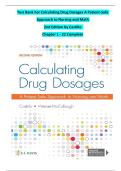
Test Bank For Calculating Drug Dosages A Patient-Safe
Approach to Nursing and Math
2nd Edition by Castillo
Chapter 1 - 22 Complete
,Table of Contents:
I. Safety in Medication Administration
Chapter 1. Safety in Medication Administration
Chapter 2. The Drug Label
II. Systems of Measurement
Chapter 3. The Metric System
Chapter 4. The Household System
III. Methods of Calculation
Chapter 5. Linear Ratio and Proportion
Chapter 6. Fractional Ratio and Proportion
Chapter 7. Dimensional Analysis
Chapter 8. Formula Method
IV. Administration of Medications
Chapter 9. Calculating Oral Medication Doses
Chapter 10. Syringes and Needles
Chapter 11. Calculating Parenteral Medication Dosages
Chapter 12. Preparing Powdered Parenteral Medications
Chapter 13. Administration of Insulin
V. IV Therapy and Administration of Intravenous Medications
Chapter 14. Intravenous Infusion and Infusion Rates
Chapter 15. Calculating Infusion and Completion Time
Chapter 16. Administering IV Push Medications
VI. Verifying Safe Dose and Critical Care Calculations
Chapter 17. Verifying Safe Dose
Chapter 18. Titration of Intravenous Medications
VII. Intake and Output
Chapter 19. Calculating Intake and Output
Chapter 20. Calculating Parenteral Intake
VIII. Dosages for Pediatric and Older Adult Populations
Chapter 21. Considerations for the Pediatric Patient
Chapter 22. Considerations for the Older Adult
,Castillo/Werner-McCullough: Calculating Drug Dosages, 2e
Chapter 1: Safety in Medication Administration
Castillo: Calculating Drug Dosages: A Patient-Safe Approach to Nursing and Math 2nd Edition
MULTIPLE CHOICE
1. The following medication order is in the patient’s medication administration record (MAR):
methylPREDnisolone 40 mg PO daily at 0900.
After reading the order, the nurse correctly determines:
A “PO” is an inappropriate abbreviation.
B the medication order is written correctly.
C 40 mg should be written as 40mg.
D tall man lettering indicates that the drug is a narcotic.
ANSWER: B
Feedback
The medication order has all the required components (drug name, dose, route,
andfrequency of administration) for a drug order. “PO” is an appropriate
abbreviation;40 mg is written correctly with a space between the dose and the
unit of measurement. Tall man lettering is used to distinguish the drug from
another drug
with a similar name.
2. Which of the following accurately describes the “Boxed Warning” found on a drug label?
A It is primarily is used to identify the safe dose for the patient.
B It is commonly found on all drug labels.
C It identifies serious potential risks and side effects related to drug use.
D It protects the patient by providing information to decrease side effects.
ANSWER: C
Feedback
A drug label with a boxed warning provides information to healthcare
professionalsand patients regarding the serious risks and side effects related to
the drug. The Boxed Warning is not the primary source for identifying the patient’s
drug dosage.
The warning is found on specific prescription medications and does not
provideinformation to reduce or decrease side effects.
3. When practicing safety in the administration of medication, for which of the
1
, Castillo/Werner-McCullough: Calculating Drug Dosages, 2e
followingmedication orders should a nurse seek clarification before the
administration of the medication?
A Regular insulin 5 u subcut now.
B Enoxaparin 80 mg subcut every 12 hours.
C Benadryl 50 mg PO PRN every 6 hr for itching.
D Ondansetron 4 mg IVP stat.
ANSWER: A
Feedback
The “u” should never be used in a medication order; rather, for safety, the
word“units” should be spelled out. The other answer options contain the
required
components needed to safely carry out the medication order.
4. A nurse is reviewing a drug label with a drug name written with tall man lettering. Which
statements shows the nurse has a correct understanding of tall man lettering on a drug
label?
A “The tall man lettering means this is a high alert drug.”
B “The tall man lettering helps me distinguish this drug with other drugs that
have similar names.”
C “The tall man lettering means that this drug must have a Boxed Warning.”
D “The tall man lettering helps me quickly identify that this drug is an injectable
drug.”
ANSWER: B
Feedback
Tall man lettering highlights a portion of the drug name to help distinguish
fromsimilar drug names. It is not used to identify high alert drugs, highlight a
boxed
warning, or identify injectable drugs.
5. The following medication orders are found in the patient’s MAR:
Metformin HCl 500 mg PO daily at 0900. Hydrochlorothiazide
25 mg PO every 12 hr at 0900 and 2100.Digoxin .25 mg PO
daily at 0900.
In reading the medication orders for the 0700–1500 shift, the nurse determines that which
ofthe following is the priority nursing intervention?
A Clarify the metformin HCl order.
2
Approach to Nursing and Math
2nd Edition by Castillo
Chapter 1 - 22 Complete
,Table of Contents:
I. Safety in Medication Administration
Chapter 1. Safety in Medication Administration
Chapter 2. The Drug Label
II. Systems of Measurement
Chapter 3. The Metric System
Chapter 4. The Household System
III. Methods of Calculation
Chapter 5. Linear Ratio and Proportion
Chapter 6. Fractional Ratio and Proportion
Chapter 7. Dimensional Analysis
Chapter 8. Formula Method
IV. Administration of Medications
Chapter 9. Calculating Oral Medication Doses
Chapter 10. Syringes and Needles
Chapter 11. Calculating Parenteral Medication Dosages
Chapter 12. Preparing Powdered Parenteral Medications
Chapter 13. Administration of Insulin
V. IV Therapy and Administration of Intravenous Medications
Chapter 14. Intravenous Infusion and Infusion Rates
Chapter 15. Calculating Infusion and Completion Time
Chapter 16. Administering IV Push Medications
VI. Verifying Safe Dose and Critical Care Calculations
Chapter 17. Verifying Safe Dose
Chapter 18. Titration of Intravenous Medications
VII. Intake and Output
Chapter 19. Calculating Intake and Output
Chapter 20. Calculating Parenteral Intake
VIII. Dosages for Pediatric and Older Adult Populations
Chapter 21. Considerations for the Pediatric Patient
Chapter 22. Considerations for the Older Adult
,Castillo/Werner-McCullough: Calculating Drug Dosages, 2e
Chapter 1: Safety in Medication Administration
Castillo: Calculating Drug Dosages: A Patient-Safe Approach to Nursing and Math 2nd Edition
MULTIPLE CHOICE
1. The following medication order is in the patient’s medication administration record (MAR):
methylPREDnisolone 40 mg PO daily at 0900.
After reading the order, the nurse correctly determines:
A “PO” is an inappropriate abbreviation.
B the medication order is written correctly.
C 40 mg should be written as 40mg.
D tall man lettering indicates that the drug is a narcotic.
ANSWER: B
Feedback
The medication order has all the required components (drug name, dose, route,
andfrequency of administration) for a drug order. “PO” is an appropriate
abbreviation;40 mg is written correctly with a space between the dose and the
unit of measurement. Tall man lettering is used to distinguish the drug from
another drug
with a similar name.
2. Which of the following accurately describes the “Boxed Warning” found on a drug label?
A It is primarily is used to identify the safe dose for the patient.
B It is commonly found on all drug labels.
C It identifies serious potential risks and side effects related to drug use.
D It protects the patient by providing information to decrease side effects.
ANSWER: C
Feedback
A drug label with a boxed warning provides information to healthcare
professionalsand patients regarding the serious risks and side effects related to
the drug. The Boxed Warning is not the primary source for identifying the patient’s
drug dosage.
The warning is found on specific prescription medications and does not
provideinformation to reduce or decrease side effects.
3. When practicing safety in the administration of medication, for which of the
1
, Castillo/Werner-McCullough: Calculating Drug Dosages, 2e
followingmedication orders should a nurse seek clarification before the
administration of the medication?
A Regular insulin 5 u subcut now.
B Enoxaparin 80 mg subcut every 12 hours.
C Benadryl 50 mg PO PRN every 6 hr for itching.
D Ondansetron 4 mg IVP stat.
ANSWER: A
Feedback
The “u” should never be used in a medication order; rather, for safety, the
word“units” should be spelled out. The other answer options contain the
required
components needed to safely carry out the medication order.
4. A nurse is reviewing a drug label with a drug name written with tall man lettering. Which
statements shows the nurse has a correct understanding of tall man lettering on a drug
label?
A “The tall man lettering means this is a high alert drug.”
B “The tall man lettering helps me distinguish this drug with other drugs that
have similar names.”
C “The tall man lettering means that this drug must have a Boxed Warning.”
D “The tall man lettering helps me quickly identify that this drug is an injectable
drug.”
ANSWER: B
Feedback
Tall man lettering highlights a portion of the drug name to help distinguish
fromsimilar drug names. It is not used to identify high alert drugs, highlight a
boxed
warning, or identify injectable drugs.
5. The following medication orders are found in the patient’s MAR:
Metformin HCl 500 mg PO daily at 0900. Hydrochlorothiazide
25 mg PO every 12 hr at 0900 and 2100.Digoxin .25 mg PO
daily at 0900.
In reading the medication orders for the 0700–1500 shift, the nurse determines that which
ofthe following is the priority nursing intervention?
A Clarify the metformin HCl order.
2