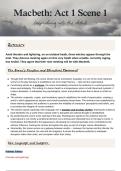
Macbeth: Act 1 Scene 1
Deep-diving into the details
Summary
Amid thunder and lightning, on an isolated heath, three witches appear through the
mist. They discuss meeting again on this very heath when a battle, currently raging,
has ended. They agree that their next meeting will be with Macbeth.
The Scene’s Function and Structural Placement
Though brief and fleeting, the scene should not be overlooked. Arguably, it is one of the most important
scenes in the play because it establishes one of its major themes — fate and the supernatural.
Functioning almost as a prologue, the scene immediately immerses the audience in a world governed by
chaos and ambiguity. The setting of a barren heath in a tempestuous storm is both literal and symbolic: it
evokes desolation. It anticipates the psychological, moral, and political chaos that is about to unfold on
stage.
The witches’ enigmatic, cryptic, and incantatory speech establishes the motif of equivocation, creating a
world in which appearances deceive and moral boundaries break down. The ominous tone established by
these witches prepares the audience to question the reliability of characters’ perceptions and beliefs, and
to scrutinise the integrity of human ambition.
The witches speak cryptically, their language rich in paradox and trochaic rhythm, drawing the audience
(and Macbeth) into a world where natural order is disrupted and rational thought is destabilised.
By positioning this scene at the opening of the play, Shakespeare signals to the audience that the
supernatural is not merely a peripheral element, but a driving and influential force in the play’s events. It
foreshadows that Macbeth’s first appearance will already be coloured (perhaps even controlled) by the
witches’ influence, framing his choices throughout the play as part of a larger cosmic disturbance.
Structurally, this scene serves as a gateway between worlds — between the human and the infernal, the
rational and the irrational, the real and the imagined. It primes the audience perfectly to anticipate
disruption rather than order, and corruption rather than clarity.
Key Language and Imagery
Pathetic Fallacy
[Thunder and lightning]
, The pathetic fallacy, paired with the isolated setting of a “desert heath”, establishes a tone of ominous and
foreboding chaos.
The tempestuous weather may have been seen by Jacobean audiences as being controlled by the
witches, therefore strongly establishing the theme of the supernatural before a single word is uttered in
the play.
From a psychoanalytical perspective, the harsh weather throughout the play may represent moral
disruption and Macbeth’s internal conflict as he grapples with honour and power, good and evil. The storm
here may therefore foreshadow his psychological deterioration, but its supernatural connotations also
connect the witches directly to that downfall.
Symbolism
‘fog and filthy air’
Another prominent example of pathetic fallacy in the opening scene, the fog and filthy air enhance the
mysterious and ominous tone of the play.
However, it also symbolically alludes to the moral and psychological obscurity that runs throughout.
Fog is a symbol of the unknown — it conceals what lies ahead. For the audience, this evokes not only
mystery but danger. Furthermore, it may foreshadow Macbeth’s ignorance of the true consequences of his
regicidal actions later in the play.
The fog and “filthy” air may also represent the corruption of moral judgement. Macbeth’s mind becomes
clouded by ambition, guilt, duplicity, and deception. He loses clarity of thought and rational judgement,
believing half-truths spoken by the witches and blinded by the corruption of his own mind. This can also
link to his later hallucinations — of the dagger and Banquo’s ghost — where what he sees cannot be
trusted.
Finally, the fog also establishes the theme of false perceptions, illusion, and duplicity. Appearance and
reality blur; the supernatural obscures the natural and overturns the truth — “nothing is but what is not.”
Interrogative
When shall we three meet again / In thunder, lightning, or in rain?
Of course, there is also pathetic fallacy in the “thunder”, “lightning”, and “rain”, as explored above.
It is imperative, however, to focus on the other, more nuanced technique used here — the interrogative.
Opening the play with a question immediately introduces a tone of uncertainty and ambiguity.
The witches, who seem to be controlling the weather (and the events of the play), paradoxically begin with
a question rather than a statement, suggesting that the world they inhabit is one of doubt, unpredictability,
and disorder — one that cannot be trusted.
The interrogative also forms the foundation of a broader theme at work in Macbeth: the instability of
knowledge and truth. Just as the witches question when they will meet, Macbeth continually wrestles with
whether the prophecies are true and whether he should succumb to his “vaulting ambition”. Structurally,
interrogatives are used throughout the play (sometimes in conjunction with declaratives) to convey the
destabilisation not only of the natural order, but also of Macbeth’s psychological state.
Fricative Consonance / Paradox / Antimetabole
Fair is foul, and foul is fair
The fricative consonance of the /f/ sounds conveys the hissing, incantatory chanting of the witches,
reinforcing the unsettling atmosphere of the opening scene.
This phrase also presents a paradox, establishing the theme of equivocation in both the scene and the
play as a whole. It conveys that we cannot truly trust appearances; the lines of morality are blurred, and
nothing is as it seems.
Deep-diving into the details
Summary
Amid thunder and lightning, on an isolated heath, three witches appear through the
mist. They discuss meeting again on this very heath when a battle, currently raging,
has ended. They agree that their next meeting will be with Macbeth.
The Scene’s Function and Structural Placement
Though brief and fleeting, the scene should not be overlooked. Arguably, it is one of the most important
scenes in the play because it establishes one of its major themes — fate and the supernatural.
Functioning almost as a prologue, the scene immediately immerses the audience in a world governed by
chaos and ambiguity. The setting of a barren heath in a tempestuous storm is both literal and symbolic: it
evokes desolation. It anticipates the psychological, moral, and political chaos that is about to unfold on
stage.
The witches’ enigmatic, cryptic, and incantatory speech establishes the motif of equivocation, creating a
world in which appearances deceive and moral boundaries break down. The ominous tone established by
these witches prepares the audience to question the reliability of characters’ perceptions and beliefs, and
to scrutinise the integrity of human ambition.
The witches speak cryptically, their language rich in paradox and trochaic rhythm, drawing the audience
(and Macbeth) into a world where natural order is disrupted and rational thought is destabilised.
By positioning this scene at the opening of the play, Shakespeare signals to the audience that the
supernatural is not merely a peripheral element, but a driving and influential force in the play’s events. It
foreshadows that Macbeth’s first appearance will already be coloured (perhaps even controlled) by the
witches’ influence, framing his choices throughout the play as part of a larger cosmic disturbance.
Structurally, this scene serves as a gateway between worlds — between the human and the infernal, the
rational and the irrational, the real and the imagined. It primes the audience perfectly to anticipate
disruption rather than order, and corruption rather than clarity.
Key Language and Imagery
Pathetic Fallacy
[Thunder and lightning]
, The pathetic fallacy, paired with the isolated setting of a “desert heath”, establishes a tone of ominous and
foreboding chaos.
The tempestuous weather may have been seen by Jacobean audiences as being controlled by the
witches, therefore strongly establishing the theme of the supernatural before a single word is uttered in
the play.
From a psychoanalytical perspective, the harsh weather throughout the play may represent moral
disruption and Macbeth’s internal conflict as he grapples with honour and power, good and evil. The storm
here may therefore foreshadow his psychological deterioration, but its supernatural connotations also
connect the witches directly to that downfall.
Symbolism
‘fog and filthy air’
Another prominent example of pathetic fallacy in the opening scene, the fog and filthy air enhance the
mysterious and ominous tone of the play.
However, it also symbolically alludes to the moral and psychological obscurity that runs throughout.
Fog is a symbol of the unknown — it conceals what lies ahead. For the audience, this evokes not only
mystery but danger. Furthermore, it may foreshadow Macbeth’s ignorance of the true consequences of his
regicidal actions later in the play.
The fog and “filthy” air may also represent the corruption of moral judgement. Macbeth’s mind becomes
clouded by ambition, guilt, duplicity, and deception. He loses clarity of thought and rational judgement,
believing half-truths spoken by the witches and blinded by the corruption of his own mind. This can also
link to his later hallucinations — of the dagger and Banquo’s ghost — where what he sees cannot be
trusted.
Finally, the fog also establishes the theme of false perceptions, illusion, and duplicity. Appearance and
reality blur; the supernatural obscures the natural and overturns the truth — “nothing is but what is not.”
Interrogative
When shall we three meet again / In thunder, lightning, or in rain?
Of course, there is also pathetic fallacy in the “thunder”, “lightning”, and “rain”, as explored above.
It is imperative, however, to focus on the other, more nuanced technique used here — the interrogative.
Opening the play with a question immediately introduces a tone of uncertainty and ambiguity.
The witches, who seem to be controlling the weather (and the events of the play), paradoxically begin with
a question rather than a statement, suggesting that the world they inhabit is one of doubt, unpredictability,
and disorder — one that cannot be trusted.
The interrogative also forms the foundation of a broader theme at work in Macbeth: the instability of
knowledge and truth. Just as the witches question when they will meet, Macbeth continually wrestles with
whether the prophecies are true and whether he should succumb to his “vaulting ambition”. Structurally,
interrogatives are used throughout the play (sometimes in conjunction with declaratives) to convey the
destabilisation not only of the natural order, but also of Macbeth’s psychological state.
Fricative Consonance / Paradox / Antimetabole
Fair is foul, and foul is fair
The fricative consonance of the /f/ sounds conveys the hissing, incantatory chanting of the witches,
reinforcing the unsettling atmosphere of the opening scene.
This phrase also presents a paradox, establishing the theme of equivocation in both the scene and the
play as a whole. It conveys that we cannot truly trust appearances; the lines of morality are blurred, and
nothing is as it seems.