Nervous System and Nervous Tissue APHY 101 Ch 12 Ivy
Tech Exam Prep
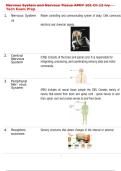
1. Nervous System Master controlling and communicating system of body; Cells communica
via
electrical and chemical signals.
2. Central (CNS) Consists of the brain and spinal cord. It is responsible for
Nervous
System integrating, processing, and coordinating sensory data and motor
commands.
3. Peripheral
Ner- vous
System
(PNS) Includes all neural tissue outside the CNS; Consists mainly of
nerves that extend from brain and spinal cord - spinal nerves to and
from spinal cord and cranial nerves to and from brain.
4. Receptors Sensory structures that detect changes in the internal or external
environment.
1/
35
, Nervous System and Nervous Tissue APHY 101 Ch 12 Ivy
Tech Exam Prep
5. Visceral Receptors that monitor internal organs like heart, spleen.
Sensory
Receptors
2/
35
, Nervous System and Nervous Tissue APHY 101 Ch 12 Ivy
Tech Exam Prep
6. Somatic Receptors that provide position, touch, pressure, pain, and temperature
Sensory
Receptors sensa- tions. Atterent fibers convey impulses from skin, skeletal muscles,
bones, and joints to CNS.
7. Special Receptors that provide sensations of smell, taste, vision, balance, and
Sensory
Receptors hearing. Atterent fibers convey impulses from special sense organs
to the CNS.
8. Sensory Division This division of the PNS brings information to the CNS from receptors in
peripheral tissues and organs. Atterent - Monitors.
9. Information Includes the integration and distribution of information in the CNS.
Pro- cessing
Decides.
10. Motor Division This division of the PNS carries motor commands from the CNS to
peripheral
tissues and systems. Etterent - Commands.
11. Somatic (SNS) Controls skeletal muscle contractions.
Nervous
System
3/
35
, Nervous System and Nervous Tissue APHY 101 Ch 12 Ivy
Tech Exam Prep
12. Autonomic (ANS) Automatically regulates smooth muscle, cardiac muscle, glands,
Ner- vous
System and adipose tissue.
13. Effectors Target organs (muscles or glands) whose activities change in response
neural
commands.
14. Nervous Neurons and Neuroglia
tissue cells
types
15. General Regions of Dendrites, Cell Body, and Axon.
Neurons
16. Dendrites Receptive region of the neuron along with the cell body. Receive stimuli
from
the environment or from other neurons. Highly branched. Typically
covered with ligand-gated ion channels. Convey incoming messages
toward cell body as graded potentials (short distance signals).
4/
35
Tech Exam Prep
1. Nervous System Master controlling and communicating system of body; Cells communica
via
electrical and chemical signals.
2. Central (CNS) Consists of the brain and spinal cord. It is responsible for
Nervous
System integrating, processing, and coordinating sensory data and motor
commands.
3. Peripheral
Ner- vous
System
(PNS) Includes all neural tissue outside the CNS; Consists mainly of
nerves that extend from brain and spinal cord - spinal nerves to and
from spinal cord and cranial nerves to and from brain.
4. Receptors Sensory structures that detect changes in the internal or external
environment.
1/
35
, Nervous System and Nervous Tissue APHY 101 Ch 12 Ivy
Tech Exam Prep
5. Visceral Receptors that monitor internal organs like heart, spleen.
Sensory
Receptors
2/
35
, Nervous System and Nervous Tissue APHY 101 Ch 12 Ivy
Tech Exam Prep
6. Somatic Receptors that provide position, touch, pressure, pain, and temperature
Sensory
Receptors sensa- tions. Atterent fibers convey impulses from skin, skeletal muscles,
bones, and joints to CNS.
7. Special Receptors that provide sensations of smell, taste, vision, balance, and
Sensory
Receptors hearing. Atterent fibers convey impulses from special sense organs
to the CNS.
8. Sensory Division This division of the PNS brings information to the CNS from receptors in
peripheral tissues and organs. Atterent - Monitors.
9. Information Includes the integration and distribution of information in the CNS.
Pro- cessing
Decides.
10. Motor Division This division of the PNS carries motor commands from the CNS to
peripheral
tissues and systems. Etterent - Commands.
11. Somatic (SNS) Controls skeletal muscle contractions.
Nervous
System
3/
35
, Nervous System and Nervous Tissue APHY 101 Ch 12 Ivy
Tech Exam Prep
12. Autonomic (ANS) Automatically regulates smooth muscle, cardiac muscle, glands,
Ner- vous
System and adipose tissue.
13. Effectors Target organs (muscles or glands) whose activities change in response
neural
commands.
14. Nervous Neurons and Neuroglia
tissue cells
types
15. General Regions of Dendrites, Cell Body, and Axon.
Neurons
16. Dendrites Receptive region of the neuron along with the cell body. Receive stimuli
from
the environment or from other neurons. Highly branched. Typically
covered with ligand-gated ion channels. Convey incoming messages
toward cell body as graded potentials (short distance signals).
4/
35