Chapter 10: Biodiversity
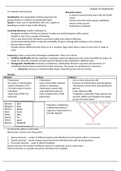
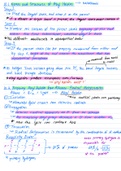
10.1 Species and taxonomy Binomial system:
- A universal system based upon Latin and Greek
Classification: the organisation of living organisms into names
groups based on a number of accepted principles - Genius comes first and is always capitalized;
Species: a basic unit of classification which are capable of species comes second
breeding to produce living, fertile offspring - Underlined or italicized
Courtship behaviour enables individuals to:
- Recognize members of their own species to make sure mating happens within species
- Identify a mate that is capable of breeding
- Form a pair bond which will lead to successful mating and raising of offspring
- Synchronized mating which is when the probability of sperm and egg cells meeting is at its maximum
- Become able to breed
- Females behave differently when they are at a receptive stage which allows males to know they’re ready to
mate.
Taxonomy: theory and practice of biological classification. There are 2 forms:
1. Artificial classification divides organisms according to physical appearances but come from different origins. Ex.
Wings of a bird and a butterfly are both used for flying but they originated in different ways.
2. Phylogenetic classification is based on evolutionary relationships between organisms and ancestors. It’s
classified by shared features derived from their ancestors. The groups are arranged into a hierarchy.
o Hierarchy: groups are contained within larger composite groups with no overlap.
Domain:
Bacteria Archaea Eukarya
- Prokaryotes - Prokaryotes - One or more eukaryotic cells
- No nuclei or mitochondria - Genes and protein synthesis - Presence of mitochondria and chloroplasts
- Smaller ribosome is 70S similar to eukaryotes - Membranes contain fatty acids attached to
- Cell walls made of murein - Membranes contain fatty glycerol
- Unicellular acids attached to glycerol - Larger ribosomes 80S
- Single loop of DNA 9no - More complex form of RNA - 4 kingdoms: protoctista, fungi, plantae and
histones0 polymerase animalia. Within each kingdom the largest
groups are known phyla.
Domain Dear
Phylogeny: evolutionary
Kingdom King
relationships between
Phylum Phillip
organisms represented in a
Class Came
tree like diagram
Order Over
Family For
Genus Good
Species Spaghetti
10.2 Diversity within a community
Biodiversity: variety in the living world
1. Species diversity – number of different species and individuals of each species within a community
2. Genetic diversity – variety of genes possessed by the individual that make up of population
3. Ecosystem diversity – range of different habitats
Species richness: the number of different species in a particular area at a given time
Index of diversity: to calculate the species diversity of two habitats
10.1 Species and taxonomy Binomial system:
- A universal system based upon Latin and Greek
Classification: the organisation of living organisms into names
groups based on a number of accepted principles - Genius comes first and is always capitalized;
Species: a basic unit of classification which are capable of species comes second
breeding to produce living, fertile offspring - Underlined or italicized
Courtship behaviour enables individuals to:
- Recognize members of their own species to make sure mating happens within species
- Identify a mate that is capable of breeding
- Form a pair bond which will lead to successful mating and raising of offspring
- Synchronized mating which is when the probability of sperm and egg cells meeting is at its maximum
- Become able to breed
- Females behave differently when they are at a receptive stage which allows males to know they’re ready to
mate.
Taxonomy: theory and practice of biological classification. There are 2 forms:
1. Artificial classification divides organisms according to physical appearances but come from different origins. Ex.
Wings of a bird and a butterfly are both used for flying but they originated in different ways.
2. Phylogenetic classification is based on evolutionary relationships between organisms and ancestors. It’s
classified by shared features derived from their ancestors. The groups are arranged into a hierarchy.
o Hierarchy: groups are contained within larger composite groups with no overlap.
Domain:
Bacteria Archaea Eukarya
- Prokaryotes - Prokaryotes - One or more eukaryotic cells
- No nuclei or mitochondria - Genes and protein synthesis - Presence of mitochondria and chloroplasts
- Smaller ribosome is 70S similar to eukaryotes - Membranes contain fatty acids attached to
- Cell walls made of murein - Membranes contain fatty glycerol
- Unicellular acids attached to glycerol - Larger ribosomes 80S
- Single loop of DNA 9no - More complex form of RNA - 4 kingdoms: protoctista, fungi, plantae and
histones0 polymerase animalia. Within each kingdom the largest
groups are known phyla.
Domain Dear
Phylogeny: evolutionary
Kingdom King
relationships between
Phylum Phillip
organisms represented in a
Class Came
tree like diagram
Order Over
Family For
Genus Good
Species Spaghetti
10.2 Diversity within a community
Biodiversity: variety in the living world
1. Species diversity – number of different species and individuals of each species within a community
2. Genetic diversity – variety of genes possessed by the individual that make up of population
3. Ecosystem diversity – range of different habitats
Species richness: the number of different species in a particular area at a given time
Index of diversity: to calculate the species diversity of two habitats