Psychopathology
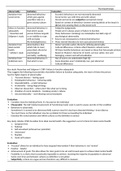
Abnormality Definition Evaluation
deviation from abnormal behaviour - Eccentric behaviours are not necessarily abnormal
social norms which goes against - Social norms vary with time and with culture
unwritten rules in a - Morals and norms are subjective (unmarried moms)
given society/culture - Based on context of behaviour (women wearing bikinis at the beach is
ok but men wearing them on the street isn’t)
failure to function abnormal behaviour is - Subjective judgements
adequately that which causes - People aren’t always aware of failure to function
* Rosenhan and person distress/anguish - Many behaviours (smoking) are maladaptive but not a sign of
Seligman’s study or an inability to cope psychological abnormality
with everyday + Easy to see consequences of abnormal behaviour
life/maladaptiveness + Many mental disorders do not cause personal distress
deviation from abnormality is that - Doesn’t provide useful criteria for defining abnormality
ideal mental which fails to meet - Cultural differences: criteria reflect Western cultural norms
health prescribed criteria for - All these healthy behaviours are based on ideas that few people achieve
* Jahoba’s study psychological - Based on Maslow’s hierarchy of needs: survival, safety, love and
normality / wellbeing belonging, esteem and self-actualisation
deviation from abnormal behaviour is - Not all scores are undesirable (high IQ)
statistical norm that which is rare - Some disorders aren’t statistically rare, just abnormal
- Cultural differences
Key study: Rosenhan and Seligman’s 1989: Failure to function adequately
They suggest the following characteristics that define failure to function adequately, the more of these the person
has the higher degree of abnormality:
1. Personal distress – feeling upset
2. Maladaptive behaviour – behaving oddly
3. Unpredictability – erratic behaviour
4. Irrationality – doing illogical things
5. Observer discomfort – others don’t like what we’re doing
6. Violation of moral standards – breaking society’s taboos
7. Unconventionality – not following normal standards
Evaluation:
+ Considers how the individual feels, it’s focused on the individual
+ Measurable: The GAF (Global Assessment of Functioning Scale) scale is used to assess severity of the condition
+ Behaviour is observable
- Sometimes it is normal to be distressed AND a person may fit in but have distorted thinking = inner distress
- Too much focus on the individual, may be a problem for those surrounding the individual
- Everyday life varies between and within cultures so the definition is unclear
Key study: Jahoba 1958: Deviation from ideal mental health. She suggested a set of criteria for ideal mental health:
1. Symptom-free
2. Rational
3. Self-actualised (achieved our potential)
4. Unstressed
5. Realistic
6. Good self-esteem
Evaluation:
+ ‘Focused’ allows for an individual to have targeted intervention if their behaviour is not ‘normal’
+ Positive – helpful
+ Achievement of goals: This idea allows for clear goals to be set and focused upon to achieve ideal mental health
- Feasibility is a criteria that is practically impossible to achieve, meaning the majority of population Is abnormal
- Varies over time and between cultures so definition is not global
- Subjectivity: criteria are vague and are therefore very difficult to measure
Abnormality Definition Evaluation
deviation from abnormal behaviour - Eccentric behaviours are not necessarily abnormal
social norms which goes against - Social norms vary with time and with culture
unwritten rules in a - Morals and norms are subjective (unmarried moms)
given society/culture - Based on context of behaviour (women wearing bikinis at the beach is
ok but men wearing them on the street isn’t)
failure to function abnormal behaviour is - Subjective judgements
adequately that which causes - People aren’t always aware of failure to function
* Rosenhan and person distress/anguish - Many behaviours (smoking) are maladaptive but not a sign of
Seligman’s study or an inability to cope psychological abnormality
with everyday + Easy to see consequences of abnormal behaviour
life/maladaptiveness + Many mental disorders do not cause personal distress
deviation from abnormality is that - Doesn’t provide useful criteria for defining abnormality
ideal mental which fails to meet - Cultural differences: criteria reflect Western cultural norms
health prescribed criteria for - All these healthy behaviours are based on ideas that few people achieve
* Jahoba’s study psychological - Based on Maslow’s hierarchy of needs: survival, safety, love and
normality / wellbeing belonging, esteem and self-actualisation
deviation from abnormal behaviour is - Not all scores are undesirable (high IQ)
statistical norm that which is rare - Some disorders aren’t statistically rare, just abnormal
- Cultural differences
Key study: Rosenhan and Seligman’s 1989: Failure to function adequately
They suggest the following characteristics that define failure to function adequately, the more of these the person
has the higher degree of abnormality:
1. Personal distress – feeling upset
2. Maladaptive behaviour – behaving oddly
3. Unpredictability – erratic behaviour
4. Irrationality – doing illogical things
5. Observer discomfort – others don’t like what we’re doing
6. Violation of moral standards – breaking society’s taboos
7. Unconventionality – not following normal standards
Evaluation:
+ Considers how the individual feels, it’s focused on the individual
+ Measurable: The GAF (Global Assessment of Functioning Scale) scale is used to assess severity of the condition
+ Behaviour is observable
- Sometimes it is normal to be distressed AND a person may fit in but have distorted thinking = inner distress
- Too much focus on the individual, may be a problem for those surrounding the individual
- Everyday life varies between and within cultures so the definition is unclear
Key study: Jahoba 1958: Deviation from ideal mental health. She suggested a set of criteria for ideal mental health:
1. Symptom-free
2. Rational
3. Self-actualised (achieved our potential)
4. Unstressed
5. Realistic
6. Good self-esteem
Evaluation:
+ ‘Focused’ allows for an individual to have targeted intervention if their behaviour is not ‘normal’
+ Positive – helpful
+ Achievement of goals: This idea allows for clear goals to be set and focused upon to achieve ideal mental health
- Feasibility is a criteria that is practically impossible to achieve, meaning the majority of population Is abnormal
- Varies over time and between cultures so definition is not global
- Subjectivity: criteria are vague and are therefore very difficult to measure