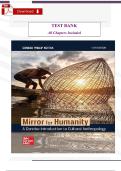
Mirror for Humanity: A Concise
Introduction to Cultural
ST
Anthropology – 13th Edition
UV
TEST BANK
IA
?_
AP
Conrad Phillip Kottak
PR
Comprehensive Test Bank for Instructors
OV
and Students
ED
© Conrad Phillip Kottak
All rights reserved. Reproduction or distribution without permission is prohibited.
?
Created by MedConnoisseur ©2025/2026
, TABLE OF CONTENTS
Mirror for Humanity: A Concise Introduction
ST
to Cultural Anthropology – 13th Edition
Conrad Phillip Kottak
UV
1. What Is Anthropology?
2. Culture
3. Doing Anthropology
IA
4. Language and Communication
5. Making a Living
6. Political Systems
?_
7. Families, Kinship, and Marriage
8. Gender
9. Religion
AP
10.Ethnicity and Race
11.Applying Anthropology
12.The World System, Colonialism, and Inequality
13.Anthropology’s Role in a Globalizing World
PR
OV
ED
?
Created by MedConnoisseur ©2025/2026
, Test Bank for Mirror for Humanity: A Concise Introduction to Cultural Anthropolog
13th Edition by Conrad Kottak
Chapter 01 13e Answers Included ✅
1) This chapter begins with a commonly heard opinion: "People are pretty much the same
ST
all over the world." Why is this assumption often wrong? How might your consideration of this
understanding affect how you would design an anthropological study?
UV
IA
2) What is culture? How do anthropologists define and study culture?
?_
AP
3) What does holism refer to? Why is the concept central to anthropology? How does this
concept relate to the "four-field" approach within the discipline? Have you encountered this
PR
concept in any of your other classes?
OV
ED
4) This chapter provides an example of human adaptation to high altitude to illustrate the
various forms of cultural and biological adaptation. Can you think of another example that
illustrates the broad capacity of humans to adapt both biologically and culturally?
?
1
,ST
UV
5) What doesbiocultural perspective refer to? If you are planning to major in the biological
sciences or planning a career as a medical doctor or clinical researcher, how might a minor in
anthropology complement your education? If you are thinking of majoring in the humanities,
how might a minor in anthropology complement your education?
IA
?_
AP
6) This chapter considers differences and similarities between anthropology and other
academic fields such as sociology. What about history?
PR
OV
7) Anthropology is the study of
A) humans around the world and through time.
ED
B) the psychological stages of human development.
C) myths in industrial societies.
D) the evolution of religion.
E) long-term psychological adaptation.
?
2
Introduction to Cultural
ST
Anthropology – 13th Edition
UV
TEST BANK
IA
?_
AP
Conrad Phillip Kottak
PR
Comprehensive Test Bank for Instructors
OV
and Students
ED
© Conrad Phillip Kottak
All rights reserved. Reproduction or distribution without permission is prohibited.
?
Created by MedConnoisseur ©2025/2026
, TABLE OF CONTENTS
Mirror for Humanity: A Concise Introduction
ST
to Cultural Anthropology – 13th Edition
Conrad Phillip Kottak
UV
1. What Is Anthropology?
2. Culture
3. Doing Anthropology
IA
4. Language and Communication
5. Making a Living
6. Political Systems
?_
7. Families, Kinship, and Marriage
8. Gender
9. Religion
AP
10.Ethnicity and Race
11.Applying Anthropology
12.The World System, Colonialism, and Inequality
13.Anthropology’s Role in a Globalizing World
PR
OV
ED
?
Created by MedConnoisseur ©2025/2026
, Test Bank for Mirror for Humanity: A Concise Introduction to Cultural Anthropolog
13th Edition by Conrad Kottak
Chapter 01 13e Answers Included ✅
1) This chapter begins with a commonly heard opinion: "People are pretty much the same
ST
all over the world." Why is this assumption often wrong? How might your consideration of this
understanding affect how you would design an anthropological study?
UV
IA
2) What is culture? How do anthropologists define and study culture?
?_
AP
3) What does holism refer to? Why is the concept central to anthropology? How does this
concept relate to the "four-field" approach within the discipline? Have you encountered this
PR
concept in any of your other classes?
OV
ED
4) This chapter provides an example of human adaptation to high altitude to illustrate the
various forms of cultural and biological adaptation. Can you think of another example that
illustrates the broad capacity of humans to adapt both biologically and culturally?
?
1
,ST
UV
5) What doesbiocultural perspective refer to? If you are planning to major in the biological
sciences or planning a career as a medical doctor or clinical researcher, how might a minor in
anthropology complement your education? If you are thinking of majoring in the humanities,
how might a minor in anthropology complement your education?
IA
?_
AP
6) This chapter considers differences and similarities between anthropology and other
academic fields such as sociology. What about history?
PR
OV
7) Anthropology is the study of
A) humans around the world and through time.
ED
B) the psychological stages of human development.
C) myths in industrial societies.
D) the evolution of religion.
E) long-term psychological adaptation.
?
2