Test Bank – Essentials of Strategic Management: The
Quest for Competitive Advantage | Chapter 9
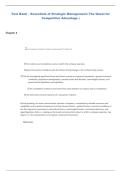
Business ethics concerns
developing a consensus among companies worldwide as to what ethical principles that businesses
should be expected to observe in the course of conducting their operations.
what ethical behaviors should be expected of company personnel in the course of doing their jobs.
the application of ethical principles and standards to business activities, behavior, and decisions.
developing a special set of ethical standards for businesses to observe in conducting their affairs.
picking and choosing among the normative ethical standards of society in order to arrive at a set of
ethical standards that apply directly to operating a business.
Business actions have to be judged in the context and via the application of society’s standards of right
and wrong. There is no special set of rules that businesspeople decide to apply to their own conduct.
, Award: 10.00 points
2.
Ethical principles in business
deal chiefly with the actions and behaviors required to operate companies in a socially responsible
manner.
deal chiefly with the rules each company’s top management and board of directors make about
“what is right” and “what is wrong.”
are not materially different from ethical principles in general.
are generally less stringent than the ethical principles for society at large.
are generally more stringent than the ethical principles for society at large.
Ethical principles in business are not materially different from ethical principles in general.
The results of strategies that cannot pass the test of moral scrutiny often are not manifested in
criminal indictment and convictions of company executives.
,4. Award: 10.00 po ints
sizable fines.
devastating hits to public relations and company reputation.
sharp drops in stock prices and lower dividends.
increased customer loyalty.
See Figure 9.1. Shareholders suffer major damage when a company’s unethical behavior is discovered and
punished. Making amends for unethical business conduct is costly, and it takes years to rehabilitate a
tarnished company reputation.
Although exposing children to hazardous work and long work hours is unquestionably deplorable, which
of the following, if true, leads to a moral dilemma?
Children are not as efficient as adults in doing physically demanding work.
Many child laborers come from poverty-stricken families.
Banning child labor increases school attendance.
Working children learn independence.
Use of adults leads to higher labor costs.
Although exposing children to hazardous work and long work hours is unquestionably deplorable, the fact
remains that poverty-stricken families in many poor countries cannot subsist without the work efforts of
young family members; sending their children to school instead of having them work is not a realistic
option. If such children are not permitted to work (especially those in the 12-to-17 age group)—due to
pressures imposed by activist groups in industrialized nations—they may be forced to go out on the
streets begging or to seek work in parts of the “underground” economy such as drug trafficking and
prostitution.
, 5. Award: 10.00 po ints
As they apply to business conduct and business decisions, ethical principles
deal chiefly with a company’s standards about what is right and wrong insofar as the conduct of its
business is concerned and about what behaviors are expected of company personnel.
deal chiefly with the behaviors that a company’s board of directors expects of all company
personnel in both their conduct on the job and their conduct off the job.
involve the rules a company’s top management and board of directors make about “what is right”
and “what is wrong.”
are not materially different from ethical principles in general.
are generally less stringent than the ethical principles for society at large because it is well
understood that businesses should not be expected to operate any differently from what the law
requires of them.
Ethical principles in business are not materially different from ethical principles in general.
The major drivers of unethical business behavior include
pervasive managerial immorality and a general lack of scruples on the part of top executives
regarding how customers and suppliers should be treated.
corporate cultures that put the bottom line ahead of ethics, heavy pressures on company managers to
meet or beat performance targets, and overzealous or obsessive pursuit of wealth accumulation,
power, status, and other selfish interests.
widespread managerial belief in the ethical relativism school of thinking.
an aversion to ethical correctness on the part of top executives and a belief that unethical behavior
is unimportant and probably won’t be discovered.
Quest for Competitive Advantage | Chapter 9
Business ethics concerns
developing a consensus among companies worldwide as to what ethical principles that businesses
should be expected to observe in the course of conducting their operations.
what ethical behaviors should be expected of company personnel in the course of doing their jobs.
the application of ethical principles and standards to business activities, behavior, and decisions.
developing a special set of ethical standards for businesses to observe in conducting their affairs.
picking and choosing among the normative ethical standards of society in order to arrive at a set of
ethical standards that apply directly to operating a business.
Business actions have to be judged in the context and via the application of society’s standards of right
and wrong. There is no special set of rules that businesspeople decide to apply to their own conduct.
, Award: 10.00 points
2.
Ethical principles in business
deal chiefly with the actions and behaviors required to operate companies in a socially responsible
manner.
deal chiefly with the rules each company’s top management and board of directors make about
“what is right” and “what is wrong.”
are not materially different from ethical principles in general.
are generally less stringent than the ethical principles for society at large.
are generally more stringent than the ethical principles for society at large.
Ethical principles in business are not materially different from ethical principles in general.
The results of strategies that cannot pass the test of moral scrutiny often are not manifested in
criminal indictment and convictions of company executives.
,4. Award: 10.00 po ints
sizable fines.
devastating hits to public relations and company reputation.
sharp drops in stock prices and lower dividends.
increased customer loyalty.
See Figure 9.1. Shareholders suffer major damage when a company’s unethical behavior is discovered and
punished. Making amends for unethical business conduct is costly, and it takes years to rehabilitate a
tarnished company reputation.
Although exposing children to hazardous work and long work hours is unquestionably deplorable, which
of the following, if true, leads to a moral dilemma?
Children are not as efficient as adults in doing physically demanding work.
Many child laborers come from poverty-stricken families.
Banning child labor increases school attendance.
Working children learn independence.
Use of adults leads to higher labor costs.
Although exposing children to hazardous work and long work hours is unquestionably deplorable, the fact
remains that poverty-stricken families in many poor countries cannot subsist without the work efforts of
young family members; sending their children to school instead of having them work is not a realistic
option. If such children are not permitted to work (especially those in the 12-to-17 age group)—due to
pressures imposed by activist groups in industrialized nations—they may be forced to go out on the
streets begging or to seek work in parts of the “underground” economy such as drug trafficking and
prostitution.
, 5. Award: 10.00 po ints
As they apply to business conduct and business decisions, ethical principles
deal chiefly with a company’s standards about what is right and wrong insofar as the conduct of its
business is concerned and about what behaviors are expected of company personnel.
deal chiefly with the behaviors that a company’s board of directors expects of all company
personnel in both their conduct on the job and their conduct off the job.
involve the rules a company’s top management and board of directors make about “what is right”
and “what is wrong.”
are not materially different from ethical principles in general.
are generally less stringent than the ethical principles for society at large because it is well
understood that businesses should not be expected to operate any differently from what the law
requires of them.
Ethical principles in business are not materially different from ethical principles in general.
The major drivers of unethical business behavior include
pervasive managerial immorality and a general lack of scruples on the part of top executives
regarding how customers and suppliers should be treated.
corporate cultures that put the bottom line ahead of ethics, heavy pressures on company managers to
meet or beat performance targets, and overzealous or obsessive pursuit of wealth accumulation,
power, status, and other selfish interests.
widespread managerial belief in the ethical relativism school of thinking.
an aversion to ethical correctness on the part of top executives and a belief that unethical behavior
is unimportant and probably won’t be discovered.