OCPP 101 Chapter 2.3 UPDATED ACTUAL Questions and CORRECT
Answers
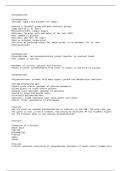
1. plus It is important to note that the eye is considered a visual system. All refractive
components of the eye have *this* power.
2. Emmetropia is the normal ocular refractive condition in which the principal focal point of
the dioptric system of the eye lies exactly in the plane of the retina (normal vision).
3. Standard, non- Emmetropia may be or .
standard
4. Standard emmetropia is when the eye has standard refractive powers in the cornea,
crystalline lens, and also contains a standard axial length.
5. Nonstandard emmetropia is when the eye contains excessive plus power in the cornea
and/or crystalline lens but may have a shorter than normal axial length. It may also
occur when the axial length may be too long, but the plus power of the cornea
and/or the crystalline lens is too little.
6. Ametropia describes a group of refractive errors, which include myopia, hyperopia,
and astigmatism. An eye that has too much or too little plus power in any principal
meridian is said to be *this*
7. Hyperopia is defined as a refractive error or optical defect of the eye in which parallel
rays of light, from a distant light source (optical infinity), come to a point focus
behind the retina. It is referred to as farsighted or long sight. The eye has too little
plus power.
, 8. not enough, Hyperopia may be a result of....
short, combina- 1. the cornea or the crystalline lens having plus power.
tion 2. The eye may be too .
3. A of the above.
9. plus Hyperopia is correct with spherical lenses.
10. Myopia is defined as a refractive error of the eye in which light rays from infinity
focus in front of the retina of an uncorrected eye. It is also referred to as nearsight-
edness or short sight. The eye has too much plus power.
11. too much, too Myopia may be a result of...
long, combina- 1. The cornea or the crystalline lens having plus power
tion 2. The eye may be too .
3. A of the above.
12. minus Myopia is corrected with spherical lenses
13. Astigmatism is a condition that causes blurred vision due either to the irregular shape
of the cornea, the clear front cover of the eye, or sometimes the curvature of the
lens inside the eye.
14. ANY distance In the astigmatic condition, an irregularly shaped cornea or lens prevents light
from focusing properly on the retina, the light sensitive surface at the back of the
eye. As a result, vision becomes blurred at .
15. Regular astigma- is identified as having the principal meridians perpendicular to one
tism another or about 90° apart.
Answers
1. plus It is important to note that the eye is considered a visual system. All refractive
components of the eye have *this* power.
2. Emmetropia is the normal ocular refractive condition in which the principal focal point of
the dioptric system of the eye lies exactly in the plane of the retina (normal vision).
3. Standard, non- Emmetropia may be or .
standard
4. Standard emmetropia is when the eye has standard refractive powers in the cornea,
crystalline lens, and also contains a standard axial length.
5. Nonstandard emmetropia is when the eye contains excessive plus power in the cornea
and/or crystalline lens but may have a shorter than normal axial length. It may also
occur when the axial length may be too long, but the plus power of the cornea
and/or the crystalline lens is too little.
6. Ametropia describes a group of refractive errors, which include myopia, hyperopia,
and astigmatism. An eye that has too much or too little plus power in any principal
meridian is said to be *this*
7. Hyperopia is defined as a refractive error or optical defect of the eye in which parallel
rays of light, from a distant light source (optical infinity), come to a point focus
behind the retina. It is referred to as farsighted or long sight. The eye has too little
plus power.
, 8. not enough, Hyperopia may be a result of....
short, combina- 1. the cornea or the crystalline lens having plus power.
tion 2. The eye may be too .
3. A of the above.
9. plus Hyperopia is correct with spherical lenses.
10. Myopia is defined as a refractive error of the eye in which light rays from infinity
focus in front of the retina of an uncorrected eye. It is also referred to as nearsight-
edness or short sight. The eye has too much plus power.
11. too much, too Myopia may be a result of...
long, combina- 1. The cornea or the crystalline lens having plus power
tion 2. The eye may be too .
3. A of the above.
12. minus Myopia is corrected with spherical lenses
13. Astigmatism is a condition that causes blurred vision due either to the irregular shape
of the cornea, the clear front cover of the eye, or sometimes the curvature of the
lens inside the eye.
14. ANY distance In the astigmatic condition, an irregularly shaped cornea or lens prevents light
from focusing properly on the retina, the light sensitive surface at the back of the
eye. As a result, vision becomes blurred at .
15. Regular astigma- is identified as having the principal meridians perpendicular to one
tism another or about 90° apart.