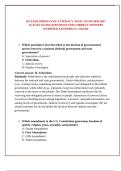
(FCLE)FLORIDA CIVIC LITERACY FINAL EXAM 2026-2027
ACTUAL EXAM QUESTIONS AND CORRECT ANSWERS
(VERIFIED ANSWERS) A+ GRADE
1. Which principle is best described as the division of governmental
powers between a national (federal) government and state
governments?
A. Separation of powers
B. Federalism
C. Judicial review
D. Popular sovereignty
Correct answer: B. Federalism
Rationale: Federalism is the constitutional principle that allocates authority
between the national and state governments. Under federalism, certain powers
(e.g., coining money, regulating interstate commerce) are delegated to the federal
government, while others (e.g., education, local law enforcement) are primarily
reserved to the states or the people. The Tenth Amendment reinforces this by
reserving non-delegated powers to states or people. Separation of powers (choice
A) refers to dividing power among legislative, executive, and judicial branches, not
among levels of government. Judicial review (C) and popular sovereignty (D) are
related concepts but do not define the division between federal and state
governments.
2. Which amendment to the U.S. Constitution guarantees freedom of
speech, religion, press, assembly, and petition?
A. Fourth Amendment
B. First Amendment
C. Fifth Amendment
D. Tenth Amendment
,Correct answer: B. First Amendment
Rationale: The First Amendment protects five fundamental liberties: religion,
speech, press, assembly, and petition. These rights are core to democratic
participation and serve as checks on government power. The Fourth Amendment
(A) protects against unreasonable searches and seizures; the Fifth (C) includes
protection against self-incrimination and guarantees due process; and the Tenth (D)
reserves powers not delegated to the federal government to the states or people.
3. What was the main constitutional significance of the Supreme Court
case Marbury v. Madison (1803)?
A. It ended segregation in public schools.
B. It expanded freedom of the press.
C. It established the principle of judicial review.
D. It defined the commerce clause.
Correct answer: C. It established the principle of judicial review.
Rationale: Marbury v. Madison is the landmark decision that established the
Supreme Court’s authority to review acts of Congress and determine their
constitutionality — judicial review. Chief Justice John Marshall’s opinion held that
when a law conflicts with the Constitution, the Constitution controls, and it is the
judiciary’s role to interpret that document. This decision significantly strengthened
the judicial branch by giving courts power to invalidate unconstitutional legislative
or executive actions. Choices A and B refer to other areas of constitutional law; D
concerns commerce clause interpretation in later cases.
4. Which of the following best describes the system of “checks and
balances”?
A. The right of citizens to vote in free elections
B. The process of amending the Constitution
C. Each branch of government having powers to limit the other
branches
D. Division of power between national and state governments
,Correct answer: C. Each branch of government having powers to limit the
other branches
Rationale: Checks and balances is the structure by which the legislative,
executive, and judicial branches constrain each other’s powers to prevent any one
branch from becoming dominant. Examples: the president can veto congressional
legislation (executive over legislative); Congress can impeach the president
(legislative over executive); the Supreme Court can declare laws unconstitutional
(judicial over legislative/executive). Option A is about democratic participation, B
is constitutional amendment procedure, and D is federalism.
5. The Emancipation Proclamation (1863) did which of the following?
A. Abolished slavery throughout the entire United States.
B. Guaranteed voting rights for formerly enslaved people.
C. Declared freedom for enslaved people in Confederate-held territories.
D. Ended the Civil War.
Correct answer: C. Declared freedom for enslaved people in Confederate-held
territories.
Rationale: The Emancipation Proclamation proclaimed that enslaved persons in
states rebelling against the Union “shall be then, thenceforward, and forever free.”
It applied only to Confederate-controlled areas, not to slaveholding border states
loyal to the Union or areas already under Union control. It did not by itself abolish
slavery nationwide — that required the Thirteenth Amendment (1865). It also did
not grant voting rights (which later amendments and laws addressed) nor did it end
the Civil War.
6. Which constitutional amendment abolished slavery in the United
States?
A. Thirteenth Amendment
B. Thirteenth Amendment
C. Fourteenth Amendment
D. Fifteenth Amendment
, Correct answer: B. Thirteenth Amendment
Rationale: The Thirteenth Amendment (ratified in 1865) explicitly abolished
slavery and involuntary servitude throughout the United States, except as
punishment for a crime. The Fourteenth Amendment (C) provided citizenship and
equal protection; the Fifteenth (D) addressed voting rights regardless of race; but
neither eliminated slavery itself. (Note: A and B are identical; B is the intended
correct choice.)
7. Which power belongs exclusively to the U.S. Senate and not the House
of Representatives?
A. Initiating revenue bills
B. Confirming presidential appointments
C. Impeaching federal officials
D. Electing the president in case of electoral tie
Correct answer: B. Confirming presidential appointments
Rationale: The Senate has the unique constitutional power to advise and consent
to presidential appointments (e.g., Cabinet members, federal judges) and to ratify
treaties. The House (A) has the exclusive power to originate revenue bills.
Impeachment (C) is initiated by the House and tried by the Senate — so initiating
impeachment is a House power, not the Senate’s exclusive role. If the Electoral
College fails to produce a majority for president, the House (not the Senate)
chooses the president; the Senate chooses the vice president in that contingency.
8. Which phrase correctly completes this sentence? “The principle of
__________ means that the authority of government comes from the
people.”
A. Federalism
B. Separation of powers
C. Judicial review
D. Popular sovereignty
Correct answer: D. Popular sovereignty
Rationale: Popular sovereignty is the doctrine that political authority rests with the
ACTUAL EXAM QUESTIONS AND CORRECT ANSWERS
(VERIFIED ANSWERS) A+ GRADE
1. Which principle is best described as the division of governmental
powers between a national (federal) government and state
governments?
A. Separation of powers
B. Federalism
C. Judicial review
D. Popular sovereignty
Correct answer: B. Federalism
Rationale: Federalism is the constitutional principle that allocates authority
between the national and state governments. Under federalism, certain powers
(e.g., coining money, regulating interstate commerce) are delegated to the federal
government, while others (e.g., education, local law enforcement) are primarily
reserved to the states or the people. The Tenth Amendment reinforces this by
reserving non-delegated powers to states or people. Separation of powers (choice
A) refers to dividing power among legislative, executive, and judicial branches, not
among levels of government. Judicial review (C) and popular sovereignty (D) are
related concepts but do not define the division between federal and state
governments.
2. Which amendment to the U.S. Constitution guarantees freedom of
speech, religion, press, assembly, and petition?
A. Fourth Amendment
B. First Amendment
C. Fifth Amendment
D. Tenth Amendment
,Correct answer: B. First Amendment
Rationale: The First Amendment protects five fundamental liberties: religion,
speech, press, assembly, and petition. These rights are core to democratic
participation and serve as checks on government power. The Fourth Amendment
(A) protects against unreasonable searches and seizures; the Fifth (C) includes
protection against self-incrimination and guarantees due process; and the Tenth (D)
reserves powers not delegated to the federal government to the states or people.
3. What was the main constitutional significance of the Supreme Court
case Marbury v. Madison (1803)?
A. It ended segregation in public schools.
B. It expanded freedom of the press.
C. It established the principle of judicial review.
D. It defined the commerce clause.
Correct answer: C. It established the principle of judicial review.
Rationale: Marbury v. Madison is the landmark decision that established the
Supreme Court’s authority to review acts of Congress and determine their
constitutionality — judicial review. Chief Justice John Marshall’s opinion held that
when a law conflicts with the Constitution, the Constitution controls, and it is the
judiciary’s role to interpret that document. This decision significantly strengthened
the judicial branch by giving courts power to invalidate unconstitutional legislative
or executive actions. Choices A and B refer to other areas of constitutional law; D
concerns commerce clause interpretation in later cases.
4. Which of the following best describes the system of “checks and
balances”?
A. The right of citizens to vote in free elections
B. The process of amending the Constitution
C. Each branch of government having powers to limit the other
branches
D. Division of power between national and state governments
,Correct answer: C. Each branch of government having powers to limit the
other branches
Rationale: Checks and balances is the structure by which the legislative,
executive, and judicial branches constrain each other’s powers to prevent any one
branch from becoming dominant. Examples: the president can veto congressional
legislation (executive over legislative); Congress can impeach the president
(legislative over executive); the Supreme Court can declare laws unconstitutional
(judicial over legislative/executive). Option A is about democratic participation, B
is constitutional amendment procedure, and D is federalism.
5. The Emancipation Proclamation (1863) did which of the following?
A. Abolished slavery throughout the entire United States.
B. Guaranteed voting rights for formerly enslaved people.
C. Declared freedom for enslaved people in Confederate-held territories.
D. Ended the Civil War.
Correct answer: C. Declared freedom for enslaved people in Confederate-held
territories.
Rationale: The Emancipation Proclamation proclaimed that enslaved persons in
states rebelling against the Union “shall be then, thenceforward, and forever free.”
It applied only to Confederate-controlled areas, not to slaveholding border states
loyal to the Union or areas already under Union control. It did not by itself abolish
slavery nationwide — that required the Thirteenth Amendment (1865). It also did
not grant voting rights (which later amendments and laws addressed) nor did it end
the Civil War.
6. Which constitutional amendment abolished slavery in the United
States?
A. Thirteenth Amendment
B. Thirteenth Amendment
C. Fourteenth Amendment
D. Fifteenth Amendment
, Correct answer: B. Thirteenth Amendment
Rationale: The Thirteenth Amendment (ratified in 1865) explicitly abolished
slavery and involuntary servitude throughout the United States, except as
punishment for a crime. The Fourteenth Amendment (C) provided citizenship and
equal protection; the Fifteenth (D) addressed voting rights regardless of race; but
neither eliminated slavery itself. (Note: A and B are identical; B is the intended
correct choice.)
7. Which power belongs exclusively to the U.S. Senate and not the House
of Representatives?
A. Initiating revenue bills
B. Confirming presidential appointments
C. Impeaching federal officials
D. Electing the president in case of electoral tie
Correct answer: B. Confirming presidential appointments
Rationale: The Senate has the unique constitutional power to advise and consent
to presidential appointments (e.g., Cabinet members, federal judges) and to ratify
treaties. The House (A) has the exclusive power to originate revenue bills.
Impeachment (C) is initiated by the House and tried by the Senate — so initiating
impeachment is a House power, not the Senate’s exclusive role. If the Electoral
College fails to produce a majority for president, the House (not the Senate)
chooses the president; the Senate chooses the vice president in that contingency.
8. Which phrase correctly completes this sentence? “The principle of
__________ means that the authority of government comes from the
people.”
A. Federalism
B. Separation of powers
C. Judicial review
D. Popular sovereignty
Correct answer: D. Popular sovereignty
Rationale: Popular sovereignty is the doctrine that political authority rests with the