Section A: Understand the structure and function of nucleic acids in order to de
and the process of protein synthesis
A1: Nucleic Acids
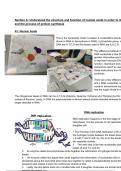
This is the nucleotide model I created. A nucleotide's structur
ribose in RNA or deoxyribose in DNA), a phosphate group, a
DNA are A,T,C,G and the bases used in RNA are A,U,C,G.
The difference between b
DNA nucleotide is that DN
genetic information and te
is important because DNA
function, reproduce and g
instructions aren't so use
those instructions from th
synthesis.
There are a few differenc
and a DNA nucleotide, on
contains deoxyribose sug
has the sugar ribose in ev
The nitrogenous bases in DNA can be A,T,C,G (Adenine, Guanine, Cytosine and Thymine) but for R
instead of thymine. Lastly, In DNA the polynucleotide is almost always double stranded whereas the
single stranded in RNA.
. DNA replication
DNA replication happens in the first stage of t
interphase). It is the process of cell replication
daughter cell.
1.The first step in the DNA replication is the D
the hydrogen bonds between the bases break
( A with T and C with G), this is so the double
two separate strands.
2. The next step is the free nucleotides pair
bases (A and T,C and,G)
3. An enzyme called dna polymerase binds together the reformation of hydrogen bonds be
bases.
4. An enzyme called dna ligase then seals together the reformation of nucleotides (this is
phosphate group,the bond that joins these two together is called a phosphodiester bond) this
sequence and makes it back into continuous strands of dna.
5. Lastly, the dna twists back into a double helix and 2 daughter molecules are formed and
and the process of protein synthesis
A1: Nucleic Acids
This is the nucleotide model I created. A nucleotide's structur
ribose in RNA or deoxyribose in DNA), a phosphate group, a
DNA are A,T,C,G and the bases used in RNA are A,U,C,G.
The difference between b
DNA nucleotide is that DN
genetic information and te
is important because DNA
function, reproduce and g
instructions aren't so use
those instructions from th
synthesis.
There are a few differenc
and a DNA nucleotide, on
contains deoxyribose sug
has the sugar ribose in ev
The nitrogenous bases in DNA can be A,T,C,G (Adenine, Guanine, Cytosine and Thymine) but for R
instead of thymine. Lastly, In DNA the polynucleotide is almost always double stranded whereas the
single stranded in RNA.
. DNA replication
DNA replication happens in the first stage of t
interphase). It is the process of cell replication
daughter cell.
1.The first step in the DNA replication is the D
the hydrogen bonds between the bases break
( A with T and C with G), this is so the double
two separate strands.
2. The next step is the free nucleotides pair
bases (A and T,C and,G)
3. An enzyme called dna polymerase binds together the reformation of hydrogen bonds be
bases.
4. An enzyme called dna ligase then seals together the reformation of nucleotides (this is
phosphate group,the bond that joins these two together is called a phosphodiester bond) this
sequence and makes it back into continuous strands of dna.
5. Lastly, the dna twists back into a double helix and 2 daughter molecules are formed and