Gerontology Final Exam Questions
and Answers with Rationale
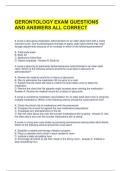
A nurse at a long-term care facility is planning care for a client who has Alzheimer's
disease and wanders at night. Which of the following interventions should the nurse
include in the plan?
a. Place the client in wrist restraints at night.
b. Request a prescription for a psychotropic medication.
c. Assign the client to a room closer to the nurse's station.
d. Keep the television on at night. - Answer-Assign the client to a room closer to the
nurse's station.
*RATIONALE* The nurse should place the client who wanders in a room that allows for
close observation. The nurse should provide clients who wander a safe place to walk
and supervision when the client is ambulating.
*FYI* The nurse should avoid the use of excessive light and sound stimulation for the
client who has Alzheimer's disease; this can cause further agitation and confusion for
the client.
A nurse at a long-term care facility is planning care for an older adult client who has
dementia. Which of the following interventions should the nurse include in the plan?
a. Vary the staff members caring for the client.
b. Use photographs as memory triggers.
c. Provide a minimum of three activity choices to the client.
d. Break client tasks down to three or four steps at a time. - Answer-Use photographs
as memory triggers.
*RATIONALE* The nurse should place photographs on the unit that trigger the client's
memories, such as a picture of a toilet at the entrance to the bathroom, or a picture of
the client as a young adult at the entrance to her room.
*FYI* The nurse should use consistent staff to provide care for the client because
changing staff increases client confusion ... Providing the client with a number of activity
choices and steps to complete causes confusion and frustration.
,A nurse is caring for an older adult client who reports that he has just retired and
expresses feeling of loneliness due to the loss of daily interactions with coworkers.
Which of the following responses should the nurse make?
a. "Do you know about the local senior citizen group?"
b. "You need to take a vacation."
c. "But now you can finally relax and enjoy your life."
d. "Why don't you go into work and visit with your old friends?" - Answer-"Do you know
about the local senior citizen group?"
*RATIONALE* The nurse should assist the client in the resocialization process by using
the therapeutic communication technique of giving information. Becoming involved in an
organization might assist the client in resocialization, which is beneficial to clients who
have depended upon their employment for social interaction.
A public health nurse is planning an immunization clinic for older adults. At which of the
following times should an older adult client receive the influenza vaccine?
a. Once during the client's lifetime
b. Every 10 years
c. Every 5 years
d. Annually in the fall - Answer-Annually in the fall
*RATIONALE* The nurse should recommend that older adult clients receive the
influenza vaccine annually. Influenza outbreaks occur annually, and the influenza virus
changes constantly. Consequently, an influenza vaccine from a previous year will not
protect a client exposed to this year's influenza strain. Influenza in older adults can
result in the development of primary viral influenza pneumonia, which causes several
deaths a year. An influenza vaccine given in the fall, prior to the onset of flu season, will
be most effective in preventing influenza in this target population.
A home-health nurse is caring for a client who has cancer and is using a fentanyl
transdermal patch for pain control. Which of the following actions should the nurse take
when caring for this client?
a. Avoid using a heating pad on the area with the patch.
b. To decrease the dose, cut the patch in half.
c. Dispose of the used patch by placing it in the trash can.
d. Assess the client for urinary retention every 8 hr. - Answer-Avoid using a heating pad
on the area with the patch.
*RATIONALE* Applying heat over the site of the transdermal patch will increase the rate
of absorption of the opioid medication and might cause respiratory depression.
, *FYI* The nurse should dispose of a used patch by folding it with the adhesive edges
together and placing it in a tamper-proof receptacle ... The nurse should assess the
client using a fentanyl patch for urinary retention every 4 to 6 hr.
A nurse working in a community health center is completing an assessment of an older
adult female client. Which of the following findings should the nurse identify as a
priority?
a. Rales heard in the bases of the lungs
b. Constipation
c. Urinary frequency
d. Painful intercourse - Answer-Rales heard in the bases of the lungs
*RATIONALE* The nurse should apply the ABC priority-setting framework. This
framework emphasizes the basic core of human functioning - having an open airway,
being able to breathe in adequate amounts of oxygen, and circulating oxygen to the
body's organs via the blood. An alteration in any of these can indicate a threat to life,
and is therefore, the nurse's priority concern. When applying the ABC priority-setting
framework, airway is always the highest priority because the airway must be clear and
open for oxygen exchange to occur. Breathing is the second-highest priority in the ABC
priority-setting framework because adequate ventilator effort is essential in order for
oxygen exchange to occur. Circulation is the third-highest priority in the ABC priority-
setting framework because delivery of oxygen to critical organs only occurs if the heart
and blood vessels are capable to efficiently carrying oxygen to them. Air moving into
collapsed airways results in rales and can occur in clients who have bronchitis,
pneumonia, or chronic pulmonary disease. This finding is the priority and requires
further assessment.
*FYI* Although bowel motility slows somewhat with aging, it does not normally result in
constipation; more likely, this is the result of medications, life habits, immobility or
inadequate fluid intake ... Bladder capacity decreases, and weakened contractions
during emptying of the bladder can result in post-void residual amounts and increased
risk of infection ... A report of painful intercourse is common in older adult clients due to
vaginal narrowing, loss of elasticity, and decreased secretions.
A nurse is admitting an older adult client who has urinary incontinence and smells
strongly of urine. The client's partner, who has been caring for her at home, states that
he is sorry and embarrassed about the unpleasant smell. Which of the following
responses should the nurse make?
a. "A lot of clients who are cared for at home have the same problem."
b. "Don't worry about it. She will get a bath, and that will take care of the odor."
c. "It must be difficult to care for someone who has incontinence."
d. "When was the last time that she had a bath?" - Answer-"It must be difficult to care
for someone who has incontinence."
and Answers with Rationale
A nurse at a long-term care facility is planning care for a client who has Alzheimer's
disease and wanders at night. Which of the following interventions should the nurse
include in the plan?
a. Place the client in wrist restraints at night.
b. Request a prescription for a psychotropic medication.
c. Assign the client to a room closer to the nurse's station.
d. Keep the television on at night. - Answer-Assign the client to a room closer to the
nurse's station.
*RATIONALE* The nurse should place the client who wanders in a room that allows for
close observation. The nurse should provide clients who wander a safe place to walk
and supervision when the client is ambulating.
*FYI* The nurse should avoid the use of excessive light and sound stimulation for the
client who has Alzheimer's disease; this can cause further agitation and confusion for
the client.
A nurse at a long-term care facility is planning care for an older adult client who has
dementia. Which of the following interventions should the nurse include in the plan?
a. Vary the staff members caring for the client.
b. Use photographs as memory triggers.
c. Provide a minimum of three activity choices to the client.
d. Break client tasks down to three or four steps at a time. - Answer-Use photographs
as memory triggers.
*RATIONALE* The nurse should place photographs on the unit that trigger the client's
memories, such as a picture of a toilet at the entrance to the bathroom, or a picture of
the client as a young adult at the entrance to her room.
*FYI* The nurse should use consistent staff to provide care for the client because
changing staff increases client confusion ... Providing the client with a number of activity
choices and steps to complete causes confusion and frustration.
,A nurse is caring for an older adult client who reports that he has just retired and
expresses feeling of loneliness due to the loss of daily interactions with coworkers.
Which of the following responses should the nurse make?
a. "Do you know about the local senior citizen group?"
b. "You need to take a vacation."
c. "But now you can finally relax and enjoy your life."
d. "Why don't you go into work and visit with your old friends?" - Answer-"Do you know
about the local senior citizen group?"
*RATIONALE* The nurse should assist the client in the resocialization process by using
the therapeutic communication technique of giving information. Becoming involved in an
organization might assist the client in resocialization, which is beneficial to clients who
have depended upon their employment for social interaction.
A public health nurse is planning an immunization clinic for older adults. At which of the
following times should an older adult client receive the influenza vaccine?
a. Once during the client's lifetime
b. Every 10 years
c. Every 5 years
d. Annually in the fall - Answer-Annually in the fall
*RATIONALE* The nurse should recommend that older adult clients receive the
influenza vaccine annually. Influenza outbreaks occur annually, and the influenza virus
changes constantly. Consequently, an influenza vaccine from a previous year will not
protect a client exposed to this year's influenza strain. Influenza in older adults can
result in the development of primary viral influenza pneumonia, which causes several
deaths a year. An influenza vaccine given in the fall, prior to the onset of flu season, will
be most effective in preventing influenza in this target population.
A home-health nurse is caring for a client who has cancer and is using a fentanyl
transdermal patch for pain control. Which of the following actions should the nurse take
when caring for this client?
a. Avoid using a heating pad on the area with the patch.
b. To decrease the dose, cut the patch in half.
c. Dispose of the used patch by placing it in the trash can.
d. Assess the client for urinary retention every 8 hr. - Answer-Avoid using a heating pad
on the area with the patch.
*RATIONALE* Applying heat over the site of the transdermal patch will increase the rate
of absorption of the opioid medication and might cause respiratory depression.
, *FYI* The nurse should dispose of a used patch by folding it with the adhesive edges
together and placing it in a tamper-proof receptacle ... The nurse should assess the
client using a fentanyl patch for urinary retention every 4 to 6 hr.
A nurse working in a community health center is completing an assessment of an older
adult female client. Which of the following findings should the nurse identify as a
priority?
a. Rales heard in the bases of the lungs
b. Constipation
c. Urinary frequency
d. Painful intercourse - Answer-Rales heard in the bases of the lungs
*RATIONALE* The nurse should apply the ABC priority-setting framework. This
framework emphasizes the basic core of human functioning - having an open airway,
being able to breathe in adequate amounts of oxygen, and circulating oxygen to the
body's organs via the blood. An alteration in any of these can indicate a threat to life,
and is therefore, the nurse's priority concern. When applying the ABC priority-setting
framework, airway is always the highest priority because the airway must be clear and
open for oxygen exchange to occur. Breathing is the second-highest priority in the ABC
priority-setting framework because adequate ventilator effort is essential in order for
oxygen exchange to occur. Circulation is the third-highest priority in the ABC priority-
setting framework because delivery of oxygen to critical organs only occurs if the heart
and blood vessels are capable to efficiently carrying oxygen to them. Air moving into
collapsed airways results in rales and can occur in clients who have bronchitis,
pneumonia, or chronic pulmonary disease. This finding is the priority and requires
further assessment.
*FYI* Although bowel motility slows somewhat with aging, it does not normally result in
constipation; more likely, this is the result of medications, life habits, immobility or
inadequate fluid intake ... Bladder capacity decreases, and weakened contractions
during emptying of the bladder can result in post-void residual amounts and increased
risk of infection ... A report of painful intercourse is common in older adult clients due to
vaginal narrowing, loss of elasticity, and decreased secretions.
A nurse is admitting an older adult client who has urinary incontinence and smells
strongly of urine. The client's partner, who has been caring for her at home, states that
he is sorry and embarrassed about the unpleasant smell. Which of the following
responses should the nurse make?
a. "A lot of clients who are cared for at home have the same problem."
b. "Don't worry about it. She will get a bath, and that will take care of the odor."
c. "It must be difficult to care for someone who has incontinence."
d. "When was the last time that she had a bath?" - Answer-"It must be difficult to care
for someone who has incontinence."