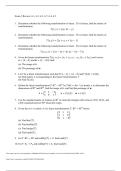
Exam 3 Review: 6.1, 6.2, 6.3, 4.7, 6.4, 6.5
1. Determine whether the following transformation is linear. If it is linear, find the matrix of
transformation.
𝑇(𝑥, 𝑦) = (𝑥𝑦, 3𝑥 − 𝑦)
2. Determine whether the following transformation is linear. If it is linear, find the matrix of
transformation.
𝑇(𝑥, 𝑦) = (2𝑥 + 𝑦, 𝑥 + 3𝑦 − 1)
3. Determine whether the following transformation is linear. If it is linear, find the matrix of
transformation.
𝑇(𝑥, 𝑦, 𝑧) = (2𝑥 − 3𝑦 + 4𝑧, 3𝑥 − 5𝑦 − 7𝑧)
4. Given the linear transformation 𝑇(𝑣1 , 𝑣2 ) = (𝑣1 + 𝑣2 , 𝑣1 − 𝑣2 , 2𝑣1 + 3𝑣2 ) and vectors
𝒗 = (2, −3) and 𝒘 = (1, −3,4) find:
(a) The image of 𝒗.
(b) The preimage of 𝒘.
5. Let T be a linear transformation such that 𝑇(1, −1) = (2, −3) and 𝑇(0,2) = (0,8).
(a) Find matrix A corresponding to the linear transformation T.
(b) Find 𝑇(2,4).
6. Define the linear transformation 𝑇: ℝ𝑛 → ℝ𝑚 by 𝑇(𝒗) = 𝐴𝒗. Use matrix A to determine the
dimensions of ℝ𝑛 and ℝ𝑚 , find the image of 𝒗, and find the preimage of 𝒘.
1 2 −1
𝐴=[ ] 𝒗 = (5,2,2) 𝒘 = (4,2)
1 0 1
7. Use the standard matrix of rotation in ℝ2 to rotate the triangle with vertices (3,5), (5,3), and
(3,0) counterclockwise 90° about the origin.
8. Given the 𝑚 × 𝑛 matrix A of a linear transformation T: ℝ𝑛 → ℝ𝑚 below:
2 1 3
[1 1 0 ]
0 1 −3
(a) Find ker(𝑇).
(b) Find nullity(𝑇).
(c) Find range(𝑇).
(d) Find rank(𝑇).
9. For 𝑇: ℝ5 → ℝ3 and nullity(𝑇) = 2, find rank(𝑇).
10. For 𝑇: 𝑃5 → 𝑃3 and nullity(𝑇) = 4, find rank(𝑇).
This study source was downloaded by 100000901307859 from CourseHero.com on 10-10-2025 06:26:28 GMT -05:00
https://www.coursehero.com/file/251685453/220pr31pdf/
1. Determine whether the following transformation is linear. If it is linear, find the matrix of
transformation.
𝑇(𝑥, 𝑦) = (𝑥𝑦, 3𝑥 − 𝑦)
2. Determine whether the following transformation is linear. If it is linear, find the matrix of
transformation.
𝑇(𝑥, 𝑦) = (2𝑥 + 𝑦, 𝑥 + 3𝑦 − 1)
3. Determine whether the following transformation is linear. If it is linear, find the matrix of
transformation.
𝑇(𝑥, 𝑦, 𝑧) = (2𝑥 − 3𝑦 + 4𝑧, 3𝑥 − 5𝑦 − 7𝑧)
4. Given the linear transformation 𝑇(𝑣1 , 𝑣2 ) = (𝑣1 + 𝑣2 , 𝑣1 − 𝑣2 , 2𝑣1 + 3𝑣2 ) and vectors
𝒗 = (2, −3) and 𝒘 = (1, −3,4) find:
(a) The image of 𝒗.
(b) The preimage of 𝒘.
5. Let T be a linear transformation such that 𝑇(1, −1) = (2, −3) and 𝑇(0,2) = (0,8).
(a) Find matrix A corresponding to the linear transformation T.
(b) Find 𝑇(2,4).
6. Define the linear transformation 𝑇: ℝ𝑛 → ℝ𝑚 by 𝑇(𝒗) = 𝐴𝒗. Use matrix A to determine the
dimensions of ℝ𝑛 and ℝ𝑚 , find the image of 𝒗, and find the preimage of 𝒘.
1 2 −1
𝐴=[ ] 𝒗 = (5,2,2) 𝒘 = (4,2)
1 0 1
7. Use the standard matrix of rotation in ℝ2 to rotate the triangle with vertices (3,5), (5,3), and
(3,0) counterclockwise 90° about the origin.
8. Given the 𝑚 × 𝑛 matrix A of a linear transformation T: ℝ𝑛 → ℝ𝑚 below:
2 1 3
[1 1 0 ]
0 1 −3
(a) Find ker(𝑇).
(b) Find nullity(𝑇).
(c) Find range(𝑇).
(d) Find rank(𝑇).
9. For 𝑇: ℝ5 → ℝ3 and nullity(𝑇) = 2, find rank(𝑇).
10. For 𝑇: 𝑃5 → 𝑃3 and nullity(𝑇) = 4, find rank(𝑇).
This study source was downloaded by 100000901307859 from CourseHero.com on 10-10-2025 06:26:28 GMT -05:00
https://www.coursehero.com/file/251685453/220pr31pdf/