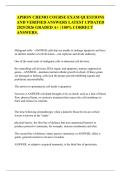
APHON CHEMO COURSE EXAM QUESTIONS
AND VERIFIED ANSWERS LATEST UPDATED
2025/2026 GRADED A+ | 100% CORRECT
ANSWERS.
Malignant cells—ANSWER cells that are unable to undergo apoptosis and have
an infinite number of cell divisions—can replicate and divide endlessly.
One of the main traits of malignant cells is abnormal cell division.
By controlling cell division, DNA repair, and apoptosis, tumour suppression
genes—ANSWER—maintain normal cellular growth in check. If these genes
are damaged or lacking, cells lack the proper growth-inhibiting signals and
proliferate uncontrollably.
The answer to spontaneous cell death is apoptosis.
Necrosis is ANSWER cell death brought on by an insult, such as a lack of blood
flow, physical harm, or cytotoxic treatment that causes the cell membrane to
burst and release its contents.
The time following chemotherapy when a patient's blood levels are at their
lowest is known as the "nadir."
physical barrier: the first line of defence that uses anatomical barriers to
produce protective immunity, for example. mucous membranes and skin
The second line of defense, innate passive immunity, or ANSWER, offers a
quick, general reaction to invasive invaders.
ANSWER, or adaptive acquired immunity, is the third line of protection.
, A tumor marker is a feature or byproduct of a tumor cell that can be used to
determine the origin of the tumor or its activity.
ANSWER's risk stratification approach enables early treatment intensification
by customizing therapy after taking into account variables not included in
previous staging systems.
Pharmacokinetics is the study of how a drug moves through the body and how
the body reacts to the drug that is administered.
Pharmacogenetics is the study of how a person's genetic composition influences
how they react to medication therapy.
The basic objective of surgery, which is frequently used to treat cancer, is to
lessen the tumor burden so that any cancer cells that remain can be more
successfully eliminated by immunotherapy, chemotherapy, or host immunologic
factors.
ANSWER surgical removal of a tumor is known as resection.
Total resection is an ANSWER surgical procedure in which all microscopic and
visible tumor evidence is removed.
Partially resecting a tumor is an ANSWER surgical debulking technique used
when the entire mass cannot be safely or totally removed.
When immunosuppression or myelosuppression would be a dose-limiting
factor, autologous transplants are frequently administered as a "rescue"
following high-dose chemotherapy; there is no danger of GVHD. ANSWER:
The patient is both the donor and the recipient.
Allogenic transplant: ANSWER The donor is healthy and the recipient is related
or closely matched
The source of the syngeneic transplant is an identical twin.
AND VERIFIED ANSWERS LATEST UPDATED
2025/2026 GRADED A+ | 100% CORRECT
ANSWERS.
Malignant cells—ANSWER cells that are unable to undergo apoptosis and have
an infinite number of cell divisions—can replicate and divide endlessly.
One of the main traits of malignant cells is abnormal cell division.
By controlling cell division, DNA repair, and apoptosis, tumour suppression
genes—ANSWER—maintain normal cellular growth in check. If these genes
are damaged or lacking, cells lack the proper growth-inhibiting signals and
proliferate uncontrollably.
The answer to spontaneous cell death is apoptosis.
Necrosis is ANSWER cell death brought on by an insult, such as a lack of blood
flow, physical harm, or cytotoxic treatment that causes the cell membrane to
burst and release its contents.
The time following chemotherapy when a patient's blood levels are at their
lowest is known as the "nadir."
physical barrier: the first line of defence that uses anatomical barriers to
produce protective immunity, for example. mucous membranes and skin
The second line of defense, innate passive immunity, or ANSWER, offers a
quick, general reaction to invasive invaders.
ANSWER, or adaptive acquired immunity, is the third line of protection.
, A tumor marker is a feature or byproduct of a tumor cell that can be used to
determine the origin of the tumor or its activity.
ANSWER's risk stratification approach enables early treatment intensification
by customizing therapy after taking into account variables not included in
previous staging systems.
Pharmacokinetics is the study of how a drug moves through the body and how
the body reacts to the drug that is administered.
Pharmacogenetics is the study of how a person's genetic composition influences
how they react to medication therapy.
The basic objective of surgery, which is frequently used to treat cancer, is to
lessen the tumor burden so that any cancer cells that remain can be more
successfully eliminated by immunotherapy, chemotherapy, or host immunologic
factors.
ANSWER surgical removal of a tumor is known as resection.
Total resection is an ANSWER surgical procedure in which all microscopic and
visible tumor evidence is removed.
Partially resecting a tumor is an ANSWER surgical debulking technique used
when the entire mass cannot be safely or totally removed.
When immunosuppression or myelosuppression would be a dose-limiting
factor, autologous transplants are frequently administered as a "rescue"
following high-dose chemotherapy; there is no danger of GVHD. ANSWER:
The patient is both the donor and the recipient.
Allogenic transplant: ANSWER The donor is healthy and the recipient is related
or closely matched
The source of the syngeneic transplant is an identical twin.