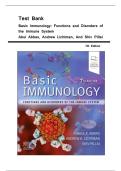
Test Bank
Basic Immunology: Functions and Disorders of
the Immune System
Abul Abbas, Andrew Lichtman, And Shiv Pillai
7th Edition
,TABLE OF CONTENTS
1. Introduction to the Immune System
2. Innate Immunity
3. Antigen Capture and Presentations to Lymphocytes
4. Antigen Recognition in the Adaptive Immune System
5. Cell-Mediated Immune Responses
6. Effector Mechanisms of Cell-Mediated Immunity
7. Humoral Immune Responses
8. Effector Mechanisms of Humoral Immunity
9. Immunologic Tolerance and Autoimmunity
10. Immune Responses Against Tumors and Transplants
11. Hypersensitivity Diseases
12. Congenital and Acquired Immunodeficiencies
,Abbas: Basic Immunology, 7th Edition
Chapter 01: Introduction To The Immune System
Test Bank
MULTIPLE CHOICE
1. The Principal Function Of The Immune System Is:
A. Defense Against Cancer
B. Repair Of Injured Tissues
C. Defense Against Microbial Infections
D. Prevention Of Inflammatory Diseases
E. Protection Against Environmental Toxins
ANS: C
The Immune System Has Evolved In The Setting Of Selective Pressures Imposed By
Microbial Infections. Although Immune Responses To Cancer May Occur, The Concept
That “Immunosurveillance” Against Cancer Is A Principal Function Of The Immune
System Is Controversial. Repair Of Injured Tissues May Be A Secondary Consequence
Of The Immune Responses And Inflammation. Although The Immune System Has
Regulatory Features That Are Needed To Prevent Excessive Inflammation, Prevention
Of Inflammatory Diseases Is Not A Primary Function. The Immune System Can Protect
Against Microbial Toxins, But It Generally Does Not Offer Protection Against Toxins Of
Nonbiologic Origin.
2. Which Of The Following Infectious Diseases Was Prevented By The First
Successful Vaccination?
A. Polio
B. Tuberculosis
C. Smallpox
D. Tetanus
E. Rubella
ANS: C
In 1798, Edward Jenner Reported The First Intentional Successful Vaccination, Which
Was Against Smallpox In A Boy, Using Material From The Cowpox Pustules Of A
Milkmaid. In 1980, Smallpox Was Reported To Be Eradicated Worldwide By A
Vaccination Program.
Effective Vaccines Against Tetanus Toxin, Rubella Virus, And Poliovirus Were
Developed In The 20th Century And Are Widely Used. There Is No Effective Vaccine
Against Mycobacterium Tuberculosis.
3. A Previously Healthy 8-Year-Old Boy Is Infected With An Upper Respiratory Tract
Virus For The First Time. During The First Few Hours Of Infection, Which One Of
The Following Events Occurs?
A. The Adaptive Immune System Responds Rapidly To The Virus And Keeps
The Viral Infection Under Control.
B. The Innate Immune System Responds Rapidly To The Viral Infection And
Keeps The Viral Infection Under Control.
, C. Passive Immunity Mediated By Maternal Antibodies Limits The Spread Of
Infection.
D. B And T Lymphocytes Recognize The Virus And Stimulate The Innate
Immune Response.
E. The Virus Causes Malignant Transformation Of Respiratory Mucosal Epithelial
Cells, And The Malignant Cells Are Recognized By The Adaptive Immune System.
ANS: B
The Innate Immune Response To Microbes Develops Within Hours Of Infection, Well
Before The Adaptive Immune Response. B And T Lymphocytes Are Components Of
The Adaptive Immune Response, And They Would Not Be Able To Respond To A
Newly Encountered Virus Before The Innate Immune Response. An 8-Year-Old Boy
Would No Longer Have Maternal Antibodies From Transplacental Passive Transfer And
Is Unlikely To Be Breast-Feeding, Which Is Another Potential Source Of Maternal
Antibodies. Malignant Transformation Takes Months Or Years To Develop.
4. Which Of The Following Is A Unique Property Of The Adaptive Immune System?
A. Highly Diverse Repertoire Of Specificities For Antigens
B. Self-Nonself Discrimination
C. Recognition Of Microbial Structures By Both Cell-Associated And Soluble
Receptors
D. Protection Against Viral Infections
E. Responses That Have The Same Kinetics And Magnitude On Repeated Exposure
To The Same Microbe
ANS: A
Highly Diverse Repertoires Of Specificities For Antigens Are Found Only In T And B
Lymphocytes, Which Are The Central Cellular Components Of The Adaptive Immune
System. Both The Innate And The Adaptive Immune Systems Use Cell-Associated And
Soluble Receptors To Recognize Microbes, Display Some Degree Of Self-Nonself
Discrimination, And Protec
t Against Viruses. On Repeated Exposure To The Same Microbe, The Adaptive Immune
Response Becomes More Rapid And Of Greater Magnitude; This Is The Manifestation
Of Memory.
5. Antibodies And T Lymphocytes Are The Respective Mediators Of Which Two
Types Of Immunity?
A. Innate And Adaptive
B. Passive And Active
C. Specific And Nonspecific
D. Humoral And Cell-Mediated
E. Adult And Neonatal
ANS: D
Both B And T Lymphocytes Are Principal Components Of Adaptive Immunity. B
Lymphocytes Produce Antibodies, Which Are The Recognition And Effector Molecules
Of Humoral Immune Responses To Extracellular Pathogens. T Cells Recognize And
Promote Eradication Of Intracellular Pathogens In Cell-Mediated Immunity. Passive
And Active Immunity Both Can Be Mediated By Either B Or T Lymphocytes. Specific
Immunity Is Another Term For Adaptive Immunity. Both B And T Lymphocytes
Participate In Adult Adaptive Immunity But Are Still Developing In The Neonatal
Period.
Basic Immunology: Functions and Disorders of
the Immune System
Abul Abbas, Andrew Lichtman, And Shiv Pillai
7th Edition
,TABLE OF CONTENTS
1. Introduction to the Immune System
2. Innate Immunity
3. Antigen Capture and Presentations to Lymphocytes
4. Antigen Recognition in the Adaptive Immune System
5. Cell-Mediated Immune Responses
6. Effector Mechanisms of Cell-Mediated Immunity
7. Humoral Immune Responses
8. Effector Mechanisms of Humoral Immunity
9. Immunologic Tolerance and Autoimmunity
10. Immune Responses Against Tumors and Transplants
11. Hypersensitivity Diseases
12. Congenital and Acquired Immunodeficiencies
,Abbas: Basic Immunology, 7th Edition
Chapter 01: Introduction To The Immune System
Test Bank
MULTIPLE CHOICE
1. The Principal Function Of The Immune System Is:
A. Defense Against Cancer
B. Repair Of Injured Tissues
C. Defense Against Microbial Infections
D. Prevention Of Inflammatory Diseases
E. Protection Against Environmental Toxins
ANS: C
The Immune System Has Evolved In The Setting Of Selective Pressures Imposed By
Microbial Infections. Although Immune Responses To Cancer May Occur, The Concept
That “Immunosurveillance” Against Cancer Is A Principal Function Of The Immune
System Is Controversial. Repair Of Injured Tissues May Be A Secondary Consequence
Of The Immune Responses And Inflammation. Although The Immune System Has
Regulatory Features That Are Needed To Prevent Excessive Inflammation, Prevention
Of Inflammatory Diseases Is Not A Primary Function. The Immune System Can Protect
Against Microbial Toxins, But It Generally Does Not Offer Protection Against Toxins Of
Nonbiologic Origin.
2. Which Of The Following Infectious Diseases Was Prevented By The First
Successful Vaccination?
A. Polio
B. Tuberculosis
C. Smallpox
D. Tetanus
E. Rubella
ANS: C
In 1798, Edward Jenner Reported The First Intentional Successful Vaccination, Which
Was Against Smallpox In A Boy, Using Material From The Cowpox Pustules Of A
Milkmaid. In 1980, Smallpox Was Reported To Be Eradicated Worldwide By A
Vaccination Program.
Effective Vaccines Against Tetanus Toxin, Rubella Virus, And Poliovirus Were
Developed In The 20th Century And Are Widely Used. There Is No Effective Vaccine
Against Mycobacterium Tuberculosis.
3. A Previously Healthy 8-Year-Old Boy Is Infected With An Upper Respiratory Tract
Virus For The First Time. During The First Few Hours Of Infection, Which One Of
The Following Events Occurs?
A. The Adaptive Immune System Responds Rapidly To The Virus And Keeps
The Viral Infection Under Control.
B. The Innate Immune System Responds Rapidly To The Viral Infection And
Keeps The Viral Infection Under Control.
, C. Passive Immunity Mediated By Maternal Antibodies Limits The Spread Of
Infection.
D. B And T Lymphocytes Recognize The Virus And Stimulate The Innate
Immune Response.
E. The Virus Causes Malignant Transformation Of Respiratory Mucosal Epithelial
Cells, And The Malignant Cells Are Recognized By The Adaptive Immune System.
ANS: B
The Innate Immune Response To Microbes Develops Within Hours Of Infection, Well
Before The Adaptive Immune Response. B And T Lymphocytes Are Components Of
The Adaptive Immune Response, And They Would Not Be Able To Respond To A
Newly Encountered Virus Before The Innate Immune Response. An 8-Year-Old Boy
Would No Longer Have Maternal Antibodies From Transplacental Passive Transfer And
Is Unlikely To Be Breast-Feeding, Which Is Another Potential Source Of Maternal
Antibodies. Malignant Transformation Takes Months Or Years To Develop.
4. Which Of The Following Is A Unique Property Of The Adaptive Immune System?
A. Highly Diverse Repertoire Of Specificities For Antigens
B. Self-Nonself Discrimination
C. Recognition Of Microbial Structures By Both Cell-Associated And Soluble
Receptors
D. Protection Against Viral Infections
E. Responses That Have The Same Kinetics And Magnitude On Repeated Exposure
To The Same Microbe
ANS: A
Highly Diverse Repertoires Of Specificities For Antigens Are Found Only In T And B
Lymphocytes, Which Are The Central Cellular Components Of The Adaptive Immune
System. Both The Innate And The Adaptive Immune Systems Use Cell-Associated And
Soluble Receptors To Recognize Microbes, Display Some Degree Of Self-Nonself
Discrimination, And Protec
t Against Viruses. On Repeated Exposure To The Same Microbe, The Adaptive Immune
Response Becomes More Rapid And Of Greater Magnitude; This Is The Manifestation
Of Memory.
5. Antibodies And T Lymphocytes Are The Respective Mediators Of Which Two
Types Of Immunity?
A. Innate And Adaptive
B. Passive And Active
C. Specific And Nonspecific
D. Humoral And Cell-Mediated
E. Adult And Neonatal
ANS: D
Both B And T Lymphocytes Are Principal Components Of Adaptive Immunity. B
Lymphocytes Produce Antibodies, Which Are The Recognition And Effector Molecules
Of Humoral Immune Responses To Extracellular Pathogens. T Cells Recognize And
Promote Eradication Of Intracellular Pathogens In Cell-Mediated Immunity. Passive
And Active Immunity Both Can Be Mediated By Either B Or T Lymphocytes. Specific
Immunity Is Another Term For Adaptive Immunity. Both B And T Lymphocytes
Participate In Adult Adaptive Immunity But Are Still Developing In The Neonatal
Period.