Test Bank
Microbiology: The Human Experience 3e By John W. Foster; Joan L. Slonczewski
Chapter 01: Microbes Shape Our History
MULTIPLE CHOICE
1. Which of the following is NOT considered a benefit of microorganisms?
a. nitrogen fixation c. synthesis of vitamins
b. production of fermented foods d. causative agents of disease
ANS: D DIF: Easy REF: 1.1
OBJ: 1.1a Describe how we define a microbe, and explain why the definition is a challenge.
MSC: Remembering
2. A microbe that is 50 nm in size would most likely be
a. fungi. c. virus.
b. E. coli. d. algae.
ANS: C DIF: Moderate REF: 1.1
OBJ: 1.1b Describe the three major domains of life: Archaea, Bacteaaria, and Eukarya. Explain
what the three domains have in common and how they differ. MSC: Applying
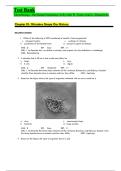
3. Based on the figure shown, the type of organism indicated with an arrow could be a
a. virus. c. macroscopic fungi.
b. bacteria. d. large ameba.
ANS: B DIF: Easy REF: 1.1
OBJ: 1.1b Describe the three major domains of life: Archaea, Bacteria, and Eukarya. Explain what
the three domains have in common and how they differ. MSC: Applying
4. Based on the figure, the type of organism shown is a(n)
, a. virus. c. archaea.
b. bacteria. d. eukaryote.
ANS: D DIF: Moderate REF: 1.1
OBJ: 1.1b Describe the three major domains of life: Archaea, Bacteria, and Eukarya. Explain what
the three domains have in common and how they differ. MSC: Applying
5. Which of the following demonstrates correct scientific notation of a bacterial organism?
a. Staphylococcus Epidermidis c. Staphylococcus epidermidis
b. Staphylococcus epidermidis d. Staphylococcus Epidermidis
ANS: C DIF: Easy REF: 1.1
OBJ: 1.1b Describe the three major domains of life: Archaea, Bacteria, and Eukarya. Explain what
the three domains have in common and how they differ. MSC: Applying
6. Which key characteristic differentiates a prokaryote from a eukaryote?
a. the absence of proteins
b. the presence of DNA
c. the absence of membrane-bound organelles
d. the presence of a cell wall
ANS: C DIF: Easy REF: 1.1
OBJ: 1.1b Describe the three major domains of life: Archaea, Bacteria, and Eukarya. Explain what
the three domains have in common and how they differ. MSC: Remembering
7. Which of the following methods for classifying life forms can best be used to distinguish between two
closely related rod-shaped bacterial organisms, Salmonella typhimurium and Escherichia coli?
a. physical characteristics c. DNA sequence comparison
b. method of reproduction d. environmental habitat
ANS: C DIF: Moderate REF: 1.1
OBJ: 1.1b Describe the three major domains of life: Archaea, Bacteria, and Eukarya. Explain what
the three domains have in common and how they differ. MSC: Applying
8. Which of the following is always classified as a eukaryote?
a. papillomavirus c. Escherichia coli
b. methanogen d. yeast
ANS: D DIF: Moderate REF: 1.1
, OBJ: 1.1b Describe the three major domains of life: Archaea, Bacteria, and Eukarya. Explain what
the three domains have in common and how they differ. MSC: Understanding
9. Which of the following has been used as a tool for gene therapy?
a. viruses c. protozoa
b. archaea d. fungi
ANS: A DIF: Easy REF: 1.1
OBJ: 1.1b Describe the three major domains of life: Archaea, Bacteria, and Eukarya. Explain what
the three domains have in common and how they differ. MSC: Understanding
10. Which of the following would you not expect to find in the human digestive tract?
a. archaea c. bacteria
b. algae d. intestinal viruses
ANS: B DIF: Moderate REF: 1.1
OBJ: 1.1b Describe the three major domains of life: Archaea, Bacteria, and Eukarya. Explain what
the three domains have in common and how they differ. MSC: Understanding
11. Antibiotics are chemotherapeutic drugs that function by inhibiting an important cellular structure or
process of an organism that is causing an infection. Which of the following would not be affected by
an antibiotic that targets cellular metabolic enzymes?
a. Streptococcus pyogenes bacteria c. ameba
b. Herpes virus d. bread mold
ANS: B DIF: Moderate REF: 1.1
OBJ: 1.1c Define viruses, and explain how they relate to living cells. MSC:
Analyzing
12. Which scientist is credited with constructing the first microscope?
a. Antonie van Leeuwenhoek c. Robert Hooke
b. Catherine of Siena d. Louis Pasteur
ANS: C DIF: Easy REF: 1.2
OBJ: 1.2a Explain how microbial diseases have changed human history.
MSC: Remembering
13. Which of the following was an unexpected benefit of the bubonic plague?
a. There was no benefit to the bubonic plague.
b. The population of Europe experienced a baby boom.
c. It resulted in a better understanding of aseptic practices and how to prevent the spread
of infection.
d. The population decline enabled the cultural advancement of the Renaissance.
ANS: D DIF: Easy REF: 1.2
OBJ: 1.2a Explain how microbial diseases have changed human history.
MSC: Understanding
14. Which of the following organisms would you NOT be able to see using Robert Hooke’s microscope?
a. vinegar eels c. mold filaments
b. dust mites d. Mycobacterium tuberculosis
ANS: D DIF: Moderate REF: 1.2
, OBJ: 1.2a Explain how microbial diseases have changed human history.
MSC: Understanding
15. Which of the following is NOT an explanation for the centuries it took between Leeuwenhoek observing
microorganisms with his microscope and the discovery that microbes are capable of causing disease?
a. Microbes are found everywhere.
b. Bacteria appeared similar to sperm and blood cells under the microscope.
c. Microorganisms are capable of existing through spontaneous generation.
d. Diseases were not a problem in the world until long after the discovery of microorganisms.
ANS: D DIF: Moderate REF: 1.2
OBJ: 1.2a Explain how microbial diseases have changed human history.
MSC: Applying
16. If Spallanzani had unknowingly poked a hole in the top of his flask of meat broth, what would this
have implied about the theory of spontaneous generation?
a. No growth would have occurred in the flask, refuting the theory of spontaneous generation.
b. No growth would have occurred in the flask, supporting the theory of spontaneous
generation.
c. Growth would have occurred in the flask, refuting the theory of spontaneous generation.
d. Growth would have occurred in the flask, supporting the theory of spontaneous generation.
ANS: D DIF: Difficult REF: 1.2
OBJ: 1.2b Describe how microbes participate in human cultural practices such as production of food
and drink. MSC: Applying
17. What would John Tyndall have needed to use to disprove the theory of spontaneous generation with
his experiments?
a. a swan-neck flask c. an autoclave
b. a microscope d. organic media
ANS: C DIF: Moderate REF: 1.2
OBJ: 1.2b Describe how microbes participate in human cultural practices such as production of food
and drink. MSC: Applying
18. Which of the following theories was the Miller experiment designed to test?
a. the endosymbiotic origin of life
b. the idea that all the chemicals found in early Earth could have come together to form the
basic components of cellular life
c. spontaneous generation
d. the RNA world hypothesis
ANS: B DIF: Moderate REF: 1.2
OBJ: 1.2a Explain how microbial diseases have changed human history.
MSC: Understanding
19. Why did fewer soldiers die from infectious disease during the Crimean War in the winter months?
a. Pathogens do not multiply as quickly in colder temperatures.
b. Pathogens do not multiply as quickly in wet environments.
c. Soldiers have fewer close interactions with other individuals during the winter months.
d. Chemical agents used to treat and prevent infections do not function effectively in warmer
temperatures.
Microbiology: The Human Experience 3e By John W. Foster; Joan L. Slonczewski
Chapter 01: Microbes Shape Our History
MULTIPLE CHOICE
1. Which of the following is NOT considered a benefit of microorganisms?
a. nitrogen fixation c. synthesis of vitamins
b. production of fermented foods d. causative agents of disease
ANS: D DIF: Easy REF: 1.1
OBJ: 1.1a Describe how we define a microbe, and explain why the definition is a challenge.
MSC: Remembering
2. A microbe that is 50 nm in size would most likely be
a. fungi. c. virus.
b. E. coli. d. algae.
ANS: C DIF: Moderate REF: 1.1
OBJ: 1.1b Describe the three major domains of life: Archaea, Bacteaaria, and Eukarya. Explain
what the three domains have in common and how they differ. MSC: Applying
3. Based on the figure shown, the type of organism indicated with an arrow could be a
a. virus. c. macroscopic fungi.
b. bacteria. d. large ameba.
ANS: B DIF: Easy REF: 1.1
OBJ: 1.1b Describe the three major domains of life: Archaea, Bacteria, and Eukarya. Explain what
the three domains have in common and how they differ. MSC: Applying
4. Based on the figure, the type of organism shown is a(n)
, a. virus. c. archaea.
b. bacteria. d. eukaryote.
ANS: D DIF: Moderate REF: 1.1
OBJ: 1.1b Describe the three major domains of life: Archaea, Bacteria, and Eukarya. Explain what
the three domains have in common and how they differ. MSC: Applying
5. Which of the following demonstrates correct scientific notation of a bacterial organism?
a. Staphylococcus Epidermidis c. Staphylococcus epidermidis
b. Staphylococcus epidermidis d. Staphylococcus Epidermidis
ANS: C DIF: Easy REF: 1.1
OBJ: 1.1b Describe the three major domains of life: Archaea, Bacteria, and Eukarya. Explain what
the three domains have in common and how they differ. MSC: Applying
6. Which key characteristic differentiates a prokaryote from a eukaryote?
a. the absence of proteins
b. the presence of DNA
c. the absence of membrane-bound organelles
d. the presence of a cell wall
ANS: C DIF: Easy REF: 1.1
OBJ: 1.1b Describe the three major domains of life: Archaea, Bacteria, and Eukarya. Explain what
the three domains have in common and how they differ. MSC: Remembering
7. Which of the following methods for classifying life forms can best be used to distinguish between two
closely related rod-shaped bacterial organisms, Salmonella typhimurium and Escherichia coli?
a. physical characteristics c. DNA sequence comparison
b. method of reproduction d. environmental habitat
ANS: C DIF: Moderate REF: 1.1
OBJ: 1.1b Describe the three major domains of life: Archaea, Bacteria, and Eukarya. Explain what
the three domains have in common and how they differ. MSC: Applying
8. Which of the following is always classified as a eukaryote?
a. papillomavirus c. Escherichia coli
b. methanogen d. yeast
ANS: D DIF: Moderate REF: 1.1
, OBJ: 1.1b Describe the three major domains of life: Archaea, Bacteria, and Eukarya. Explain what
the three domains have in common and how they differ. MSC: Understanding
9. Which of the following has been used as a tool for gene therapy?
a. viruses c. protozoa
b. archaea d. fungi
ANS: A DIF: Easy REF: 1.1
OBJ: 1.1b Describe the three major domains of life: Archaea, Bacteria, and Eukarya. Explain what
the three domains have in common and how they differ. MSC: Understanding
10. Which of the following would you not expect to find in the human digestive tract?
a. archaea c. bacteria
b. algae d. intestinal viruses
ANS: B DIF: Moderate REF: 1.1
OBJ: 1.1b Describe the three major domains of life: Archaea, Bacteria, and Eukarya. Explain what
the three domains have in common and how they differ. MSC: Understanding
11. Antibiotics are chemotherapeutic drugs that function by inhibiting an important cellular structure or
process of an organism that is causing an infection. Which of the following would not be affected by
an antibiotic that targets cellular metabolic enzymes?
a. Streptococcus pyogenes bacteria c. ameba
b. Herpes virus d. bread mold
ANS: B DIF: Moderate REF: 1.1
OBJ: 1.1c Define viruses, and explain how they relate to living cells. MSC:
Analyzing
12. Which scientist is credited with constructing the first microscope?
a. Antonie van Leeuwenhoek c. Robert Hooke
b. Catherine of Siena d. Louis Pasteur
ANS: C DIF: Easy REF: 1.2
OBJ: 1.2a Explain how microbial diseases have changed human history.
MSC: Remembering
13. Which of the following was an unexpected benefit of the bubonic plague?
a. There was no benefit to the bubonic plague.
b. The population of Europe experienced a baby boom.
c. It resulted in a better understanding of aseptic practices and how to prevent the spread
of infection.
d. The population decline enabled the cultural advancement of the Renaissance.
ANS: D DIF: Easy REF: 1.2
OBJ: 1.2a Explain how microbial diseases have changed human history.
MSC: Understanding
14. Which of the following organisms would you NOT be able to see using Robert Hooke’s microscope?
a. vinegar eels c. mold filaments
b. dust mites d. Mycobacterium tuberculosis
ANS: D DIF: Moderate REF: 1.2
, OBJ: 1.2a Explain how microbial diseases have changed human history.
MSC: Understanding
15. Which of the following is NOT an explanation for the centuries it took between Leeuwenhoek observing
microorganisms with his microscope and the discovery that microbes are capable of causing disease?
a. Microbes are found everywhere.
b. Bacteria appeared similar to sperm and blood cells under the microscope.
c. Microorganisms are capable of existing through spontaneous generation.
d. Diseases were not a problem in the world until long after the discovery of microorganisms.
ANS: D DIF: Moderate REF: 1.2
OBJ: 1.2a Explain how microbial diseases have changed human history.
MSC: Applying
16. If Spallanzani had unknowingly poked a hole in the top of his flask of meat broth, what would this
have implied about the theory of spontaneous generation?
a. No growth would have occurred in the flask, refuting the theory of spontaneous generation.
b. No growth would have occurred in the flask, supporting the theory of spontaneous
generation.
c. Growth would have occurred in the flask, refuting the theory of spontaneous generation.
d. Growth would have occurred in the flask, supporting the theory of spontaneous generation.
ANS: D DIF: Difficult REF: 1.2
OBJ: 1.2b Describe how microbes participate in human cultural practices such as production of food
and drink. MSC: Applying
17. What would John Tyndall have needed to use to disprove the theory of spontaneous generation with
his experiments?
a. a swan-neck flask c. an autoclave
b. a microscope d. organic media
ANS: C DIF: Moderate REF: 1.2
OBJ: 1.2b Describe how microbes participate in human cultural practices such as production of food
and drink. MSC: Applying
18. Which of the following theories was the Miller experiment designed to test?
a. the endosymbiotic origin of life
b. the idea that all the chemicals found in early Earth could have come together to form the
basic components of cellular life
c. spontaneous generation
d. the RNA world hypothesis
ANS: B DIF: Moderate REF: 1.2
OBJ: 1.2a Explain how microbial diseases have changed human history.
MSC: Understanding
19. Why did fewer soldiers die from infectious disease during the Crimean War in the winter months?
a. Pathogens do not multiply as quickly in colder temperatures.
b. Pathogens do not multiply as quickly in wet environments.
c. Soldiers have fewer close interactions with other individuals during the winter months.
d. Chemical agents used to treat and prevent infections do not function effectively in warmer
temperatures.