📘 Chapter 1: Introduction to Project
Management
1.1 Overview
This opening chapter introduces the foundation of project management (PM) — what projects
are, why they matter, and how structured management practices improve success rates.
It also introduces the Project Management Institute (PMI), PMBOK Guide, and the roles and
responsibilities of a project manager in a modern organization.
1.2 What Is a Project?
Definition (PMI):
A project is a temporary endeavor undertaken to create a unique product, service, or result.
Key Characteristics:
● Temporary: has a definite start and end date.
● Unique: delivers a specific outcome, not routine work.
● Progressive Elaboration: evolves in steps, refined as details emerge.
● Purpose-driven: aimed at achieving defined objectives within constraints of scope, time,
and budget.
Examples:
● Developing a new app or software product.
● Constructing a building.
● Organizing a conference or marketing campaign.
● Implementing a new HR system.
,1.3 Projects vs. Operations
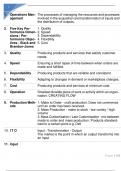
Aspect Projects Operations
Duration Temporary Ongoing
Objective Create unique result Maintain steady state
Change Drives change Supports stability
Example Launching a new Maintaining existing IT
website systems
Projects often lead to or modify operations. After project completion, deliverables transition into
operational use.
1.4 What Is Project Management?
Definition (PMBOK 7th Edition):
Project management is the application of knowledge, skills, tools, and techniques to project
activities to meet project requirements.
Key Components:
● Knowledge Areas: Scope, Time, Cost, Quality, HR, Communication, Risk,
Procurement, Integration, and Stakeholder Management.
● Triple Constraint: balancing Scope, Time, and Cost — adjusting one affects the
others.
● Extended Constraints: now includes Quality, Resources, and Risk.
1.5 The Importance of Project Management
Effective PM improves:
● Efficiency: structured process ensures timely and cost-effective results.
● Customer satisfaction: clear goals and deliverables meet expectations.
● Strategic alignment: projects support business objectives.
● Risk control: early identification and mitigation.
, ● Communication: organized stakeholder interaction.
💡 “Project management turns vision into reality through disciplined execution.”
1.6 Project Management Framework
Projects operate within a framework that includes:
1. Project Life Cycle
2. Project Management Process Groups
3. Knowledge Areas
1.6.1 Project Life Cycle
Phases typically include:
1. Initiating – define purpose, create charter, identify stakeholders.
2. Planning – establish scope, schedule, cost, and risks.
3. Executing – perform work to meet specifications.
4. Monitoring & Controlling – track progress, manage changes.
5. Closing – finalize all activities, hand off deliverables.
Each phase ends with a review or gate before moving to the next.
, 1.6.2 Process Groups
The five process groups (as per PMBOK) apply to all projects:
Group Description Key Outputs
Initiating Authorize the project Project charter
Planning Define course of action Project plan, scope
statement
Executing Carry out plan Deliverables
Monitoring & Controlling Track progress and Status reports, change logs
adjust
Closing Complete formally Lessons learned, sign-off
1.6.3 Knowledge Areas
Each process group involves specific knowledge areas (10 total):
1. Integration
2. Scope
3. Schedule
4. Cost
5. Quality
6. Resource
7. Communications
8. Risk
9. Procurement
10.Stakeholder
These represent what a project manager must manage.
Management
1.1 Overview
This opening chapter introduces the foundation of project management (PM) — what projects
are, why they matter, and how structured management practices improve success rates.
It also introduces the Project Management Institute (PMI), PMBOK Guide, and the roles and
responsibilities of a project manager in a modern organization.
1.2 What Is a Project?
Definition (PMI):
A project is a temporary endeavor undertaken to create a unique product, service, or result.
Key Characteristics:
● Temporary: has a definite start and end date.
● Unique: delivers a specific outcome, not routine work.
● Progressive Elaboration: evolves in steps, refined as details emerge.
● Purpose-driven: aimed at achieving defined objectives within constraints of scope, time,
and budget.
Examples:
● Developing a new app or software product.
● Constructing a building.
● Organizing a conference or marketing campaign.
● Implementing a new HR system.
,1.3 Projects vs. Operations
Aspect Projects Operations
Duration Temporary Ongoing
Objective Create unique result Maintain steady state
Change Drives change Supports stability
Example Launching a new Maintaining existing IT
website systems
Projects often lead to or modify operations. After project completion, deliverables transition into
operational use.
1.4 What Is Project Management?
Definition (PMBOK 7th Edition):
Project management is the application of knowledge, skills, tools, and techniques to project
activities to meet project requirements.
Key Components:
● Knowledge Areas: Scope, Time, Cost, Quality, HR, Communication, Risk,
Procurement, Integration, and Stakeholder Management.
● Triple Constraint: balancing Scope, Time, and Cost — adjusting one affects the
others.
● Extended Constraints: now includes Quality, Resources, and Risk.
1.5 The Importance of Project Management
Effective PM improves:
● Efficiency: structured process ensures timely and cost-effective results.
● Customer satisfaction: clear goals and deliverables meet expectations.
● Strategic alignment: projects support business objectives.
● Risk control: early identification and mitigation.
, ● Communication: organized stakeholder interaction.
💡 “Project management turns vision into reality through disciplined execution.”
1.6 Project Management Framework
Projects operate within a framework that includes:
1. Project Life Cycle
2. Project Management Process Groups
3. Knowledge Areas
1.6.1 Project Life Cycle
Phases typically include:
1. Initiating – define purpose, create charter, identify stakeholders.
2. Planning – establish scope, schedule, cost, and risks.
3. Executing – perform work to meet specifications.
4. Monitoring & Controlling – track progress, manage changes.
5. Closing – finalize all activities, hand off deliverables.
Each phase ends with a review or gate before moving to the next.
, 1.6.2 Process Groups
The five process groups (as per PMBOK) apply to all projects:
Group Description Key Outputs
Initiating Authorize the project Project charter
Planning Define course of action Project plan, scope
statement
Executing Carry out plan Deliverables
Monitoring & Controlling Track progress and Status reports, change logs
adjust
Closing Complete formally Lessons learned, sign-off
1.6.3 Knowledge Areas
Each process group involves specific knowledge areas (10 total):
1. Integration
2. Scope
3. Schedule
4. Cost
5. Quality
6. Resource
7. Communications
8. Risk
9. Procurement
10.Stakeholder
These represent what a project manager must manage.