Business-Level Strategy Papers
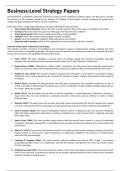
This document is a centralized, structured repository for notes on every compulsory academic paper in the BLS course. Crucially,
the structure of this repository should not be arbitrary. The syllabus of BLS provide a precise framework for analyzing the
assigned readings, breaking them down into key components.
Each entry in the is a single page dedicated to one paper, following this exact structure:
Topic & Expected Contribution: What is the main research question? What is the paper's contribution to the field?
Framing: Which theory does the paper use? What gap in the literature does it address?
Theory Development: What are the hypotheses and how are they justified?
Methods: What is the empirical design (sample, method, variables)?
Results: Were the hypotheses validated? What explanations are provided?
Discussion and Conclusions: What are the implications for theory, practice, and future research?
Overview of Key Papers in Business-Level Strategy
This collection provides summaries of foundational and contemporary papers in business-level strategy, exploring how firms
achieve and sustain a competitive advantage. The papers cover the spectrum from industry structure and competitive dynamics
to the internal resources and capabilities that drive performance.
0. Porter (1991): This paper establishes a dynamic theory of strategy, arguing that sustained competitive advantage
originates from the unique pressures and opportunities within a firm's local "diamond" environment.
1. Boyd & Bresser (2008): Challenging the "faster is better" assumption, this study shows that a responder's performance
follows an inverted U-shape, where moderately timed responses are optimal, while any delay benefits the first-mover.
2. Nadkarni & Chen (2016): This research introduces executive time orientation as a key driver of competitive strategy,
finding that a firm's success depends on the "temporal fit" between its leaders' cognitive time horizons and the speed of
its industry.
3. Sirmon (2010): Expanding the Resource-Based View, this paper demonstrates that capability weaknesses are just as
critical as strengths in determining firm performance and that a combination of high strengths and high weaknesses can
be a viable, albeit risky, strategy.
4. Schilke (2014): This study finds that the value of dynamic capabilities is context-dependent, following an inverted U-
shape where they are most beneficial in moderately dynamic environments and less effective in stable or highly
turbulent ones.
5. Flammer (2013): This paper shows that investors financially reward environmental CSR, but this valuation has changed
over time, with punishments for irresponsible acts intensifying while rewards for positive initiatives have diminished.
6. Hawn & Ioannou (2016): This research distinguishes between internal ("walking the talk") and external ("talking the
talk") CSR actions, finding that while both are valuable, a misalignment or "gap" between them is negatively associated
with market value.
7. Hatch & Dyer (2004): This study provides strong evidence that firm-specific human capital is a source of sustainable
competitive advantage, showing that it is inimitable because poaching experienced employees from rivals actually hurts
performance.
8. Riley et al. (2017): This research demonstrates that firms can profit even from general employee training, and that the
financial returns on these human capital investments are significantly amplified by the presence of complementary
assets like R&D and advertising.
9. Cassiman & Veugelers (2006): This paper provides rigorous evidence that internal R&D ("make") and external
knowledge acquisition ("buy") are complements, and that this synergy is strongest for firms that rely on basic science
for their innovation.
10. Klingebiel & Joseph (2016): This study resolves the debate on first-mover advantage by showing that both early and late
entry can be successful, as performance depends on the strategic alignment between a firm's timing and its innovation
portfolio's breadth and selectiveness.
, Overall Summary
The Strategic Quest for Competitive Advantage
The pursuit of a sustainable competitive advantage is a dynamic journey that requires a firm to master both the external
competitive landscape and its own internal engine of value creation. The papers in business-level strategy collectively tell a story
of how this is achieved, moving from understanding the environment to building and deploying unique capabilities.
Navigating the Competitive Arena
A firm’s journey begins in its competitive environment, where advantage is forged. The nature of this environment—from the
sophistication of local customers to the intensity of rivalry—shapes a firm's capacity for innovation and upgrading from the very
start (Porter, 1991). Within this arena, success is not merely a race for speed but a contest of calculated timing and strategic fit.
Responding to rivals is a nuanced art. The fastest response is not always the best; a measured, intermediate delay often yields
the highest performance by avoiding the risks of both premature and late action (Boyd & Bresser, 2008).
Similarly, innovation timing isn't a simple race to be first; success comes from aligning the timing of entry—either early or late—
with the corresponding innovation strategy of breadth or selectiveness (Klingebiel & Joseph, 2016).
Ultimately, a firm’s actions are a reflection of its leaders, and success depends on a “temporal fit” between a CEO's time horizon
and the industry's speed (Nadkarni & Chen, 2016).
Forging the Internal Engine of Value
While the environment sets the stage, the resource-based view (RBV) shows that sustainable advantage is built from unique,
internal capabilities. Human capital and innovation stand out as critical pillars.
Human capital is a deeply valuable and inimitable resource when cultivated correctly. Firm-specific human capital, built through
careful selection, training, and deployment, is a powerful and inimitable resource; trying to buy it by poaching from rivals is an
ineffective strategy that hurts performance (Hatch & Dyer, 2004). Even investments in general training create market value,
especially when amplified by complementary assets like R&D and advertising (Riley et al., 2017).
Innovation capabilities must be managed as a synergistic system. Internal R&D ("make") is not a substitute for external
knowledge acquisition ("buy"); rather, it builds the crucial "absorptive capacity" needed to effectively integrate external ideas,
making them powerful complements (Cassiman & Veugelers, 2006).
The nature of capabilities is complex and context dependent. The value of dynamic capabilities is not absolute but follows an
inverted U-shape, peaking in moderately dynamic environments (Schilke, 2014). Furthermore, a complete view requires looking
at both sides of the coin; managing capability weaknesses is just as critical as building strengths (Sirmon, 2010).
Deploying and Protecting Advantage
Finally, a firm must leverage its capabilities in the marketplace and manage its relationship with key stakeholders to protect and
enhance its value. Corporate Social Responsibility (CSR) serves as a prime example of building such intangible, strategic assets.
Investors recognize environmental CSR as a valuable asset, and their scrutiny has intensified over time, with financial
punishments for irresponsibility growing more severe (Flammer, 2013).
To capture this value, firms must ensure alignment between their internal actions ("walking the talk") and external
communications ("talking the talk"), as a gap between the two can destroy market value (Hawn & Ioannou, 2016).
In conclusion, the path to sustained competitive advantage requires a holistic approach, integrating external awareness with the
careful cultivation and deployment of internal resources and stakeholder relationships.
This document is a centralized, structured repository for notes on every compulsory academic paper in the BLS course. Crucially,
the structure of this repository should not be arbitrary. The syllabus of BLS provide a precise framework for analyzing the
assigned readings, breaking them down into key components.
Each entry in the is a single page dedicated to one paper, following this exact structure:
Topic & Expected Contribution: What is the main research question? What is the paper's contribution to the field?
Framing: Which theory does the paper use? What gap in the literature does it address?
Theory Development: What are the hypotheses and how are they justified?
Methods: What is the empirical design (sample, method, variables)?
Results: Were the hypotheses validated? What explanations are provided?
Discussion and Conclusions: What are the implications for theory, practice, and future research?
Overview of Key Papers in Business-Level Strategy
This collection provides summaries of foundational and contemporary papers in business-level strategy, exploring how firms
achieve and sustain a competitive advantage. The papers cover the spectrum from industry structure and competitive dynamics
to the internal resources and capabilities that drive performance.
0. Porter (1991): This paper establishes a dynamic theory of strategy, arguing that sustained competitive advantage
originates from the unique pressures and opportunities within a firm's local "diamond" environment.
1. Boyd & Bresser (2008): Challenging the "faster is better" assumption, this study shows that a responder's performance
follows an inverted U-shape, where moderately timed responses are optimal, while any delay benefits the first-mover.
2. Nadkarni & Chen (2016): This research introduces executive time orientation as a key driver of competitive strategy,
finding that a firm's success depends on the "temporal fit" between its leaders' cognitive time horizons and the speed of
its industry.
3. Sirmon (2010): Expanding the Resource-Based View, this paper demonstrates that capability weaknesses are just as
critical as strengths in determining firm performance and that a combination of high strengths and high weaknesses can
be a viable, albeit risky, strategy.
4. Schilke (2014): This study finds that the value of dynamic capabilities is context-dependent, following an inverted U-
shape where they are most beneficial in moderately dynamic environments and less effective in stable or highly
turbulent ones.
5. Flammer (2013): This paper shows that investors financially reward environmental CSR, but this valuation has changed
over time, with punishments for irresponsible acts intensifying while rewards for positive initiatives have diminished.
6. Hawn & Ioannou (2016): This research distinguishes between internal ("walking the talk") and external ("talking the
talk") CSR actions, finding that while both are valuable, a misalignment or "gap" between them is negatively associated
with market value.
7. Hatch & Dyer (2004): This study provides strong evidence that firm-specific human capital is a source of sustainable
competitive advantage, showing that it is inimitable because poaching experienced employees from rivals actually hurts
performance.
8. Riley et al. (2017): This research demonstrates that firms can profit even from general employee training, and that the
financial returns on these human capital investments are significantly amplified by the presence of complementary
assets like R&D and advertising.
9. Cassiman & Veugelers (2006): This paper provides rigorous evidence that internal R&D ("make") and external
knowledge acquisition ("buy") are complements, and that this synergy is strongest for firms that rely on basic science
for their innovation.
10. Klingebiel & Joseph (2016): This study resolves the debate on first-mover advantage by showing that both early and late
entry can be successful, as performance depends on the strategic alignment between a firm's timing and its innovation
portfolio's breadth and selectiveness.
, Overall Summary
The Strategic Quest for Competitive Advantage
The pursuit of a sustainable competitive advantage is a dynamic journey that requires a firm to master both the external
competitive landscape and its own internal engine of value creation. The papers in business-level strategy collectively tell a story
of how this is achieved, moving from understanding the environment to building and deploying unique capabilities.
Navigating the Competitive Arena
A firm’s journey begins in its competitive environment, where advantage is forged. The nature of this environment—from the
sophistication of local customers to the intensity of rivalry—shapes a firm's capacity for innovation and upgrading from the very
start (Porter, 1991). Within this arena, success is not merely a race for speed but a contest of calculated timing and strategic fit.
Responding to rivals is a nuanced art. The fastest response is not always the best; a measured, intermediate delay often yields
the highest performance by avoiding the risks of both premature and late action (Boyd & Bresser, 2008).
Similarly, innovation timing isn't a simple race to be first; success comes from aligning the timing of entry—either early or late—
with the corresponding innovation strategy of breadth or selectiveness (Klingebiel & Joseph, 2016).
Ultimately, a firm’s actions are a reflection of its leaders, and success depends on a “temporal fit” between a CEO's time horizon
and the industry's speed (Nadkarni & Chen, 2016).
Forging the Internal Engine of Value
While the environment sets the stage, the resource-based view (RBV) shows that sustainable advantage is built from unique,
internal capabilities. Human capital and innovation stand out as critical pillars.
Human capital is a deeply valuable and inimitable resource when cultivated correctly. Firm-specific human capital, built through
careful selection, training, and deployment, is a powerful and inimitable resource; trying to buy it by poaching from rivals is an
ineffective strategy that hurts performance (Hatch & Dyer, 2004). Even investments in general training create market value,
especially when amplified by complementary assets like R&D and advertising (Riley et al., 2017).
Innovation capabilities must be managed as a synergistic system. Internal R&D ("make") is not a substitute for external
knowledge acquisition ("buy"); rather, it builds the crucial "absorptive capacity" needed to effectively integrate external ideas,
making them powerful complements (Cassiman & Veugelers, 2006).
The nature of capabilities is complex and context dependent. The value of dynamic capabilities is not absolute but follows an
inverted U-shape, peaking in moderately dynamic environments (Schilke, 2014). Furthermore, a complete view requires looking
at both sides of the coin; managing capability weaknesses is just as critical as building strengths (Sirmon, 2010).
Deploying and Protecting Advantage
Finally, a firm must leverage its capabilities in the marketplace and manage its relationship with key stakeholders to protect and
enhance its value. Corporate Social Responsibility (CSR) serves as a prime example of building such intangible, strategic assets.
Investors recognize environmental CSR as a valuable asset, and their scrutiny has intensified over time, with financial
punishments for irresponsibility growing more severe (Flammer, 2013).
To capture this value, firms must ensure alignment between their internal actions ("walking the talk") and external
communications ("talking the talk"), as a gap between the two can destroy market value (Hawn & Ioannou, 2016).
In conclusion, the path to sustained competitive advantage requires a holistic approach, integrating external awareness with the
careful cultivation and deployment of internal resources and stakeholder relationships.