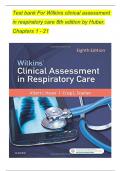
Test Bank for Wilkins' Clinical Assessment in Respiratory Care 7th Edition
Test Bank for Wilkins' Clinical Assessment in Respiratory Care 7th Edition
,Test Bank for Wilkins' Clinical Assessment in Respiratory Care 7th Edition
Wilkins’ Clinical Assessment in Respiratory Care 7th
Edition Heuer Test Bank
Chapter 1: Preparing for the Patient Encounter
Test Bank
MULTIPLE CHOICE
1. Which of the following activities is not part of the role of respiratory therapists (RTs) in
patient assessment?
a. Assist the physician with diagnostic reasoning skills.
b. Help the physician select appropriate pulmonary function tests.
c. Interpret arterial blood gas values and suggest mechanical ventilation changes.
d. Document the patient diagnosis in the patient’s chart.
ANS: D
RTs are not qualified to make an official diagnosis. This is the role of the attending physician.
REF: Table 1-1, pg. 4 OBJ: 9
2. In which of the following stages of patient–clinician interaction is the review of physician
orders carried out?
a. Treatment stage
b. Introductory stage
c. Preinteraction stage
d. Initial assessment stage
ANS: C
Physician orders should be reviewed in the patient’s chart before the physician sees the
patient.
REF: Table 1-1, pg. 4 OBJ: 9
3. In which stage of patient–clinician interaction is the patient identification bracelet checked?
a. Introductory stage
b. Preinteraction stage
c. Initial assessment stage
d. Treatment stage
ANS: A
The patient ID bracelet must be checked before moving forward with assessment and
treatment.
REF: Table 1-1, pg. 4 OBJ: 9
4. What should be done just before the patient’s ID bracelet is checked?
a. Check the patient’s SpO2.
b. Ask the patient for permission.
c. Check the chart for vital signs.
d. Listen to breath sounds.
ANS: B
Test Bank for Wilkins' Clinical Assessment in Respiratory Care 7th Edition
,Test Bank for Wilkins' Clinical Assessment in Respiratory Care 7th Edition
It is considered polite to ask the patient for permission before touching and reading his or her
ID bracelet.
Test Bank for Wilkins' Clinical Assessment in Respiratory Care 7th Edition
, Test Bank for Wilkins' Clinical Assessment in Respiratory Care 7th Edition
REF: pg. 3 OBJ: 3 | 5
5. What is the goal of the introductory phase?
a. Assess the patient’s apparent age.
b. Identify the patient’s family history.
c. Determine the patient’s diagnosis.
d. Establish a rapport with the patient.
ANS: D
The introductory phase is all about getting to know the patient and establishing a rapport with
him or her.
REF: Table 1-1, pg. 4 OBJ: 3
6. Which of the following behaviors is not consistent with resistive behavior of a patient?
a. Crossed arms
b. Minimal eye contact
c. Brief answers to questions
d. Asking the purpose of the treatment
ANS: D
If a patient asks about the purpose of the treatment you are about to give, this generally
indicates that he or she is not upset.
REF: Table 1-1, pg. 4 OBJ: 3
7. What is the main purpose oTfEthSeTin
BiA
tiaNl K
asSseEsLLeEnRt s.taCgOe?M
sm
a. To identify any allergies to medications
b. To document the patient’s smoking history
c. To personally get to know the patient better
d. To verify that the prescribed treatment is still needed and appropriate
ANS: D
When you first see the patient, you are encouraged to perform a brief assessment to make sure
the treatment order by the physician is still appropriate. The patient’s status may have changed
abruptly recently.
REF: Table 1-1, pg. 4 OBJ: 3
8. What is the appropriate distance for the social space from the patient?
a. 3 to 5 feet
b. 4 to 12 feet
c. 6 to 18 feet
d. 8 to 20 feet
ANS: B
The social space is 4 to 12 feet.
REF: pg. 5 OBJ: 5
9. What is the appropriate distance for the personal space?
Test Bank for Wilkins' Clinical Assessment in Respiratory Care 7th Edition
Test Bank for Wilkins' Clinical Assessment in Respiratory Care 7th Edition
,Test Bank for Wilkins' Clinical Assessment in Respiratory Care 7th Edition
Wilkins’ Clinical Assessment in Respiratory Care 7th
Edition Heuer Test Bank
Chapter 1: Preparing for the Patient Encounter
Test Bank
MULTIPLE CHOICE
1. Which of the following activities is not part of the role of respiratory therapists (RTs) in
patient assessment?
a. Assist the physician with diagnostic reasoning skills.
b. Help the physician select appropriate pulmonary function tests.
c. Interpret arterial blood gas values and suggest mechanical ventilation changes.
d. Document the patient diagnosis in the patient’s chart.
ANS: D
RTs are not qualified to make an official diagnosis. This is the role of the attending physician.
REF: Table 1-1, pg. 4 OBJ: 9
2. In which of the following stages of patient–clinician interaction is the review of physician
orders carried out?
a. Treatment stage
b. Introductory stage
c. Preinteraction stage
d. Initial assessment stage
ANS: C
Physician orders should be reviewed in the patient’s chart before the physician sees the
patient.
REF: Table 1-1, pg. 4 OBJ: 9
3. In which stage of patient–clinician interaction is the patient identification bracelet checked?
a. Introductory stage
b. Preinteraction stage
c. Initial assessment stage
d. Treatment stage
ANS: A
The patient ID bracelet must be checked before moving forward with assessment and
treatment.
REF: Table 1-1, pg. 4 OBJ: 9
4. What should be done just before the patient’s ID bracelet is checked?
a. Check the patient’s SpO2.
b. Ask the patient for permission.
c. Check the chart for vital signs.
d. Listen to breath sounds.
ANS: B
Test Bank for Wilkins' Clinical Assessment in Respiratory Care 7th Edition
,Test Bank for Wilkins' Clinical Assessment in Respiratory Care 7th Edition
It is considered polite to ask the patient for permission before touching and reading his or her
ID bracelet.
Test Bank for Wilkins' Clinical Assessment in Respiratory Care 7th Edition
, Test Bank for Wilkins' Clinical Assessment in Respiratory Care 7th Edition
REF: pg. 3 OBJ: 3 | 5
5. What is the goal of the introductory phase?
a. Assess the patient’s apparent age.
b. Identify the patient’s family history.
c. Determine the patient’s diagnosis.
d. Establish a rapport with the patient.
ANS: D
The introductory phase is all about getting to know the patient and establishing a rapport with
him or her.
REF: Table 1-1, pg. 4 OBJ: 3
6. Which of the following behaviors is not consistent with resistive behavior of a patient?
a. Crossed arms
b. Minimal eye contact
c. Brief answers to questions
d. Asking the purpose of the treatment
ANS: D
If a patient asks about the purpose of the treatment you are about to give, this generally
indicates that he or she is not upset.
REF: Table 1-1, pg. 4 OBJ: 3
7. What is the main purpose oTfEthSeTin
BiA
tiaNl K
asSseEsLLeEnRt s.taCgOe?M
sm
a. To identify any allergies to medications
b. To document the patient’s smoking history
c. To personally get to know the patient better
d. To verify that the prescribed treatment is still needed and appropriate
ANS: D
When you first see the patient, you are encouraged to perform a brief assessment to make sure
the treatment order by the physician is still appropriate. The patient’s status may have changed
abruptly recently.
REF: Table 1-1, pg. 4 OBJ: 3
8. What is the appropriate distance for the social space from the patient?
a. 3 to 5 feet
b. 4 to 12 feet
c. 6 to 18 feet
d. 8 to 20 feet
ANS: B
The social space is 4 to 12 feet.
REF: pg. 5 OBJ: 5
9. What is the appropriate distance for the personal space?
Test Bank for Wilkins' Clinical Assessment in Respiratory Care 7th Edition