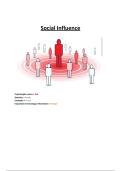
Social Influence
sychologist names =Red
P
Statistics =Purple
Examples =Green
Important terminology/ information =Orange
,Social Influence
Discuss explanations of conformity (16)
Discuss factors that can affect conformity. Refer to variations of Asch’s experiment in your answer. (16)
Outline and evaluate research into conformity to social roles, with reference to Zimbardo. (16)
Discuss research into obedience as investigated by Milgram (situational variables) (16)
Discuss agentic state and legitimacy of authority as a (situational) explanation of obedience (16)
Outline and evaluate the authoritarian personality as a dispositional explanation for obedience. (16)
Outline and evaluate two explanations of resistance to social influence. (16)
Outline and evaluate research into minority influence. (16)
Outline and evaluate the role of social influence processes in social change. (16)
,Discuss explanations of conformity (16)
A01 eutsch and Geralddeveloped a two-process theory,arguing that there are two main reasons people conform: the
D
need to be right (ISI) and the need to be liked (NSI)
Informational - hen someone conforms because they want to be right
W
social influence - Look to others by copying or obeying them to have the right answer when a person is
(ISI) unsure
- Usually leads to internalisation as you truly believe that they have the right answer
- We do not have the knowledge to make our own decisions (ambiguous situation), the
idea of following who has the better/ expert knowledge
- e.g. You don't know the answer in class, if most of the class picks one answer, you
usually accept it. We follow the behaviour of the majority as we want to be right.
ormative social
N - hen someone conforms because they want to be liked
W
influence (NSI) - When a person needs to be accepted or have approval from a group
- Individuals follow the norms of the group as they don't like to appear foolish and
prefer social approval
- Emotional process as it's how we feel about ourselves
- Temporary change in opinions/ behaviour (compliance)
- e.g. laughing at an unfunny joke
A03 S upport for NSI - - S ome ofAsch'sparticipants conformed because theyfelt self-conscious when giving
Asch answers and were afraid of disapproval.
- When participants wrote down their answers,conformityfell to 12.5% because there
was no normative pressure.
Individual - oesn't predict conformity in every case; some people are concerned with being liked
D
differences in NSI by others
-McGhee and - These are known as nAffiliators (they have a strong need relate to other people)
Tevanfound - nAffiliators are more likely to conform(McGhee andTevan found this)
- NSI underlies conformity for some but not others; we cannot explain individual
differences in conformity by one general theory
S upport for ISI - - L ucasfound participants conformed more to incorrectanswers when the
Lucas mathematical questions were difficult.
- When questions were easier, they knew their own minds
- When in a hard situation, they were uncertain, so they relied on the answers given by
others.
Instead, we - schfound conformity is reduced when there is anotherdissenting participant,
A
should take an - They might reduce the power of NSI (because they provide social support), or they
interactionist may reduce the power of ISI (because they give an alternative source of information).
approach. - Both interpretations are possible.
- This means that it may be more beneficial to look at NSI and ISI as complementary, as
opposed to mutually exclusive mechanisms.
, Discuss factors that can affect conformity. Refer to variations of Asch’s experiment in your answer. (16)
A01 - schwanted to measure the extent to which peoplewould conform to the opinions of others, even in a task
A
that is obvious and clearly wrong.
- 123 male American undergraduates
- Presented with 4 lines; 3 comparison lines and 1 standard line
- Asked to state which of the three lines was the same length as the standard line
- The real participant answered the last or penultimate
- Confederates would give the same incorrect answer for12 out of 18 trials, these are known as the critical
trials.
- Asch observed how the participant would give the same incorrect answer as the confederates versus the
correct answer, which was obviously the correct answer -75% conformed on at least one critical trial
roup
G - roup size: An individual is more likely to conform in a larger group
G
size - Rates of conformity with 2 confederates - 13%
- Rates of conformity with 3 confederates - 32%
- Above 3 confederates, conformity rates plateaued (it is a curvilinear relationship)
- Conformity doesn't increase in groups larger than four as it's the optimal group size.
- A person is more likely to conform if all members of the group are in agreement because their
confidence in the correctness of the group rises.
nani
U - n individual is more likely to conform when the group is unanimous.
A
mity - Aschintroduced a dissenter, who ALWAYS disagreedwith the majority.
- Conformity fell from 32% (ppts conformed on 32% of critical trials) to 5.5%
- Having a dissenter enables the naive participant to behave more independently; the participant
has more confidence that their answer is correct.
T ask - schaltered the length of the lines, making themsimilar to one another.
A
difficu - Since it was harder to judge the correct answer, conformity increased.
lty - When a task is difficult, we are more uncertain of the answer, so we look to others' confirmation.
- Suggesting that informational social influence is a major mechanism for conformity
A03 S upport ofAsch’s - L ucasfound that individuals were more likely to conformto the wrong answers of
study -Lucas previous participants when the mathematical questions were more difficult.
- Aschalso argued this but this may be too simplistic,and it might have been confidence
(a personal factor, not situational).
L acks temporal - errin and Spencercriticised the study as the timeperiod the study was conducted had
P
validity -Perrin influenced the results because during the time period.
and Spencer - The USA was very conservative and involved in anti-communist hunts(McCarthyism).
- Thus, people were less likely to behave independently because they were worried
about the consequences.
- Nowadays, individuals may not feel as obliged to conform; the experiment may not be
applicable to the modern day. Thus, the study can be said to lack temporal validity.
Artificial situation - T he ecological validity of the study can be questioned as the participants knew they
were in a research situation. Demand characteristics may be displayed.
- Additionally, the task was trivial and had no relation to real life, thus mundane realism.
ulture bound -
C - etosuggested that women may be more conformist thanmales
N
Neto - Also, collectivist cultures(e.g. China)have foundhigher rates of conformity compared
to individualistic cultures such as the USA.
- Asch'sfindings cannot be applied to all cultures.
sychologist names =Red
P
Statistics =Purple
Examples =Green
Important terminology/ information =Orange
,Social Influence
Discuss explanations of conformity (16)
Discuss factors that can affect conformity. Refer to variations of Asch’s experiment in your answer. (16)
Outline and evaluate research into conformity to social roles, with reference to Zimbardo. (16)
Discuss research into obedience as investigated by Milgram (situational variables) (16)
Discuss agentic state and legitimacy of authority as a (situational) explanation of obedience (16)
Outline and evaluate the authoritarian personality as a dispositional explanation for obedience. (16)
Outline and evaluate two explanations of resistance to social influence. (16)
Outline and evaluate research into minority influence. (16)
Outline and evaluate the role of social influence processes in social change. (16)
,Discuss explanations of conformity (16)
A01 eutsch and Geralddeveloped a two-process theory,arguing that there are two main reasons people conform: the
D
need to be right (ISI) and the need to be liked (NSI)
Informational - hen someone conforms because they want to be right
W
social influence - Look to others by copying or obeying them to have the right answer when a person is
(ISI) unsure
- Usually leads to internalisation as you truly believe that they have the right answer
- We do not have the knowledge to make our own decisions (ambiguous situation), the
idea of following who has the better/ expert knowledge
- e.g. You don't know the answer in class, if most of the class picks one answer, you
usually accept it. We follow the behaviour of the majority as we want to be right.
ormative social
N - hen someone conforms because they want to be liked
W
influence (NSI) - When a person needs to be accepted or have approval from a group
- Individuals follow the norms of the group as they don't like to appear foolish and
prefer social approval
- Emotional process as it's how we feel about ourselves
- Temporary change in opinions/ behaviour (compliance)
- e.g. laughing at an unfunny joke
A03 S upport for NSI - - S ome ofAsch'sparticipants conformed because theyfelt self-conscious when giving
Asch answers and were afraid of disapproval.
- When participants wrote down their answers,conformityfell to 12.5% because there
was no normative pressure.
Individual - oesn't predict conformity in every case; some people are concerned with being liked
D
differences in NSI by others
-McGhee and - These are known as nAffiliators (they have a strong need relate to other people)
Tevanfound - nAffiliators are more likely to conform(McGhee andTevan found this)
- NSI underlies conformity for some but not others; we cannot explain individual
differences in conformity by one general theory
S upport for ISI - - L ucasfound participants conformed more to incorrectanswers when the
Lucas mathematical questions were difficult.
- When questions were easier, they knew their own minds
- When in a hard situation, they were uncertain, so they relied on the answers given by
others.
Instead, we - schfound conformity is reduced when there is anotherdissenting participant,
A
should take an - They might reduce the power of NSI (because they provide social support), or they
interactionist may reduce the power of ISI (because they give an alternative source of information).
approach. - Both interpretations are possible.
- This means that it may be more beneficial to look at NSI and ISI as complementary, as
opposed to mutually exclusive mechanisms.
, Discuss factors that can affect conformity. Refer to variations of Asch’s experiment in your answer. (16)
A01 - schwanted to measure the extent to which peoplewould conform to the opinions of others, even in a task
A
that is obvious and clearly wrong.
- 123 male American undergraduates
- Presented with 4 lines; 3 comparison lines and 1 standard line
- Asked to state which of the three lines was the same length as the standard line
- The real participant answered the last or penultimate
- Confederates would give the same incorrect answer for12 out of 18 trials, these are known as the critical
trials.
- Asch observed how the participant would give the same incorrect answer as the confederates versus the
correct answer, which was obviously the correct answer -75% conformed on at least one critical trial
roup
G - roup size: An individual is more likely to conform in a larger group
G
size - Rates of conformity with 2 confederates - 13%
- Rates of conformity with 3 confederates - 32%
- Above 3 confederates, conformity rates plateaued (it is a curvilinear relationship)
- Conformity doesn't increase in groups larger than four as it's the optimal group size.
- A person is more likely to conform if all members of the group are in agreement because their
confidence in the correctness of the group rises.
nani
U - n individual is more likely to conform when the group is unanimous.
A
mity - Aschintroduced a dissenter, who ALWAYS disagreedwith the majority.
- Conformity fell from 32% (ppts conformed on 32% of critical trials) to 5.5%
- Having a dissenter enables the naive participant to behave more independently; the participant
has more confidence that their answer is correct.
T ask - schaltered the length of the lines, making themsimilar to one another.
A
difficu - Since it was harder to judge the correct answer, conformity increased.
lty - When a task is difficult, we are more uncertain of the answer, so we look to others' confirmation.
- Suggesting that informational social influence is a major mechanism for conformity
A03 S upport ofAsch’s - L ucasfound that individuals were more likely to conformto the wrong answers of
study -Lucas previous participants when the mathematical questions were more difficult.
- Aschalso argued this but this may be too simplistic,and it might have been confidence
(a personal factor, not situational).
L acks temporal - errin and Spencercriticised the study as the timeperiod the study was conducted had
P
validity -Perrin influenced the results because during the time period.
and Spencer - The USA was very conservative and involved in anti-communist hunts(McCarthyism).
- Thus, people were less likely to behave independently because they were worried
about the consequences.
- Nowadays, individuals may not feel as obliged to conform; the experiment may not be
applicable to the modern day. Thus, the study can be said to lack temporal validity.
Artificial situation - T he ecological validity of the study can be questioned as the participants knew they
were in a research situation. Demand characteristics may be displayed.
- Additionally, the task was trivial and had no relation to real life, thus mundane realism.
ulture bound -
C - etosuggested that women may be more conformist thanmales
N
Neto - Also, collectivist cultures(e.g. China)have foundhigher rates of conformity compared
to individualistic cultures such as the USA.
- Asch'sfindings cannot be applied to all cultures.