1(a) This question is about acids and buffer solutions.
Succinic acid, HOOC(CH2)2COOH, is a weak dibasic acid that is used in tablet form in health supplements.
A student plans to determine the mass of succinic acid in one tablet of a succinic acid health supplement.
The student carries out a titration with potassium hydroxide.
The end point occurs when both acidic protons in succinic acid have been replaced as shown in Equation 19.1.
HOOC(CH2)2COOH + 2KOH → KOOC(CH2)2COOK + 2H2O Equation 19.1
The student uses the following method.
Stage 1 The student crushes four tablets of the health supplement and dissolves the powdered tablets in
distilled water.
Stage 2 The student makes up the solution from Stage 1 to 250.0 cm3 in a volumetric flask.
Stage 3 The student titrates 10.0 cm3 portions of the solution obtained in Stage 2 with 0.0600 mol dm–3
potassium hydroxide, using phenolphthalein as the indicator.
The student carries out a trial titration, followed by three further titrations.
The results are shown below.
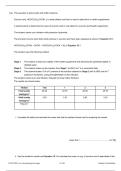
Titration Trial 1 2 3
Final burette 25.25 23.75 25.35 25.75
3
reading/cm
Initial burette 2.50 1.30 2.65 3.20
3
reading/cm
Titre/cm3
i. Complete the table and calculate the mean titre that the student should use for analysing the results.
mean titre = .................................................. cm3 [2]
ii. Use the student’s results and Equation 19.1 to calculate the mass, in mg, of succinic acid in one tablet of the
© OCR 2025. You may photocopy this page. 1 of 184 Created in ExamBuilder
, health supplement.
Give you answer to 3 significant figures.
mass = ................................................... mg [5]
(b) Glycolic acid, HOCH2COOH, (pKa = 3.83) is a weak monobasic acid used in some skincare products.
A buffer solution is prepared by adding 60.0 cm3 of 0.750 mol dm–3 glycolic acid to 40.0 cm3 of 0.625 mol dm–3
potassium hydroxide, KOH.
i. Explain why a buffer solution is formed.
[1]
ii. Calculate the pH of the buffer solution that has been prepared.
Give your answer to 2 decimal places.
© OCR 2025. You may photocopy this page. 2 of 184 Created in ExamBuilder
, pH = ......................................................... [4]
iii. A small amount of aqueous ammonia, NH3(aq), is added to the buffer solution.
Explain, in terms of equilibrium, how the buffer solution would respond to the added NH3(aq).
[2]
2 This question is about equilibria involving hydrogen.
* Hydrogen is used industrially to manufacture ammonia.
The equilibrium is shown below.
N2(g) + 3H2(g) ⇌ 2NH3(g) ΔH = –92kJ mol–1 Equilibrium 20.1
1.20 mol N2(g) is mixed with 3.60 mol H2(g) in a 8.00 dm3 container.
The mixture is heated to 550 °C with an iron catalyst and allowed to reach equilibrium.
The equilibrium mixture contains 0.160 mol of NH3.
Determine the equilibrium constant Kc for Equilibrium 20.1, and explain why the operational conditions used by
industry may be different from those required for a maximum equilibrium yield of ammonia.
© OCR 2025. You may photocopy this page. 3 of 184 Created in ExamBuilder
, [6]
© OCR 2025. You may photocopy this page. 4 of 184 Created in ExamBuilder
Succinic acid, HOOC(CH2)2COOH, is a weak dibasic acid that is used in tablet form in health supplements.
A student plans to determine the mass of succinic acid in one tablet of a succinic acid health supplement.
The student carries out a titration with potassium hydroxide.
The end point occurs when both acidic protons in succinic acid have been replaced as shown in Equation 19.1.
HOOC(CH2)2COOH + 2KOH → KOOC(CH2)2COOK + 2H2O Equation 19.1
The student uses the following method.
Stage 1 The student crushes four tablets of the health supplement and dissolves the powdered tablets in
distilled water.
Stage 2 The student makes up the solution from Stage 1 to 250.0 cm3 in a volumetric flask.
Stage 3 The student titrates 10.0 cm3 portions of the solution obtained in Stage 2 with 0.0600 mol dm–3
potassium hydroxide, using phenolphthalein as the indicator.
The student carries out a trial titration, followed by three further titrations.
The results are shown below.
Titration Trial 1 2 3
Final burette 25.25 23.75 25.35 25.75
3
reading/cm
Initial burette 2.50 1.30 2.65 3.20
3
reading/cm
Titre/cm3
i. Complete the table and calculate the mean titre that the student should use for analysing the results.
mean titre = .................................................. cm3 [2]
ii. Use the student’s results and Equation 19.1 to calculate the mass, in mg, of succinic acid in one tablet of the
© OCR 2025. You may photocopy this page. 1 of 184 Created in ExamBuilder
, health supplement.
Give you answer to 3 significant figures.
mass = ................................................... mg [5]
(b) Glycolic acid, HOCH2COOH, (pKa = 3.83) is a weak monobasic acid used in some skincare products.
A buffer solution is prepared by adding 60.0 cm3 of 0.750 mol dm–3 glycolic acid to 40.0 cm3 of 0.625 mol dm–3
potassium hydroxide, KOH.
i. Explain why a buffer solution is formed.
[1]
ii. Calculate the pH of the buffer solution that has been prepared.
Give your answer to 2 decimal places.
© OCR 2025. You may photocopy this page. 2 of 184 Created in ExamBuilder
, pH = ......................................................... [4]
iii. A small amount of aqueous ammonia, NH3(aq), is added to the buffer solution.
Explain, in terms of equilibrium, how the buffer solution would respond to the added NH3(aq).
[2]
2 This question is about equilibria involving hydrogen.
* Hydrogen is used industrially to manufacture ammonia.
The equilibrium is shown below.
N2(g) + 3H2(g) ⇌ 2NH3(g) ΔH = –92kJ mol–1 Equilibrium 20.1
1.20 mol N2(g) is mixed with 3.60 mol H2(g) in a 8.00 dm3 container.
The mixture is heated to 550 °C with an iron catalyst and allowed to reach equilibrium.
The equilibrium mixture contains 0.160 mol of NH3.
Determine the equilibrium constant Kc for Equilibrium 20.1, and explain why the operational conditions used by
industry may be different from those required for a maximum equilibrium yield of ammonia.
© OCR 2025. You may photocopy this page. 3 of 184 Created in ExamBuilder
, [6]
© OCR 2025. You may photocopy this page. 4 of 184 Created in ExamBuilder