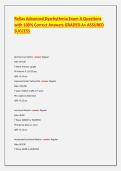
PN NCLEX POSITIONING 2025-2026
QUESTIONS AND VERIFIED ANSWERS
ALREADY GRADED A+
Low-Fowler's - ANSWERS15-30 degrees
Semi-Fowler's - ANSWERS30-45 degrees used for feedings, lung expansion =, and breating.
Fowler's - ANSWERS45-60 degrees
High-Fowler's - ANSWERS60-90 degrees used for reducing aspiration risk and also, reducing reflux
Supine - ANSWERSlying on the back
Orthopneic - ANSWERSsitting upright with a pillow over the table; used for patients with dyspnea,
shortness of breath (SOB)
Prone - ANSWERSlying face down
Trendelenburg - ANSWERSposition on back feet elevated higher than head; used for Hypotension
(Shock)
Reverse Trendelenburg - ANSWERSthe body is laid flat on the back with the head higher than the feet;
used for tube feeding emergency treatments, severe bleedings, head, and neck injury.
Sims - ANSWERSbody position in which a person is lying on his left side with the upper knee flexed and
raised toward the chest (How i sleep with one arm up)
QUESTIONS AND VERIFIED ANSWERS
ALREADY GRADED A+
Low-Fowler's - ANSWERS15-30 degrees
Semi-Fowler's - ANSWERS30-45 degrees used for feedings, lung expansion =, and breating.
Fowler's - ANSWERS45-60 degrees
High-Fowler's - ANSWERS60-90 degrees used for reducing aspiration risk and also, reducing reflux
Supine - ANSWERSlying on the back
Orthopneic - ANSWERSsitting upright with a pillow over the table; used for patients with dyspnea,
shortness of breath (SOB)
Prone - ANSWERSlying face down
Trendelenburg - ANSWERSposition on back feet elevated higher than head; used for Hypotension
(Shock)
Reverse Trendelenburg - ANSWERSthe body is laid flat on the back with the head higher than the feet;
used for tube feeding emergency treatments, severe bleedings, head, and neck injury.
Sims - ANSWERSbody position in which a person is lying on his left side with the upper knee flexed and
raised toward the chest (How i sleep with one arm up)