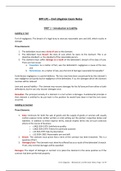
BPP LPC – Civil Litigation Exam Notes
PART 1 – Introduction to Liability
Liability in Tort
Tort of negligence: The breach of a legal duty to exercise reasonable care and skill, which results in
damage.
Three Elements:
1. The defendant must owe a duty of care to the claimant.
2. The defendant must breach the duty of care which he owes to the claimant. This is an
objective standard i.e. the standard of the reasonable person.
3. The claimant must suffer damage as a result of the defendant’s breach of his duty of care.
There are two issues:
a. Causation: As a matter of fact, was the defendant’s negligence a cause of the loss;
and
b. Remoteness: As a matter of law, was the kind of damage reasonably foreseeable?
Contributory negligence is a partial defence. The loss may have been caused partly by the claimant’s
own negligence and partly by the negligence of the defendant. If so, the damages which the claimant
receives will be reduced.
Joint and several liability – The claimant may recover damages for the full amount from either or both
defendants, but he can only recover damages once.
Remedies: The principal remedy of a claimant in a tort action is damages. Fundamental principle is
that claimant is entitled to be put back in the position he would have been in had the tort never
occurred.
Liability in Contract
Three Elements:
1. Duty: Contracts for both the sale of goods and the supply of goods or services will usually
contain express terms (either written or oral) setting out the parties’ respective duties and
liabilities. In addition to these express terms, statute implies terms into all such contracts
where in the course of business:
o s14(2) SGA 1979: Satisfactory quality.
o s14(3) SGA 1979: Fitness for particular purpose.
o s13 SGA 1979: Sale by description.
o s13 SGSA 1982: Reasonable care and skill.
2. Breach: The claimant must prove that a term of the contract has been breached. This is a
question of fact.
3. Damages/Loss: The claimant must show he suffered loss as a result of the defendant’s breach.
If not, only nominal damages will be awarded.
Damages: The object of damages in contract is to place the claimant in the same position as if the
contract had been performed properly.
Civil Litigation – Distinction Level Revision Notes | Page 1 of 45
,Limitation of Damages
- Remoteness:
o The defendant is liable for damage arising directly from the breach; and
o The defendant is also liable for other damage with can fairly or reasonably be
supposed to have been within the contemplation of both parties at the time the
contract was made, as a probable result of the breach of it.
- Mitigation:
o The claimant must take ‘reasonable’ steps to minimise his loss, and if the claimant
fails to do so, he may not be permitted to recover losses which would have been
avoided had he not so failed. What is “reasonable” is a question of fact.
Limitation of Actions
The Limitation Act 1980 provides that the basic limitation periods within which a claim must be
brought are:
1. Tort (other than a claim for personal injuries and death) – 6 years from date cause of action
accrued (date of actionable damage).
2. Contract – 6 years from date cause of action accrued (date of breach of contract).
3. Personal injuries and death – 3 years from the later of either:
a. Date on which cause of action accrued; or
b. Date of the claimant’s ‘knowledge’ of damage.
Civil Litigation – Distinction Level Revision Notes | Page 2 of 45
, PART 2 – Case Analysis & Investigation
DUTY, BREACH, CAUSATION, LOSS
1. Establish the duty:
o Whom should the claimant sue?
o Is there a duty in contract?
o Is there a duty in tort?
o Are there concurrent duties? A duty of care in tort is not excluded by a duty in
contract. Can sue in both contract and tort at the same time – no double recovery.
o Set out detail in particulars of claim: Express duty in contract, implied duty in contract,
duty in tort.
2. Has the duty been breached?
o What is the standard of care expected? Reasonably competent X.
o Do the actions likely constitute a breach?
o When does the limitation period expire in both contract and tort?
3. Causation
o Need to prove reliance/causal link.
4. Loss
o What general principles govern damages recoverable in contract?
o What general principles govern damages recoverable in tort?
o What loss will be recovered? Remoteness and mitigation in contract. Contributory
negligence in tort.
Cost/Benefit/Risk Analysis for Litigation:
In Favour Against
Large sums at stake.
Deep pockets of defendant. D has
indemnity insurance?
Costly – long and complex action – time-
consuming and risky. Will not recover
100% of costs even if win.
Difficulty proving negligence.
Publicity – Defendant will not want to be
dragged through the courts.
Evidential difficulties? Merits of the case.
Uncertainties of litigation.
Risk of paying substantial costs if lose.
General rule is that unsuccessful party
pays successful party’s costs – CPR
44.2(2)(a).
Civil Litigation – Distinction Level Revision Notes | Page 3 of 45
PART 1 – Introduction to Liability
Liability in Tort
Tort of negligence: The breach of a legal duty to exercise reasonable care and skill, which results in
damage.
Three Elements:
1. The defendant must owe a duty of care to the claimant.
2. The defendant must breach the duty of care which he owes to the claimant. This is an
objective standard i.e. the standard of the reasonable person.
3. The claimant must suffer damage as a result of the defendant’s breach of his duty of care.
There are two issues:
a. Causation: As a matter of fact, was the defendant’s negligence a cause of the loss;
and
b. Remoteness: As a matter of law, was the kind of damage reasonably foreseeable?
Contributory negligence is a partial defence. The loss may have been caused partly by the claimant’s
own negligence and partly by the negligence of the defendant. If so, the damages which the claimant
receives will be reduced.
Joint and several liability – The claimant may recover damages for the full amount from either or both
defendants, but he can only recover damages once.
Remedies: The principal remedy of a claimant in a tort action is damages. Fundamental principle is
that claimant is entitled to be put back in the position he would have been in had the tort never
occurred.
Liability in Contract
Three Elements:
1. Duty: Contracts for both the sale of goods and the supply of goods or services will usually
contain express terms (either written or oral) setting out the parties’ respective duties and
liabilities. In addition to these express terms, statute implies terms into all such contracts
where in the course of business:
o s14(2) SGA 1979: Satisfactory quality.
o s14(3) SGA 1979: Fitness for particular purpose.
o s13 SGA 1979: Sale by description.
o s13 SGSA 1982: Reasonable care and skill.
2. Breach: The claimant must prove that a term of the contract has been breached. This is a
question of fact.
3. Damages/Loss: The claimant must show he suffered loss as a result of the defendant’s breach.
If not, only nominal damages will be awarded.
Damages: The object of damages in contract is to place the claimant in the same position as if the
contract had been performed properly.
Civil Litigation – Distinction Level Revision Notes | Page 1 of 45
,Limitation of Damages
- Remoteness:
o The defendant is liable for damage arising directly from the breach; and
o The defendant is also liable for other damage with can fairly or reasonably be
supposed to have been within the contemplation of both parties at the time the
contract was made, as a probable result of the breach of it.
- Mitigation:
o The claimant must take ‘reasonable’ steps to minimise his loss, and if the claimant
fails to do so, he may not be permitted to recover losses which would have been
avoided had he not so failed. What is “reasonable” is a question of fact.
Limitation of Actions
The Limitation Act 1980 provides that the basic limitation periods within which a claim must be
brought are:
1. Tort (other than a claim for personal injuries and death) – 6 years from date cause of action
accrued (date of actionable damage).
2. Contract – 6 years from date cause of action accrued (date of breach of contract).
3. Personal injuries and death – 3 years from the later of either:
a. Date on which cause of action accrued; or
b. Date of the claimant’s ‘knowledge’ of damage.
Civil Litigation – Distinction Level Revision Notes | Page 2 of 45
, PART 2 – Case Analysis & Investigation
DUTY, BREACH, CAUSATION, LOSS
1. Establish the duty:
o Whom should the claimant sue?
o Is there a duty in contract?
o Is there a duty in tort?
o Are there concurrent duties? A duty of care in tort is not excluded by a duty in
contract. Can sue in both contract and tort at the same time – no double recovery.
o Set out detail in particulars of claim: Express duty in contract, implied duty in contract,
duty in tort.
2. Has the duty been breached?
o What is the standard of care expected? Reasonably competent X.
o Do the actions likely constitute a breach?
o When does the limitation period expire in both contract and tort?
3. Causation
o Need to prove reliance/causal link.
4. Loss
o What general principles govern damages recoverable in contract?
o What general principles govern damages recoverable in tort?
o What loss will be recovered? Remoteness and mitigation in contract. Contributory
negligence in tort.
Cost/Benefit/Risk Analysis for Litigation:
In Favour Against
Large sums at stake.
Deep pockets of defendant. D has
indemnity insurance?
Costly – long and complex action – time-
consuming and risky. Will not recover
100% of costs even if win.
Difficulty proving negligence.
Publicity – Defendant will not want to be
dragged through the courts.
Evidential difficulties? Merits of the case.
Uncertainties of litigation.
Risk of paying substantial costs if lose.
General rule is that unsuccessful party
pays successful party’s costs – CPR
44.2(2)(a).
Civil Litigation – Distinction Level Revision Notes | Page 3 of 45