Science Medicine Nursing
Final ATI PN Fundamentals Study Guide
Save
Students also studied
From the same upload Flashcard sets Study guides Practice tests
ATI PN Fundamentals: Nursing Process, Safety, and Patient Care
Study guide
Strawberrydreamgrl
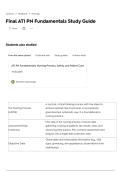
A cyclical, critical thinking process with five steps to
The Nursing Process achieve optimal client outcomes in a purposeful,
(ADPIE) goal-directed, systematic way. It is foundational to
nursing practice.
First step in the nursing process. Involves data
Assessment/Data gathering, looking at patients, lab results, vitals, and
Collection observing their actions. PNs combine assessment and
analysis into a single data collection step.
Observable and measurable information (e.g., vital
Objective Data signs, grimacing, skin appearance, observations from
staff/family).
, Subjective Data Client's reported manifestations or statements.
Observe, use correct techniques for data collection,
Critical Thinking Skills differentiate relevant/irrelevant data, organize,
(Assessment) categorize, validate data, interpret, and draw
conclusions.
Recognize patterns or trends, compare data with
Analysis/Data Collection expected standards, detect inferences, identify actual
(PNs) or potential problems/risks, and avoid making
judgments.
Second step of the nursing process for PNs. Establish
priorities and optimal outcomes of care that are
Planning
SMART (Specific, Measurable, Attainable, Realistic,
Timely) and patient-centered.
Identify goals and outcomes, set priorities, determine
appropriate strategies and interventions, apply
Critical Thinking Skills
knowledge to multiple situations, create outcome
(Planning)
criteria, theorize, and consider consequences of
implementation.
Implementation/Interventi The 'doing' stage. Carry out the plan of care; perform
on nurse-initiated and provider-initiated actions.
Determine if planned outcomes were met, if
Evaluation interventions were appropriate/effective, and if
modifications are needed.
Incomplete database, unrealistic client outcomes,
Factors leading to lack of
non-specific nursing interventions, inadequate time
goal achievement
for the client to achieve outcomes.
Determine accuracy of theories, evaluate outcomes
Critical Thinking Skills
based on specific criteria, and determine
(Evaluation)
understanding of teaching.
Purposeful, outcome-directed thinking influenced by
Critical Thinking and
professional nursing knowledge, experience, intuition,
Clinical Judgment
and flexible attitudes.
Final ATI PN Fundamentals Study Guide
Save
Students also studied
From the same upload Flashcard sets Study guides Practice tests
ATI PN Fundamentals: Nursing Process, Safety, and Patient Care
Study guide
Strawberrydreamgrl
A cyclical, critical thinking process with five steps to
The Nursing Process achieve optimal client outcomes in a purposeful,
(ADPIE) goal-directed, systematic way. It is foundational to
nursing practice.
First step in the nursing process. Involves data
Assessment/Data gathering, looking at patients, lab results, vitals, and
Collection observing their actions. PNs combine assessment and
analysis into a single data collection step.
Observable and measurable information (e.g., vital
Objective Data signs, grimacing, skin appearance, observations from
staff/family).
, Subjective Data Client's reported manifestations or statements.
Observe, use correct techniques for data collection,
Critical Thinking Skills differentiate relevant/irrelevant data, organize,
(Assessment) categorize, validate data, interpret, and draw
conclusions.
Recognize patterns or trends, compare data with
Analysis/Data Collection expected standards, detect inferences, identify actual
(PNs) or potential problems/risks, and avoid making
judgments.
Second step of the nursing process for PNs. Establish
priorities and optimal outcomes of care that are
Planning
SMART (Specific, Measurable, Attainable, Realistic,
Timely) and patient-centered.
Identify goals and outcomes, set priorities, determine
appropriate strategies and interventions, apply
Critical Thinking Skills
knowledge to multiple situations, create outcome
(Planning)
criteria, theorize, and consider consequences of
implementation.
Implementation/Interventi The 'doing' stage. Carry out the plan of care; perform
on nurse-initiated and provider-initiated actions.
Determine if planned outcomes were met, if
Evaluation interventions were appropriate/effective, and if
modifications are needed.
Incomplete database, unrealistic client outcomes,
Factors leading to lack of
non-specific nursing interventions, inadequate time
goal achievement
for the client to achieve outcomes.
Determine accuracy of theories, evaluate outcomes
Critical Thinking Skills
based on specific criteria, and determine
(Evaluation)
understanding of teaching.
Purposeful, outcome-directed thinking influenced by
Critical Thinking and
professional nursing knowledge, experience, intuition,
Clinical Judgment
and flexible attitudes.