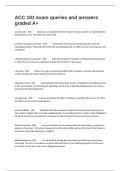
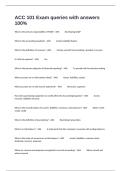
ACC 101 exam queries and answers
graded A+
accrual basis - ANS✅✅expenses are matched with the related revenues and/or are reported when
the expense occurs, not when the cash is paid
revenue recognition principle - ANS✅✅cornerstone of accrual accounting together with the
matching principle. They both determine the accounting period, in which revenues and expenses are
recognized
matching (expense) principle - ANS✅✅states that expenses should be recorded during the period
in which they are incurred, regardless of when the transfer of cash occurs.
cash basis - ANS✅✅refers to a major accounting method that recognizes revenues and expenses
at the time physical cash is actually received or paid out
adjusting entries - ANS✅✅accounting journal entries that convert a company's accounting records
to the accrual basis of accounting. An adjusting journal entry is typically made just prior to issuing a
company's financial statements.
accrued asset - ANS✅✅revenues earned by the seller for delivery of goods and services, for which
the seller has not yet received payment.
accrued liability - ANS✅✅liabilities that reflect expenses on the income statement that have not
been paid or logged under accounts payable during an accounting period; in other words, obligations
for goods and services provided to a company for which invoices have not yet been received
deferred revenue - ANS✅✅is not yet revenue. It is an amount that was received by a company in
advance of earning it. The amount unearned (and therefore deferred) as of the date of the financial
statements should be reported as a liability
deferred expense - ANS✅✅s a cost that has already been incurred, but which has not yet been
consumed. The cost is recorded as an asset until such time as the underlying goods or services are
consumed; at that point, the cost is charged to expense
graded A+
accrual basis - ANS✅✅expenses are matched with the related revenues and/or are reported when
the expense occurs, not when the cash is paid
revenue recognition principle - ANS✅✅cornerstone of accrual accounting together with the
matching principle. They both determine the accounting period, in which revenues and expenses are
recognized
matching (expense) principle - ANS✅✅states that expenses should be recorded during the period
in which they are incurred, regardless of when the transfer of cash occurs.
cash basis - ANS✅✅refers to a major accounting method that recognizes revenues and expenses
at the time physical cash is actually received or paid out
adjusting entries - ANS✅✅accounting journal entries that convert a company's accounting records
to the accrual basis of accounting. An adjusting journal entry is typically made just prior to issuing a
company's financial statements.
accrued asset - ANS✅✅revenues earned by the seller for delivery of goods and services, for which
the seller has not yet received payment.
accrued liability - ANS✅✅liabilities that reflect expenses on the income statement that have not
been paid or logged under accounts payable during an accounting period; in other words, obligations
for goods and services provided to a company for which invoices have not yet been received
deferred revenue - ANS✅✅is not yet revenue. It is an amount that was received by a company in
advance of earning it. The amount unearned (and therefore deferred) as of the date of the financial
statements should be reported as a liability
deferred expense - ANS✅✅s a cost that has already been incurred, but which has not yet been
consumed. The cost is recorded as an asset until such time as the underlying goods or services are
consumed; at that point, the cost is charged to expense