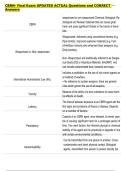
CBRN- Final Exam UPDATED ACTUAL Questions and CORRECT
Answers
weaponized or non-weaponized Chemical, Biological, Ra-
diological and Nuclear materials that can cause great
CBRN
harm and pose significant threats in the hands of terror-
ists.
Weaponized- delivered using conventional bombs (e.g.
Pipe bombs), improved explosive materials (e.g. Fuel
oil-fertilizer mixture) and enhanced blast weapons (e.g.
Dirty bombs).
Weaponized vs. Non- weaponized
Non- Weaponized- are traditionally referred to as Danger-
ous Goods (DG) or Hazardous Materials (HAZMAT) and
can include contaminated food, livestock and crops.
Includes a prohibition on the use of riot control agents as
a method of warfare.
International Humanitarian Law (IHL)
• No reference to nuclear weapons, there are general
rules which govern the use of all weapons.
Measure of the ability of a toxic substance to cause harm-
Toxicity
ful effects or death.
The interval between exposure to an CBRN agent adn the
Latency first signs and symptoms of illness or disease. Depends
on a number of factors.
Capacity of an CBRN agent, once released, to remain capa-
ble of causing significant harm for a prolonged period of
Persistency time. Two main factors: the inherent physical or chemical
stability of the agent and its propensity to degrade in line
with certain environmental conditions.
Can be transmitted from one person to another. Cross-
contamination and direct physical contact. Biological
transmissibility
agents, transmitted from person to person directly but
Answers
weaponized or non-weaponized Chemical, Biological, Ra-
diological and Nuclear materials that can cause great
CBRN
harm and pose significant threats in the hands of terror-
ists.
Weaponized- delivered using conventional bombs (e.g.
Pipe bombs), improved explosive materials (e.g. Fuel
oil-fertilizer mixture) and enhanced blast weapons (e.g.
Dirty bombs).
Weaponized vs. Non- weaponized
Non- Weaponized- are traditionally referred to as Danger-
ous Goods (DG) or Hazardous Materials (HAZMAT) and
can include contaminated food, livestock and crops.
Includes a prohibition on the use of riot control agents as
a method of warfare.
International Humanitarian Law (IHL)
• No reference to nuclear weapons, there are general
rules which govern the use of all weapons.
Measure of the ability of a toxic substance to cause harm-
Toxicity
ful effects or death.
The interval between exposure to an CBRN agent adn the
Latency first signs and symptoms of illness or disease. Depends
on a number of factors.
Capacity of an CBRN agent, once released, to remain capa-
ble of causing significant harm for a prolonged period of
Persistency time. Two main factors: the inherent physical or chemical
stability of the agent and its propensity to degrade in line
with certain environmental conditions.
Can be transmitted from one person to another. Cross-
contamination and direct physical contact. Biological
transmissibility
agents, transmitted from person to person directly but