Module 1|NURS 5433 Module 1| Questions & Answers| Latest Updated A+ Score Guide Solution
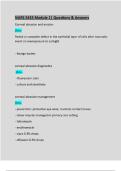
Corneal abrasion and erosion (Ans- Partial or complete defect in the epithelial layer of cells after traumatic event or overexposure to sunlight - foreign bodies corneal abrasion diagnostics (Ans- - fluorescein stain - culture and sensitivity corneal abrasion management (Ans- - prevention: protective eye wear, maintain contact lenses - minor may be managed in primary care setting - tobramycin - erythromycin - cipro 0.3% drops - ofloxacin 0.3% drops - if not healed within 1-2 days or if erosions --> refer - superficial corneal and conjunctival foreign bodies can be removed in primary care dry eye (Ans- - may be acquired or congenital - acquired disorders may be systemic - Sjogren's syndrome - may reflect a more local infectious process, as in some forms of conjunctivitis - may be related to trauma, such as in facial nerve (CN VII) palsy - causes - certain meds: anticholinergic agents, beta-adrenergic blockers, and antihistamines - aging, especially menopause - may also have diminished blink rate due to working at computer or microscope dry eye management (Ans- - level 1: education, environmental, dietary - elimination of offending systemic meds - use of artificial tear substitutes, lubricants, gels, and ointments - possibly eyelid therapy - level 2: - ocular lubricants, nonpreserved artificial tear substitutes, and anti-inflammatory agents such as topical cyclosporine A, topical corticosteroids, or topical/systemic omega 3 fatty acids - cyclosporine ophthalmic emulsion (RESTASIS) for chronic dry eye - level 3: - autologous serum, special contact lenses and permanent punctual occlusion - level 4 - systemic anti-inflammatory agents - surgical interventions - correct abnormalities of lid - grafting of mucous membranes - transplantation of salivary gland duct cataracts (Ans- - 90% of cataracts are age related - causes: congenital, metabolic, and traumatic etiologies - excessive exposure to sunlight (uv B rays) w/out protective lenses over time - in US, cataract surgery is most common surgical procedure performed under Medicare cataract assessment (Ans- - opacification of lens - diminished red reflex - leukocoria (white reflex) - subjective findings - blurred vision, glare, halo around lights, diminished night vision, diminished visual acuity cataract management (Ans- - management - prevention - routine eye exams - uv protectant eyewear - control DM - management of health conditions - reduce ETOH and quit smoking - referral Dacryostenosis (Ans- - obstruction in nasolacrimal duct - most common cause of epiphora (excessive tearing) and ocular discharge in newborn - congenital - results when inferior turbinate fails to complete canalization in newborn period - infection - staph or strep dacryostenosis RF (Ans- Brachycephalic heads Female sex Whites or non-African American Infants or adults greater than 40HX of chronic allergies, inflammatory disease, sarcoidosis, Crohn's, UC, sinusitis, previous nasal or sinus surgeries, prior midfacial fractures or radiation therapy. dacryostenosis assessment (Ans- - epiphora: persistent overflow of tears over lower lid margin - margin crusting of lashes - red eye - acute distention and inflammation of lacrimal sac region - mucus reflux through punctum when pressure applied dacryostenosis management (Ans- - nonpharm - massaging of lacrimal duct at least BID - pharm - atbx eye drops if infection - refer - ophthalmologist for dacryostenosis beyond 9-12 mo - ophthalmologist for severe obstruction prior to 6 mo of age - lacrimal duct probing to facilitate permanent drainage - intubation dacryocystography and scintillography as indicated - balloon catheter dilation of nasolacrimal system in persistent cases dacryostenosis differentials
Escuela, estudio y materia
- Institución
- University Of Texas - Arlington
- Grado
- NURS 5433
Información del documento
- Subido en
- 30 de septiembre de 2025
- Número de páginas
- 75
- Escrito en
- 2025/2026
- Tipo
- Examen
- Contiene
- Preguntas y respuestas
Temas
-
corneal abrasion and erosion
-
corneal abrasion diagnostics
-
corneal abrasion management

Documento también disponible en un lote