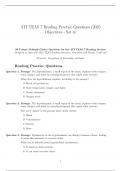
Fundamentals RN Exit Hesi 2 Exam
1. An elderly client who requires frequent monitoring fell and fractured a hip. Which nurse is at greatest risk for a malpractice judgment? A) A nurse who worked the 7 to 3 shift at the hospital and wrote poor nursing notes. B) The nurse assigned to care for the client who was at lunch at the time of the fall. C) The nurse who transferred the client to the chair when the fall occurred. D) The charge nurse who completed rounds 30 minutes before the fall occurred. - C) The nurse who transferred the client to the chair when the fall occurred The four elements of malpractice are: breach of duty owed, failure to adhere to the recognized standard of care, direct causation of injury, and evidence of actual injury. The hip fracture is the actual injury and the standard of care was "frequent monitoring." (C) implies that duty was owed and the injury occurred while the nurse was in charge of the client's care. There is no evidence of negligence in (A, B, and D) 2. The nurse observes an unlicensed assistive personnel (UAP) taking a client's blood pressure with a cuff that is too small, but the blood pressure reading obtained is within the client's usual range. What action is most important for the nurse to implement? A) Tell the UAP to use a larger cuff at the next scheduled assessment. B) Reassess the client's blood pressure using a larger cuff. C) Have the unit educator review this procedure with the UAPs. D) Teach the UAP the correct technique for assessing blood pressure. - B) Reassess the client's blood pressure using a larger cuff The most important action is to ensure that an accurate BP reading is obtained. The nurse should reassess the BP with the correct size cuff (B). Reassessment should not be postponed (A). Though (C and D) are likely indicated, these actions do not have the priority of (B). 3. An elderly client with a fractured left hip is on strict bedrest. Which nursing measure is essential to the client's nursing care? A) Massage any reddened areas for at least five minutes. B) Encourage active range of motion exercises on extremities. C) Position the client laterally, prone, and dorsally in sequence. D) Gently lift the client when moving into a desired position. - D) Gently lift the client when moving into a desired position To avoid shearing forces when repositioning, the client should be lifted gently across a surface (D). Reddened areas should not be massaged (A) since this may increase the damage to already traumatized skin. To control pain and muscle spasms, active range of motion (B) may be limited on the affected leg. The position described in (C) is contraindicated for a client with a fractured left hip. 4. A client with pneumonia has a decrease in oxygen saturation from 94% to 88% while ambulating. Based on these findings, which intervention should the nurse implement first? A) Assist the ambulating client back to the bed. B) Encourage the client to ambulate to resolve pneumonia. C) Obtain a prescription for portable oxygen while ambulating. D) Move the oximetry probe from the finger to the earlobe. - A) Assist the ambulating client back to the bed An oxygen saturation below 90% indicates inadequate oxygenation. First, the client should be assisted to return to bed (A) to minimize oxygen demands. Ambulation increases aeration of the lungs to prevent pooling of respiratory secretions, but the client's activity at this time is depleting oxygen saturation of the blood, so (B) is contraindicated. Increased activity increases respiratory effort, and oxygen may be necessary to continue ambulation (C), but first the client should return to bed to rest. Oxygen saturation levels at different sites should be evaluated after the client returns to bed (D). 5. During the initial morning assessment, a male client denies dysuria but reports that his urine appears dark amber. Which intervention should the nurse implement? A) Provide additional coffee on the client's breakfast tray. B) Exchange the client's grape juice for cranberry juice. C) Bring the client additional fruit at mid-morning. D) Encourage additional oral intake of juices and water. - D) Encourage additional oral intake of juices and water Dark amber urine is characteristic of fluid volume deficit, and the client should be encouraged to increase fluid intake (D). Caffeine, however, is a diuretic (A), and may worsen the fluid volume deficit. Any type of juice will be beneficial (B), since the client is not dysuric, a sign of an urinary tract infection. The client needs to restore fluid volume more than solid foods (C). 6. The nurse notices that the mother a 9-year-old Vietnamese child always looks at the floor when she talks to the nurse. What action should the nurse take? A) Talk directly to the child instead of the mother. B) Continue asking the mother questions about the child. C) Ask another nurse to interview the mother now. D) Tell the mother politely to look at you when answering. - B) Continue asking the mother questions about the child Eye contact is a culturally-influenced form of non-verbal communication. In some non-Western cultures, such as the Vietnamese culture, a client or family member may avoid eye contact as a form of respect, so the nurse should continue to ask the mother questions about the child (B). (A, C, and D) are not indicated. 7. The nurse observes that a male client has removed the covering from an ice pack applied to his knee. What action should the nurse take first? A) Observe the appearance of the skin under the ice pack. B) Instruct the client regarding the need for the covering. C) Reapply the covering after filling with fresh ice. D) Ask the client how long the ice was applied to the skin. - A) Observe the appearance of the skin under the ice pack The first action taken by the nurse should be to assess the skin for any possible thermal injury (A). If no injury to the skin has occurred, the nurse can take the other actions (B, C, and D) as needed. 8. The nurse witnesses the signature of a client who has signed an informed consent. Which statement best explains this nursing responsibility? A) The client voluntarily signed the form. B) The client fully understands the procedure. C) The client agrees with the procedure to be done. D) The client authorizes continued treatment. - A) The client voluntarily signed the form The nurse signs the consent form to witness that the client voluntarily signs the consent (A), that the client's signature is authentic, and that the client is otherwise competent to give consent. It is the healthcare provider's responsibility to ensure the client fully understands the procedure (B). The nurse's signature does not indicate(C or D) 9. The healthcare provider prescribes morphine sulfate 4mg IM STAT. Morphine comes in 8 mg per ml. How many ml should the nurse administer? A) 0.5 ml. B) 1 ml. C) 1.5 ml. D) 2 ml. - A) 0.5 ml 10. A client is to receive cimetidine (Tagamet) 300 mg q6h IVPB. The preparation arrives from the pharmacy diluted in 50 ml of 0.9% NaCl. The nurse plans to administer the IVPB dose over 20 minutes. For how many ml/hr should the infusion pump be set to deliver the secondary infusion? - 150 ml/hr 11. A client's infusion of normal saline infiltrated earlier today, and approximately 500 ml of saline infused into the subcutaneous tissue. The client is now complaining of excruciating arm pain and demanding "stronger pain medications." What initial action is most important for the nurse to take? A) Ask about any past history of drug abuse or addiction. B) Measure the pulse volume and capillary refill distal to the infiltration. C) Compress the infiltrated tissue to measure the degree of edema. D) Evaluate the extent of ecchymosis over the forearm area. - B) Measure the pulse volume and capillary refill distal to the infiltration 12. Pain and diminished pulse volume (B) are signs of compartment syndrome, which can progress to complete loss of the peripheral pulse in the extremity. Compartment syndrome occurs when external pressure (usually from a cast), or internal pressure (usually from subcu infused fluid), exceeds capillary perfusion pressure resulting in decreased bolld flow to the extremity. (A) should not be pursued until physical causes of the pain are ruled out. (C) is of less priority than determining the effects of the edema on circulation and nerve function. Further assessment of the client's ecchymosis can be delayed until the signs of edema and compression that suggest compartment syndrome have been examined (D). 13. A nurse is preparing to give medications through a nasogastric feeding tube. Which nursing action should prevent complications during administration? A) Mix each medication individually. B) Use sterile gloves for the procedure. C) Monitor vital signs before giving medications. D) Mix all medications together to facilitate administration. - A) Mix each medication individually Medications should be mixed separately (A) to prevent clumping. (B, C, and D) are not indicated 14. The nurse is administering medications through a nasogastric tube (NGT) which is connected to suction. After ensuring correct tube placement, what action should the nurse take next? A) Clamp the tube for 20 minutes. B) Flush the tube with water. C) Administer the medications as prescribed. D) Crush the tablets and dissolve in sterile water. - B) Flush the tube with water. The NGT tube should be flushed before, after and in between each medication administered (B). Once all medications are administered, the NGT should be clamped for 20 minutes (A). (C and D) may be implemented only after the tubing has been flushed. 15. Which intervention is most important for the nurse to implement for a male client who is experiencing urinary retention? A) Apply a condom catheter. B) Apply a skin protectant. C) Encourage increased fluid intake. D) Assess for bladder distention. - D) Assess for bladder distention Urinary retention is the inability to void all urine collected in the bladder, which leads to uncomfortable bladder distension (D). (A and B) are useful actions to protect the skin of a client with urinary incontinence. (C) may worsen the bladder distension 16. An IV infusion terbutaline sulfate 5 mg in 500 ml of D5W, is infusing at a rate of 30 mcg/min prescribed for a client in premature labor. How many ml/hr should the nurse set the infusion pump? A) 30 B) 60 C) 120 D) 180 - D) 180 17. A client who is in hospice care complains of increasing amounts of pain. The healthcare provider prescribes an analgesic every four hours as needed. Which action should the nurse implement? A) Give an around-the-clock schedule for administration of analgesics. B) Administer analgesic medication as needed when the pain is severe. C) Provide medication to keep the client sedated and unaware of stimuli. D) Offer a medication-free period so that the client can do daily activities. - A) Give an around-the-clock schedule for administration of analgesics The most effective management of pain is achieved using an around-the-clock schedule that provides analgesic medications on a regular basis (A) and in a timely manner. Analgesics are less effective if pain persists until it is severe, so an analgesic medication should be administered before the client's pain peaks (B). Providing comfort is a priority for the client who is dying, but sedation that impairs the client's ability to interact and experience the time before life ends
Escuela, estudio y materia
- Institución
- West Coast University
- Grado
- NR 222
Información del documento
- Subido en
- 29 de septiembre de 2025
- Número de páginas
- 11
- Escrito en
- 2025/2026
- Tipo
- Examen
- Contiene
- Preguntas y respuestas
Temas
-
fundamentals
-
rn exit hesi 2 exam
-
hesi 2 exam
-
fundamentals rn exit hesi 2 exam