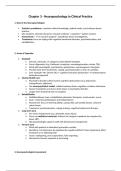
Chapter 3 - Neuropsychology in Clinical Practice
1. Role of the Neuropsychologist
Scientist–practitioner: combines clinical knowledge, patient needs, and evidence-based
practice.
Like medicine: decisions based on research evidence + expertise + patient context.
Assessments = “n=1 research projects”: hypothesis-driven investigations.
Treatments: focus on coping with cognitive/emotional disorders, psychoeducation, and
rehabilitation.
2. Areas of Expertise
1. Hospitals
o General, university, or categorical (specialised) hospitals.
o Focus: diagnostics (e.g. Parkinson’s suspicion, neurodegeneration, stroke, TBI).
o Work with neurologists, psychiatrists, geriatricians, neurosurgeons, therapists.
o Provide short-term treatments: coping, psychoeducation, return to activities.
o Case example: Mrs. Brown (ALS + cognitive/executive dysfunction → frontotemporal
dementia suspected).
2. Mental Health Care
o Psychiatric disorders often involve cognitive dysfunctions (e.g. depression,
schizophrenia, addiction).
o Use neuropsychiatric model: relation between brain–cognition–emotion–behaviour.
o Assess if symptoms are due to brain injury or psychiatric disorder.
o Longer-term treatment than in hospitals.
3. Rehabilitation
o Multidisciplinary team: rehabilitation physician, therapists, social worker, nurse.
o Goal = maximise participation and independence.
o Assessment: focus on learning ability, coping style, personality factors, safety of
return home.
o Treatment: psychoeducation, coping training, cognitive behavioural therapy.
4. Long-term Care
o For severe impairments (e.g. dementia, brain injury).
o Focus on mediative treatment: indirect via caregivers (patients too impaired for
direct CBT).
o Neuropsychologist supports staff with behavioural management.
5. Forensic Care
o Work with patients in detention/preventive custody.
o Questions: Can behaviour be explained by cognitive deficits? Does impairment affect
treatment or re-offending risk?
o Issues: malingering, poor cooperation, false reporting.
o Demand for forensic expertise is increasing.
3. Neuropsychological Assessment
, Not just tests: full diagnostic cycle.
Steps: referral → file review → hypotheses → tests/questionnaires → interviews (patient +
informant) → observation → integration → report.
Assess cognition, emotion, behaviour, daily functioning.
Reliability & validity:
Reliability = consistent results (test-retest, inter-rater).
Validity = measuring what’s intended (face, content, construct, criterion, ecological).
Must control for confounding factors: fatigue, pain, stress, low motivation, malingering.
Use performance validity tests (PVTs) and symptom validity questionnaires.
Norms & classification:
Standardised scoring: normal distribution with labels (“exceptionally low” to “exceptionally
high”).
Tools: WMS-IV, ANDI database, NIP guidelines.
Clinical guidelines:
Tailored testing sets, depending on condition (e.g. dementia vs TBI).
NIP’s General Standard of Testing (AST) + ethical code: responsibility, integrity, respect,
expertise.
Patients’ rights: view, correct factual errors, or block report release.
Medicolegal reports:
Used in liability/personal injury cases.
Must explain procedure clearly, include PVTs, symptom validity tests, consider psychosocial
factors.
Case example: Mrs. Hastings (TBI in accident → residual deficits → insurance compensation).
Cross-cultural factors:
Most tests are Western-based.
Problems: language barriers, illiteracy, cultural symptom presentation.
Solutions: adapted tools (e.g. RUDAS, Cross-Cultural Dementia Screening).
Secondary complaints:
Some disorders (e.g. diabetes, COPD, chronic fatigue, fibromyalgia) → cognitive symptoms
without clear brain lesions.
Complaints are multifactorial: biological + psychological + social.
, 4. Neuropsychological Treatment
Starting point: psychoeducation about brain injury, cognitive deficits, prognosis, and coping.
Treatment approaches:
1. Cognitive rehabilitation – training impaired functions (attention, memory, executive
tasks) and teaching compensatory strategies (agendas, reminders, apps).
2. Psychoeducation and counselling – insight into causes and consequences of
complaints, facilitating acceptance and adjustment, with strong involvement of
relatives.
3. Psychotherapy – often cognitive behavioural therapy (CBT), but adapted for
cognitive limitations (simplified structure, more repetition). Used for mood
problems, anxiety, and behavioural issues.
4. Neuropsychotherapeutic interventions – adapted psychological therapies such as
Acceptance and Commitment Therapy (ACT), mindfulness, or emotion regulation
training. Focus on coping with long-term changes.
Network involvement: relatives and partners are actively engaged, as brain injury impacts
family roles and relationships. Including them improves coping, communication, and reduces
mismatched expectations.
5. Work in Multidisciplinary Teams
Provide tailored info for different specialists:
o Neurologist → cognitive profile linked to disease.
o Occupational therapist → functional limitations.
o Dementia carers → behavioural problem management.
Common in memory clinics, vascular clinics, pain/heart disease clinics.
Case example: Mr. Johnson (memory clinic, mild dementia suspected).
6. Profession & Training
In the Netherlands:
o Healthcare psychologist (GZ-psycholoog) = 2-year post-master training.
o Clinical neuropsychologist = 4-year additional training, protected title.
Training pillars: theory, diagnostics, treatment, research, management.
Status differs across Europe: variations in training, certification, and legal protection.
1. Role of the Neuropsychologist
Scientist–practitioner: combines clinical knowledge, patient needs, and evidence-based
practice.
Like medicine: decisions based on research evidence + expertise + patient context.
Assessments = “n=1 research projects”: hypothesis-driven investigations.
Treatments: focus on coping with cognitive/emotional disorders, psychoeducation, and
rehabilitation.
2. Areas of Expertise
1. Hospitals
o General, university, or categorical (specialised) hospitals.
o Focus: diagnostics (e.g. Parkinson’s suspicion, neurodegeneration, stroke, TBI).
o Work with neurologists, psychiatrists, geriatricians, neurosurgeons, therapists.
o Provide short-term treatments: coping, psychoeducation, return to activities.
o Case example: Mrs. Brown (ALS + cognitive/executive dysfunction → frontotemporal
dementia suspected).
2. Mental Health Care
o Psychiatric disorders often involve cognitive dysfunctions (e.g. depression,
schizophrenia, addiction).
o Use neuropsychiatric model: relation between brain–cognition–emotion–behaviour.
o Assess if symptoms are due to brain injury or psychiatric disorder.
o Longer-term treatment than in hospitals.
3. Rehabilitation
o Multidisciplinary team: rehabilitation physician, therapists, social worker, nurse.
o Goal = maximise participation and independence.
o Assessment: focus on learning ability, coping style, personality factors, safety of
return home.
o Treatment: psychoeducation, coping training, cognitive behavioural therapy.
4. Long-term Care
o For severe impairments (e.g. dementia, brain injury).
o Focus on mediative treatment: indirect via caregivers (patients too impaired for
direct CBT).
o Neuropsychologist supports staff with behavioural management.
5. Forensic Care
o Work with patients in detention/preventive custody.
o Questions: Can behaviour be explained by cognitive deficits? Does impairment affect
treatment or re-offending risk?
o Issues: malingering, poor cooperation, false reporting.
o Demand for forensic expertise is increasing.
3. Neuropsychological Assessment
, Not just tests: full diagnostic cycle.
Steps: referral → file review → hypotheses → tests/questionnaires → interviews (patient +
informant) → observation → integration → report.
Assess cognition, emotion, behaviour, daily functioning.
Reliability & validity:
Reliability = consistent results (test-retest, inter-rater).
Validity = measuring what’s intended (face, content, construct, criterion, ecological).
Must control for confounding factors: fatigue, pain, stress, low motivation, malingering.
Use performance validity tests (PVTs) and symptom validity questionnaires.
Norms & classification:
Standardised scoring: normal distribution with labels (“exceptionally low” to “exceptionally
high”).
Tools: WMS-IV, ANDI database, NIP guidelines.
Clinical guidelines:
Tailored testing sets, depending on condition (e.g. dementia vs TBI).
NIP’s General Standard of Testing (AST) + ethical code: responsibility, integrity, respect,
expertise.
Patients’ rights: view, correct factual errors, or block report release.
Medicolegal reports:
Used in liability/personal injury cases.
Must explain procedure clearly, include PVTs, symptom validity tests, consider psychosocial
factors.
Case example: Mrs. Hastings (TBI in accident → residual deficits → insurance compensation).
Cross-cultural factors:
Most tests are Western-based.
Problems: language barriers, illiteracy, cultural symptom presentation.
Solutions: adapted tools (e.g. RUDAS, Cross-Cultural Dementia Screening).
Secondary complaints:
Some disorders (e.g. diabetes, COPD, chronic fatigue, fibromyalgia) → cognitive symptoms
without clear brain lesions.
Complaints are multifactorial: biological + psychological + social.
, 4. Neuropsychological Treatment
Starting point: psychoeducation about brain injury, cognitive deficits, prognosis, and coping.
Treatment approaches:
1. Cognitive rehabilitation – training impaired functions (attention, memory, executive
tasks) and teaching compensatory strategies (agendas, reminders, apps).
2. Psychoeducation and counselling – insight into causes and consequences of
complaints, facilitating acceptance and adjustment, with strong involvement of
relatives.
3. Psychotherapy – often cognitive behavioural therapy (CBT), but adapted for
cognitive limitations (simplified structure, more repetition). Used for mood
problems, anxiety, and behavioural issues.
4. Neuropsychotherapeutic interventions – adapted psychological therapies such as
Acceptance and Commitment Therapy (ACT), mindfulness, or emotion regulation
training. Focus on coping with long-term changes.
Network involvement: relatives and partners are actively engaged, as brain injury impacts
family roles and relationships. Including them improves coping, communication, and reduces
mismatched expectations.
5. Work in Multidisciplinary Teams
Provide tailored info for different specialists:
o Neurologist → cognitive profile linked to disease.
o Occupational therapist → functional limitations.
o Dementia carers → behavioural problem management.
Common in memory clinics, vascular clinics, pain/heart disease clinics.
Case example: Mr. Johnson (memory clinic, mild dementia suspected).
6. Profession & Training
In the Netherlands:
o Healthcare psychologist (GZ-psycholoog) = 2-year post-master training.
o Clinical neuropsychologist = 4-year additional training, protected title.
Training pillars: theory, diagnostics, treatment, research, management.
Status differs across Europe: variations in training, certification, and legal protection.