Robbins & Cotran 10th Ed. Pathology Test Bank | Chapter-
by-Chapter Questions & Verified Solutions
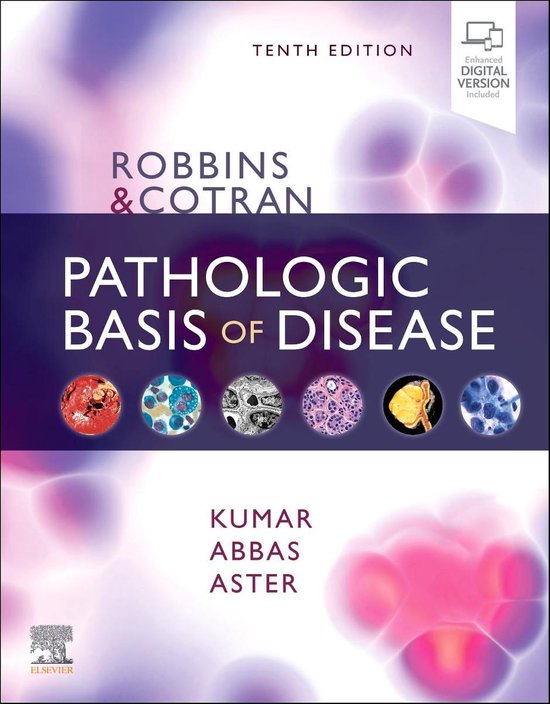
Robbins & Cotran Pathologic Basis of Disease
10th Edition
• Author(s)Vinay Kumar; Abul K. Abbas; Jon C. Aster
Chapter 1 — The Genome
1. Stem: A 6-year-old with extreme sun sensitivity and early
skin cancers is suspected to have a defect in removing UV-
induced pyrimidine dimers. Which DNA repair mechanism
is most likely defective?
A. Base-excision repair
B. Mismatch repair
C. Nucleotide-excision repair
D. Homologous recombination repair
Correct Answer: C. Nucleotide-excision repair
Rationales:
• Correct (C): Nucleotide-excision repair removes bulky
helix-distorting lesions such as UV-induced pyrimidine
, dimers; defects cause xeroderma pigmentosum. (Robbins
Ch.1, The Genome).
• A: Base-excision repair fixes small, non-helix-distorting
base lesions (e.g., deaminated bases), not bulky dimers.
• B: Mismatch repair corrects replication errors (base
mispairs/insertions), not UV-induced dimers.
• D: Homologous recombination repairs double-strand
breaks, not single-strand bulky adducts.
Teaching Point: Nucleotide-excision repair removes bulky
UV lesions like pyrimidine dimers.
Citation: Robbins Ch.1 — The Genome (DNA repair
pathways).
2. Chapter 1 — The Genome
Stem: A woman carries a pathogenic mitochondrial DNA
mutation. Which pattern of inheritance best predicts
transmission to her children?
A. Autosomal dominant transmission to 50% of offspring
B. Mitochondrial (maternal) transmission to all her
children, variable severity
C. Paternal transmission to all sons only
D. Mendelian recessive transmission requiring both
parents to be carriers
Correct Answer: B. Mitochondrial (maternal) transmission
, to all her children, variable severity
Rationales:
• Correct (B): Mitochondrial DNA is inherited almost
exclusively from the mother; all offspring receive maternal
mtDNA, but heteroplasmy causes variable expression.
(Robbins Ch.1, The Genome).
• A: Autosomal dominant describes nuclear gene
inheritance, not mitochondrial genomes.
• C: Paternal transmission of mtDNA is exceptionally rare
and not the rule.
• D: Recessive Mendelian inheritance applies to nuclear
genes, not mtDNA.
Teaching Point: mtDNA is maternally inherited;
heteroplasmy causes variable phenotypes.
Citation: Robbins Ch.1 — The Genome (mitochondrial
genetics).
3. Chapter 1 — Cellular Housekeeping
Stem: A patient’s biopsy shows accumulation of misfolded
cytosolic proteins that are ubiquitinated but not degraded.
Which pathway normally disposes of ubiquitinated soluble
proteins?
A. Autophagy–lysosomal pathway
B. Ubiquitin–proteasome system
C. Phagocytosis by neutrophils
, D. Endoplasmic reticulum–associated secretion
Correct Answer: B. Ubiquitin–proteasome system
Rationales:
• Correct (B): Soluble, short-lived, and misfolded proteins
are tagged with ubiquitin and degraded by the
proteasome; impairment leads to toxic accumulation.
(Robbins Ch.1, Cellular Housekeeping).
• A: Autophagy primarily handles large aggregates and
organelles via lysosomes, not most soluble ubiquitinated
proteins.
• C: Phagocytosis is a cellular process for extracellular
particles, not intracellular protein disposal.
• D: ER-associated secretion exports proteins, but misfolded
proteins are typically retrotranslocated for proteasomal
degradation.
Teaching Point: Ubiquitin tags mark soluble misfolded
proteins for proteasomal degradation.
Citation: Robbins Ch.1 — Cellular Housekeeping
(proteasome and ubiquitin).
4. Chapter 1 — Cellular Metabolism and Mitochondrial
Function
Stem: During acute ischemia a tissue rapidly becomes pale
and swollen. Which immediate cellular event best explains
early reversible injury?
by-Chapter Questions & Verified Solutions
Robbins & Cotran Pathologic Basis of Disease
10th Edition
• Author(s)Vinay Kumar; Abul K. Abbas; Jon C. Aster
Chapter 1 — The Genome
1. Stem: A 6-year-old with extreme sun sensitivity and early
skin cancers is suspected to have a defect in removing UV-
induced pyrimidine dimers. Which DNA repair mechanism
is most likely defective?
A. Base-excision repair
B. Mismatch repair
C. Nucleotide-excision repair
D. Homologous recombination repair
Correct Answer: C. Nucleotide-excision repair
Rationales:
• Correct (C): Nucleotide-excision repair removes bulky
helix-distorting lesions such as UV-induced pyrimidine
, dimers; defects cause xeroderma pigmentosum. (Robbins
Ch.1, The Genome).
• A: Base-excision repair fixes small, non-helix-distorting
base lesions (e.g., deaminated bases), not bulky dimers.
• B: Mismatch repair corrects replication errors (base
mispairs/insertions), not UV-induced dimers.
• D: Homologous recombination repairs double-strand
breaks, not single-strand bulky adducts.
Teaching Point: Nucleotide-excision repair removes bulky
UV lesions like pyrimidine dimers.
Citation: Robbins Ch.1 — The Genome (DNA repair
pathways).
2. Chapter 1 — The Genome
Stem: A woman carries a pathogenic mitochondrial DNA
mutation. Which pattern of inheritance best predicts
transmission to her children?
A. Autosomal dominant transmission to 50% of offspring
B. Mitochondrial (maternal) transmission to all her
children, variable severity
C. Paternal transmission to all sons only
D. Mendelian recessive transmission requiring both
parents to be carriers
Correct Answer: B. Mitochondrial (maternal) transmission
, to all her children, variable severity
Rationales:
• Correct (B): Mitochondrial DNA is inherited almost
exclusively from the mother; all offspring receive maternal
mtDNA, but heteroplasmy causes variable expression.
(Robbins Ch.1, The Genome).
• A: Autosomal dominant describes nuclear gene
inheritance, not mitochondrial genomes.
• C: Paternal transmission of mtDNA is exceptionally rare
and not the rule.
• D: Recessive Mendelian inheritance applies to nuclear
genes, not mtDNA.
Teaching Point: mtDNA is maternally inherited;
heteroplasmy causes variable phenotypes.
Citation: Robbins Ch.1 — The Genome (mitochondrial
genetics).
3. Chapter 1 — Cellular Housekeeping
Stem: A patient’s biopsy shows accumulation of misfolded
cytosolic proteins that are ubiquitinated but not degraded.
Which pathway normally disposes of ubiquitinated soluble
proteins?
A. Autophagy–lysosomal pathway
B. Ubiquitin–proteasome system
C. Phagocytosis by neutrophils
, D. Endoplasmic reticulum–associated secretion
Correct Answer: B. Ubiquitin–proteasome system
Rationales:
• Correct (B): Soluble, short-lived, and misfolded proteins
are tagged with ubiquitin and degraded by the
proteasome; impairment leads to toxic accumulation.
(Robbins Ch.1, Cellular Housekeeping).
• A: Autophagy primarily handles large aggregates and
organelles via lysosomes, not most soluble ubiquitinated
proteins.
• C: Phagocytosis is a cellular process for extracellular
particles, not intracellular protein disposal.
• D: ER-associated secretion exports proteins, but misfolded
proteins are typically retrotranslocated for proteasomal
degradation.
Teaching Point: Ubiquitin tags mark soluble misfolded
proteins for proteasomal degradation.
Citation: Robbins Ch.1 — Cellular Housekeeping
(proteasome and ubiquitin).
4. Chapter 1 — Cellular Metabolism and Mitochondrial
Function
Stem: During acute ischemia a tissue rapidly becomes pale
and swollen. Which immediate cellular event best explains
early reversible injury?