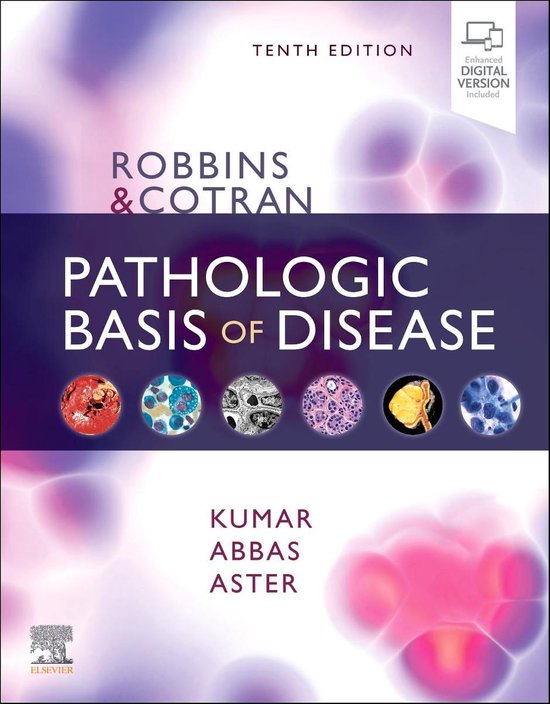
Robbins & Cotran 10th Ed. Pathology Test Bank | Chapter-
by-Chapter Questions & Verified Solutions
Robbins & Cotran Pathologic Basis of Disease
10th Edition
• Author(s)Vinay Kumar; Abul K. Abbas; Jon C. Aster
• Chapter 1 — The Genome
• Stem: A 2-year-old boy is found to have failure-to-thrive
and recurrent infections. Genetic testing shows a frameshift
mutation in a gene essential for DNA mismatch repair.
Which genomic concept best explains why a single
frameshift can have severe effects?
A. Frameshift mutations only affect regulatory noncoding
DNA.
B. A frameshift alters the reading frame, producing a
dysfunctional protein.
C. Frameshifts are corrected by mitochondrial DNA
polymerases.
D. Frameshift mutations rarely change protein sequence
because of wobble at third base.
• Correct Answer: B
• Rationale (correct): A frameshift changes the triplet
reading frame downstream of the mutation, typically
, producing an abnormal amino acid sequence and premature
stop codons, often resulting in loss of protein function.
Rationale (A): Frameshifts occur in coding sequences and
directly affect the translated protein, not only noncoding
DNA.
Rationale (C): Mitochondrial polymerases do not correct
nuclear DNA replication errors; nuclear mismatch repair
pathways are responsible.
Rationale (D): Wobble affects only the third base of
codons and cannot rescue the extensive sequence shift from
a frameshift mutation.
• Teaching Point: Frameshift mutations disrupt the entire
downstream protein reading frame.
Citation: Robbins & Cotran, 10th Ed., Chapter 1: The
Genome. ClinicalKey+1
•
• 2) Chapter 1 — The Genome
• Stem: A 45-year-old patient has a disease caused by
trinucleotide repeat expansion that shows anticipation
(earlier onset in successive generations). Which mechanism
from the genome section best explains anticipation?
A. Somatic point mutations accumulate with age.
B. Expansion of unstable repeat sequences during meiosis.
C. Mitochondrial DNA heteroplasmy increases each
generation.
D. Copy number neutral loss of heterozygosity.
• Correct Answer: B
• Rationale (correct): Trinucleotide repeat disorders feature
unstable repeat sequences that can expand during
gametogenesis, producing longer repeats in offspring and
earlier/more severe disease (anticipation).
, Rationale (A): Somatic point mutations with age do not
account for generational earlier onset.
Rationale (C): Mitochondrial heteroplasmy is maternally
inherited but does not explain expanding nuclear
trinucleotide repeats with anticipation.
Rationale (D): Loss of heterozygosity affects allele
balance but does not produce progressive repeat expansion.
• Teaching Point: Anticipation arises from meiotic
expansion of unstable trinucleotide repeats.
Citation: Robbins & Cotran, 10th Ed., Chapter 1: The
Genome. ClinicalKey+1
•
• 3) Chapter 1 — Cellular Housekeeping
• Stem: A hepatocyte exposed to chronic alcohol shows
coarse, eosinophilic intracytoplasmic inclusions composed
of aggregated intermediate filaments. Which cellular
housekeeping failure best describes this finding?
A. Impaired proteasomal degradation leading to protein
aggregates.
B. Enhanced autophagy clearing misfolded proteins.
C. Increased exocytosis of damaged proteins.
D. Upregulated heat-shock proteins fully prevent
aggregation.
• Correct Answer: A
• Rationale (correct): Failure of the ubiquitin–proteasome
system impairs removal of misfolded proteins, resulting in
intracellular aggregates (e.g., Mallory bodies).
Rationale (B): Autophagy can clear aggregates but is often
overwhelmed or insufficient in chronic injury.
Rationale (C): Exocytosis does not typically remove large
intracellular protein aggregates.
, Rationale (D): Heat-shock proteins help folding but cannot
always prevent aggregation when degradation is impaired.
• Teaching Point: Proteasomal dysfunction leads to toxic
intracellular protein aggregates.
Citation: Robbins & Cotran, 10th Ed., Chapter 1: Cellular
Housekeeping. ClinicalKey+1
•
• 4) Chapter 1 — Cellular Housekeeping
• Stem: A neuron contains numerous lysosomes filled with
partially degraded material and lipid residues (lipofuscin).
Which process most likely produced this pigment?
A. Excessive mitochondrial biogenesis.
B. Autophagic digestion of cellular components with
incomplete lysosomal degradation.
C. Immediate exocytosis of damaged organelles.
D. Increased nuclear DNA methylation.
• Correct Answer: B
• Rationale (correct): Lipofuscin results from autophagy
and lysosomal digestion of organelles; incomplete
degradation yields residual bodies that accumulate with age
or oxidative stress.
Rationale (A): Mitochondrial biogenesis would not explain
lysosomal pigment accumulation.
Rationale (C): Exocytosis would remove material rather
than leave pigment-filled lysosomes.
Rationale (D): DNA methylation is epigenetic and
unrelated to lipofuscin formation.
• Teaching Point: Lipofuscin arises from incomplete
lysosomal degradation of damaged organelles.
Citation: Robbins & Cotran, 10th Ed., Chapter 1: Cellular
Housekeeping. ClinicalKey+1
by-Chapter Questions & Verified Solutions
Robbins & Cotran Pathologic Basis of Disease
10th Edition
• Author(s)Vinay Kumar; Abul K. Abbas; Jon C. Aster
• Chapter 1 — The Genome
• Stem: A 2-year-old boy is found to have failure-to-thrive
and recurrent infections. Genetic testing shows a frameshift
mutation in a gene essential for DNA mismatch repair.
Which genomic concept best explains why a single
frameshift can have severe effects?
A. Frameshift mutations only affect regulatory noncoding
DNA.
B. A frameshift alters the reading frame, producing a
dysfunctional protein.
C. Frameshifts are corrected by mitochondrial DNA
polymerases.
D. Frameshift mutations rarely change protein sequence
because of wobble at third base.
• Correct Answer: B
• Rationale (correct): A frameshift changes the triplet
reading frame downstream of the mutation, typically
, producing an abnormal amino acid sequence and premature
stop codons, often resulting in loss of protein function.
Rationale (A): Frameshifts occur in coding sequences and
directly affect the translated protein, not only noncoding
DNA.
Rationale (C): Mitochondrial polymerases do not correct
nuclear DNA replication errors; nuclear mismatch repair
pathways are responsible.
Rationale (D): Wobble affects only the third base of
codons and cannot rescue the extensive sequence shift from
a frameshift mutation.
• Teaching Point: Frameshift mutations disrupt the entire
downstream protein reading frame.
Citation: Robbins & Cotran, 10th Ed., Chapter 1: The
Genome. ClinicalKey+1
•
• 2) Chapter 1 — The Genome
• Stem: A 45-year-old patient has a disease caused by
trinucleotide repeat expansion that shows anticipation
(earlier onset in successive generations). Which mechanism
from the genome section best explains anticipation?
A. Somatic point mutations accumulate with age.
B. Expansion of unstable repeat sequences during meiosis.
C. Mitochondrial DNA heteroplasmy increases each
generation.
D. Copy number neutral loss of heterozygosity.
• Correct Answer: B
• Rationale (correct): Trinucleotide repeat disorders feature
unstable repeat sequences that can expand during
gametogenesis, producing longer repeats in offspring and
earlier/more severe disease (anticipation).
, Rationale (A): Somatic point mutations with age do not
account for generational earlier onset.
Rationale (C): Mitochondrial heteroplasmy is maternally
inherited but does not explain expanding nuclear
trinucleotide repeats with anticipation.
Rationale (D): Loss of heterozygosity affects allele
balance but does not produce progressive repeat expansion.
• Teaching Point: Anticipation arises from meiotic
expansion of unstable trinucleotide repeats.
Citation: Robbins & Cotran, 10th Ed., Chapter 1: The
Genome. ClinicalKey+1
•
• 3) Chapter 1 — Cellular Housekeeping
• Stem: A hepatocyte exposed to chronic alcohol shows
coarse, eosinophilic intracytoplasmic inclusions composed
of aggregated intermediate filaments. Which cellular
housekeeping failure best describes this finding?
A. Impaired proteasomal degradation leading to protein
aggregates.
B. Enhanced autophagy clearing misfolded proteins.
C. Increased exocytosis of damaged proteins.
D. Upregulated heat-shock proteins fully prevent
aggregation.
• Correct Answer: A
• Rationale (correct): Failure of the ubiquitin–proteasome
system impairs removal of misfolded proteins, resulting in
intracellular aggregates (e.g., Mallory bodies).
Rationale (B): Autophagy can clear aggregates but is often
overwhelmed or insufficient in chronic injury.
Rationale (C): Exocytosis does not typically remove large
intracellular protein aggregates.
, Rationale (D): Heat-shock proteins help folding but cannot
always prevent aggregation when degradation is impaired.
• Teaching Point: Proteasomal dysfunction leads to toxic
intracellular protein aggregates.
Citation: Robbins & Cotran, 10th Ed., Chapter 1: Cellular
Housekeeping. ClinicalKey+1
•
• 4) Chapter 1 — Cellular Housekeeping
• Stem: A neuron contains numerous lysosomes filled with
partially degraded material and lipid residues (lipofuscin).
Which process most likely produced this pigment?
A. Excessive mitochondrial biogenesis.
B. Autophagic digestion of cellular components with
incomplete lysosomal degradation.
C. Immediate exocytosis of damaged organelles.
D. Increased nuclear DNA methylation.
• Correct Answer: B
• Rationale (correct): Lipofuscin results from autophagy
and lysosomal digestion of organelles; incomplete
degradation yields residual bodies that accumulate with age
or oxidative stress.
Rationale (A): Mitochondrial biogenesis would not explain
lysosomal pigment accumulation.
Rationale (C): Exocytosis would remove material rather
than leave pigment-filled lysosomes.
Rationale (D): DNA methylation is epigenetic and
unrelated to lipofuscin formation.
• Teaching Point: Lipofuscin arises from incomplete
lysosomal degradation of damaged organelles.
Citation: Robbins & Cotran, 10th Ed., Chapter 1: Cellular
Housekeeping. ClinicalKey+1