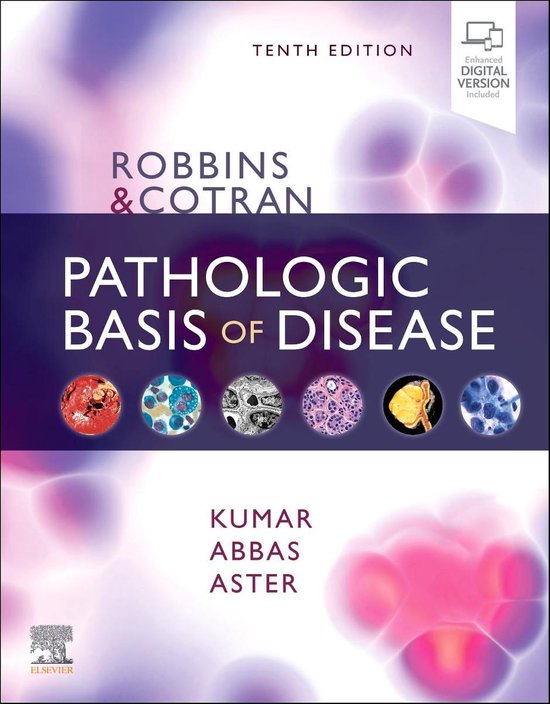
Robbins & Cotran 10th Ed. Pathology Test Bank | Chapter-
by-Chapter Questions & Verified Solutions
Robbins & Cotran Pathologic Basis of Disease
10th Edition
• Author(s)Vinay Kumar; Abul K. Abbas; Jon C. Aster
1.
Chapter Reference – Chapter 1: The Cell as a Unit of Health
and Disease — The Genome
Question: A 45-year-old woman’s tumor shows loss of a DNA
repair protein that normally corrects single-base oxidative
damage. Which repair pathway is most likely defective?
A. Nucleotide excision repair
B. Base excision repair
C. Mismatch repair
D. Homologous recombination repair
Correct Answer: B
Rationales:
• Correct (B): Base excision repair (BER) corrects small,
non-helix-distorting base lesions such as oxidized or
, deaminated bases; loss of BER enzymes (e.g., DNA
glycosylases) causes accumulation of such damage.
• A: Nucleotide excision repair removes bulky helix-
distorting lesions (e.g., thymine dimers), not single-base
oxidative damage.
• C: Mismatch repair corrects replication-associated base–
base mismatches and insertion–deletion loops, not isolated
oxidized bases.
• D: Homologous recombination repairs double-strand
breaks using a sister chromatid; it doesn’t target single
oxidized bases.
Teaching Point: BER repairs small oxidative and deaminated
base lesions.
Citation: Robbins & Cotran, 10th Ed., Ch. 1 — The Genome
(DNA repair pathways; base excision repair).
2. Chapter 1 — The Genome
Question: A patient’s tumor harbors defective BRCA1. Which
DNA repair defect best explains the tumor’s sensitivity to PARP
inhibitors?
A. Impaired mismatch repair leading to microsatellite instability
B. Loss of nucleotide excision repair causing bulky adduct
accumulation
C. Defective homologous recombination causing reliance on
single-strand repair
,D. Excessive base excision repair increasing double-strand
breaks
Correct Answer: C
Rationales:
• Correct (C): BRCA1 is essential for homologous
recombination (HR) repair of double-strand breaks; HR-
deficient cells rely on alternative/single-strand repair
pathways, making them vulnerable to PARP inhibition.
• A: Mismatch repair defects cause microsatellite instability
but do not explain PARP sensitivity.
• B: NER defects produce bulky adduct accumulation,
unrelated to BRCA1/PARP synthetic lethality.
• D: Excessive BER is not the mechanism by which BRCA1
loss creates PARP sensitivity.
Teaching Point: HR-deficient tumors (BRCA1/2 mutant) are
synthetically lethal with PARP inhibition.
Citation: Robbins & Cotran, 10th Ed., Ch. 1 — The Genome
(double-strand break repair; BRCA and clinical implications).
3. Chapter 1 — Cellular Housekeeping
Question: A clinician sees elevated intracellular aggregates of
ubiquitinated proteins in neurons. Which cellular pathway is
most likely overwhelmed?
A. Autophagy–lysosome pathway
B. Mitochondrial oxidative phosphorylation
, C. Nucleotide excision repair
D. Extracellular matrix turnover
Correct Answer: A
Rationales:
• Correct (A): The autophagy–lysosome system clears
aggregated proteins and damaged organelles; when
overwhelmed or defective, ubiquitinated protein aggregates
accumulate.
• B: Oxidative phosphorylation dysfunction causes energy
failure, not specifically ubiquitinated protein aggregates.
• C: NER is a DNA repair process unrelated to protein
aggregate clearance.
• D: ECM turnover pertains to extracellular matrix
components, not intracellular protein aggregates.
Teaching Point: Autophagy removes protein aggregates and
damaged organelles; failure causes accumulation.
Citation: Robbins & Cotran, 10th Ed., Ch. 1 — Cellular
Housekeeping (autophagy and proteostasis).
4. Chapter 1 — Cellular Housekeeping
Question: A drug causes prolonged ER stress in hepatocytes.
Which cellular response initially attempts to restore
proteostasis?
A. Upregulation of cyclin-dependent kinases
B. Unfolded protein response (UPR) activation
by-Chapter Questions & Verified Solutions
Robbins & Cotran Pathologic Basis of Disease
10th Edition
• Author(s)Vinay Kumar; Abul K. Abbas; Jon C. Aster
1.
Chapter Reference – Chapter 1: The Cell as a Unit of Health
and Disease — The Genome
Question: A 45-year-old woman’s tumor shows loss of a DNA
repair protein that normally corrects single-base oxidative
damage. Which repair pathway is most likely defective?
A. Nucleotide excision repair
B. Base excision repair
C. Mismatch repair
D. Homologous recombination repair
Correct Answer: B
Rationales:
• Correct (B): Base excision repair (BER) corrects small,
non-helix-distorting base lesions such as oxidized or
, deaminated bases; loss of BER enzymes (e.g., DNA
glycosylases) causes accumulation of such damage.
• A: Nucleotide excision repair removes bulky helix-
distorting lesions (e.g., thymine dimers), not single-base
oxidative damage.
• C: Mismatch repair corrects replication-associated base–
base mismatches and insertion–deletion loops, not isolated
oxidized bases.
• D: Homologous recombination repairs double-strand
breaks using a sister chromatid; it doesn’t target single
oxidized bases.
Teaching Point: BER repairs small oxidative and deaminated
base lesions.
Citation: Robbins & Cotran, 10th Ed., Ch. 1 — The Genome
(DNA repair pathways; base excision repair).
2. Chapter 1 — The Genome
Question: A patient’s tumor harbors defective BRCA1. Which
DNA repair defect best explains the tumor’s sensitivity to PARP
inhibitors?
A. Impaired mismatch repair leading to microsatellite instability
B. Loss of nucleotide excision repair causing bulky adduct
accumulation
C. Defective homologous recombination causing reliance on
single-strand repair
,D. Excessive base excision repair increasing double-strand
breaks
Correct Answer: C
Rationales:
• Correct (C): BRCA1 is essential for homologous
recombination (HR) repair of double-strand breaks; HR-
deficient cells rely on alternative/single-strand repair
pathways, making them vulnerable to PARP inhibition.
• A: Mismatch repair defects cause microsatellite instability
but do not explain PARP sensitivity.
• B: NER defects produce bulky adduct accumulation,
unrelated to BRCA1/PARP synthetic lethality.
• D: Excessive BER is not the mechanism by which BRCA1
loss creates PARP sensitivity.
Teaching Point: HR-deficient tumors (BRCA1/2 mutant) are
synthetically lethal with PARP inhibition.
Citation: Robbins & Cotran, 10th Ed., Ch. 1 — The Genome
(double-strand break repair; BRCA and clinical implications).
3. Chapter 1 — Cellular Housekeeping
Question: A clinician sees elevated intracellular aggregates of
ubiquitinated proteins in neurons. Which cellular pathway is
most likely overwhelmed?
A. Autophagy–lysosome pathway
B. Mitochondrial oxidative phosphorylation
, C. Nucleotide excision repair
D. Extracellular matrix turnover
Correct Answer: A
Rationales:
• Correct (A): The autophagy–lysosome system clears
aggregated proteins and damaged organelles; when
overwhelmed or defective, ubiquitinated protein aggregates
accumulate.
• B: Oxidative phosphorylation dysfunction causes energy
failure, not specifically ubiquitinated protein aggregates.
• C: NER is a DNA repair process unrelated to protein
aggregate clearance.
• D: ECM turnover pertains to extracellular matrix
components, not intracellular protein aggregates.
Teaching Point: Autophagy removes protein aggregates and
damaged organelles; failure causes accumulation.
Citation: Robbins & Cotran, 10th Ed., Ch. 1 — Cellular
Housekeeping (autophagy and proteostasis).
4. Chapter 1 — Cellular Housekeeping
Question: A drug causes prolonged ER stress in hepatocytes.
Which cellular response initially attempts to restore
proteostasis?
A. Upregulation of cyclin-dependent kinases
B. Unfolded protein response (UPR) activation