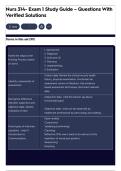
Nurs 314- Exam 1 Study Guide – Questions With
Verified Solutions
Save
Terms in this set (99)
1. Assessment
2. Diagnosis
Name the steps to the
3. Outcome ID
Nursing Process, based
4. Planning
on Jarvis
5. Implementing
6. Evaluation
Collect data: Review the clinical record, health
history, physical examination, functional/risk
Identify components of
assessment, review of literature. Use evidence
Assessment
based assessment techniques, document relevant
data
Subjective data- what the person say about
Recognize difference
him/herself (pain)
between subjective and
objective data, identify
Objective data- what can be observed by
examples of each
healthcare professional by percussing, auscultating...
Open-ended
Closed-end
Know types of interview Validating (confirming)
questions - slide 11 Clarifying
Introduction to Reflective (This one is hard to do well as it is the
Communication... repetition of words just spoken.)
Sequencing
Directing
, Therapeutic communication includes nonverbal
communication that allows patient to feel at ease
Recognize Therapeutic
(posture, active listening, equal status seating, etc.)
versus Non-therapeutic
and involves empathy.
communication
Non-therapeutic communication can involve
techniques.
excessive note taking, asking closed-ended
questions, and leading questions.
Providing false assurance
Giving unwanted advice
Using authority
Using avoidance language
Engaging in distancing (using "the" instead of "my";
Traps of interviewing using pass away)
Using professional jargon
Using leading or biased questions
Talking too much
Interrupting
Using "Why" questions
General survey gives overall impression of pt. @ first
encounter
Physical Appearance
Components of a general Body Structure
survey Mobility
Behavior
Measurement
Vital Signs
On admission to healthcare agency to gather
baseline data
Agency policy and procedures
Changes in patient's condition
When to assess VS Before and after surgery or invasive procedures
Before and after surgical activity that may increase
risk
Before administering meds that affect
cardiovascular or respiratory functioning
, Vasodilation
Sources of heat loss,
Diaphoresis (sweating profusely), evaporation
other factors affecting
Increased respiration
body temp
Excretion of urine and feces
Radial
Ulnar
Brachial
Location of pulse points Carotid
and what is assessed for Femoral
Popliteal
Posterior Tibial
Dorsalis Pedis
Respiration controlled by Medulla & Pons
Age -respiratory rate decreases with age starting
with newborns who have a RR of 30 - 60/min.
Gender - men tend to have more diaphragmatic
movements and women use more intercostal
movement.
Exercise- increases RR during exertion, decreases it
at rest.
Pathological conditions- will effect the rate, depth
and movements of respiration.
Factors affecting
Alterations in fluid, electrolyte and acid balances
respiration
such as acidosis and hyperventilation affect the PH
balance that how the body's regulatory systems
attempts to compensate through the respiratory
center.
Medications (narcotics) and trauma such as head
injury can slow the RR down.
Infection will speed up body metabolism causing
fever and increase the RR.
Pain and anxiety activate the sympathetic nervous
system that increases the RR.
Korotkoff sounds - which First K sound is systole
ones to record for bp No more K sounds mean diastole
reading
, The pulse pressure is the difference between the
systolic and diastolic pressures and reflects the
Pulse Pressure - stroke volume
definition, significance
Represents the force that the heart generates each
time it contracts
Little Cuff- false high BP reading
BP: Effects of big BP cuff,
little cuff
Big Cuff- false low BP reading
Importance of palpating Need to ensure that the cuff is correctly placed in
arterial pulse before order to completely occlude artery. Failure to place
taking BP correctly can lead to incorrect auscultation.
Age: increases with age
Sex: After puberty, females have lower BP; after
menopause females have higher BP
Race: African-American adult's BP higher than white
person of same age; hypertension twice as high in
African-Americans than Caucasian-Americans
(genetics)
Diurnal rhythm: daily cycle of peaks/troughs
Factors affecting bp
Weight: BP higher with higher weights
Exercise: Increased activity yields increase in BP,
lower at rest
Emotions: BP increases with fear, anger, pain
Stress: BP elevated with continual stress
Sodium intake
T: 98.6°F or 37°C
Normal values of T-P-R- P: 60-100 bpm
BP R: 12-20
BP: 120/80
Verified Solutions
Save
Terms in this set (99)
1. Assessment
2. Diagnosis
Name the steps to the
3. Outcome ID
Nursing Process, based
4. Planning
on Jarvis
5. Implementing
6. Evaluation
Collect data: Review the clinical record, health
history, physical examination, functional/risk
Identify components of
assessment, review of literature. Use evidence
Assessment
based assessment techniques, document relevant
data
Subjective data- what the person say about
Recognize difference
him/herself (pain)
between subjective and
objective data, identify
Objective data- what can be observed by
examples of each
healthcare professional by percussing, auscultating...
Open-ended
Closed-end
Know types of interview Validating (confirming)
questions - slide 11 Clarifying
Introduction to Reflective (This one is hard to do well as it is the
Communication... repetition of words just spoken.)
Sequencing
Directing
, Therapeutic communication includes nonverbal
communication that allows patient to feel at ease
Recognize Therapeutic
(posture, active listening, equal status seating, etc.)
versus Non-therapeutic
and involves empathy.
communication
Non-therapeutic communication can involve
techniques.
excessive note taking, asking closed-ended
questions, and leading questions.
Providing false assurance
Giving unwanted advice
Using authority
Using avoidance language
Engaging in distancing (using "the" instead of "my";
Traps of interviewing using pass away)
Using professional jargon
Using leading or biased questions
Talking too much
Interrupting
Using "Why" questions
General survey gives overall impression of pt. @ first
encounter
Physical Appearance
Components of a general Body Structure
survey Mobility
Behavior
Measurement
Vital Signs
On admission to healthcare agency to gather
baseline data
Agency policy and procedures
Changes in patient's condition
When to assess VS Before and after surgery or invasive procedures
Before and after surgical activity that may increase
risk
Before administering meds that affect
cardiovascular or respiratory functioning
, Vasodilation
Sources of heat loss,
Diaphoresis (sweating profusely), evaporation
other factors affecting
Increased respiration
body temp
Excretion of urine and feces
Radial
Ulnar
Brachial
Location of pulse points Carotid
and what is assessed for Femoral
Popliteal
Posterior Tibial
Dorsalis Pedis
Respiration controlled by Medulla & Pons
Age -respiratory rate decreases with age starting
with newborns who have a RR of 30 - 60/min.
Gender - men tend to have more diaphragmatic
movements and women use more intercostal
movement.
Exercise- increases RR during exertion, decreases it
at rest.
Pathological conditions- will effect the rate, depth
and movements of respiration.
Factors affecting
Alterations in fluid, electrolyte and acid balances
respiration
such as acidosis and hyperventilation affect the PH
balance that how the body's regulatory systems
attempts to compensate through the respiratory
center.
Medications (narcotics) and trauma such as head
injury can slow the RR down.
Infection will speed up body metabolism causing
fever and increase the RR.
Pain and anxiety activate the sympathetic nervous
system that increases the RR.
Korotkoff sounds - which First K sound is systole
ones to record for bp No more K sounds mean diastole
reading
, The pulse pressure is the difference between the
systolic and diastolic pressures and reflects the
Pulse Pressure - stroke volume
definition, significance
Represents the force that the heart generates each
time it contracts
Little Cuff- false high BP reading
BP: Effects of big BP cuff,
little cuff
Big Cuff- false low BP reading
Importance of palpating Need to ensure that the cuff is correctly placed in
arterial pulse before order to completely occlude artery. Failure to place
taking BP correctly can lead to incorrect auscultation.
Age: increases with age
Sex: After puberty, females have lower BP; after
menopause females have higher BP
Race: African-American adult's BP higher than white
person of same age; hypertension twice as high in
African-Americans than Caucasian-Americans
(genetics)
Diurnal rhythm: daily cycle of peaks/troughs
Factors affecting bp
Weight: BP higher with higher weights
Exercise: Increased activity yields increase in BP,
lower at rest
Emotions: BP increases with fear, anger, pain
Stress: BP elevated with continual stress
Sodium intake
T: 98.6°F or 37°C
Normal values of T-P-R- P: 60-100 bpm
BP R: 12-20
BP: 120/80