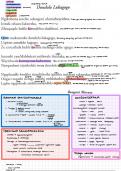
Composition of the Cell
● Cytoplasm- Cellular jelly in which organelles are suspended and give forms to the cell.
● Centriole- Aid in cellular division.
● Mitochondria- Powerhouse of the cell.
● Smooth ER (Endoplasmic Reticulum)- Makes lipids (fats) and packages proteins to be
delivered out of the cell.
● Nuclear Membrane- Protects the nucleus and nucleolus and helps to transport DNA
material from the nucleus.
● Ribosome- Protein factories.
● Golgi Body (Golgi Apparatus)- Changes, package, and transports materials out of the
cell.
● Rough ER- Same as smooth ER but contains ribosomes.
● Cell Membrane- Protects the cell from the outside environment and gives the cell its
shape.
● Nucleus- The brain of the cell which contains DNA and is responsible for all cell
functions.
Bacteria
● Microorganisms are measured in microns, which means they’re extremely small to the
naked eye.
● All bacteria consist of one cell (unicellular) and reproduce by binary fission.
● Bacteria require food, water, and warm temperatures to survive.
● Bacteria requiring oxygen are referred to as aerobic.
● Bacteria that don’t require oxygen are referred to as anaerobic.
Bacteria come in various shapes:
● Cocci- Round or sphere-shaped.
● Bacilli- Rod-shaped.
● Spirochetes- Spiral-shaped.
● Vibrios- Shaped like a comma.
● Diplococci- Shape is formed in pairs.
● Staphylococci- Shape is formed in clusters.
● Streptococci- Shape is formed in chains.
Different Types of Bacteria
● Bacteria can be classified as gram-positive or gram-negative.
Gram-Positive Bacteria Gram-Negative Bacteria
Stain the colors blue or purple when Stain the colors red or pink.
placed underneath the microscope.
Considered to be more complex than
positive because their cell walls (outer
layer of the cell) consist of more
ingredients within their cell walls.
Examples: Examples:
● Cytoplasm- Cellular jelly in which organelles are suspended and give forms to the cell.
● Centriole- Aid in cellular division.
● Mitochondria- Powerhouse of the cell.
● Smooth ER (Endoplasmic Reticulum)- Makes lipids (fats) and packages proteins to be
delivered out of the cell.
● Nuclear Membrane- Protects the nucleus and nucleolus and helps to transport DNA
material from the nucleus.
● Ribosome- Protein factories.
● Golgi Body (Golgi Apparatus)- Changes, package, and transports materials out of the
cell.
● Rough ER- Same as smooth ER but contains ribosomes.
● Cell Membrane- Protects the cell from the outside environment and gives the cell its
shape.
● Nucleus- The brain of the cell which contains DNA and is responsible for all cell
functions.
Bacteria
● Microorganisms are measured in microns, which means they’re extremely small to the
naked eye.
● All bacteria consist of one cell (unicellular) and reproduce by binary fission.
● Bacteria require food, water, and warm temperatures to survive.
● Bacteria requiring oxygen are referred to as aerobic.
● Bacteria that don’t require oxygen are referred to as anaerobic.
Bacteria come in various shapes:
● Cocci- Round or sphere-shaped.
● Bacilli- Rod-shaped.
● Spirochetes- Spiral-shaped.
● Vibrios- Shaped like a comma.
● Diplococci- Shape is formed in pairs.
● Staphylococci- Shape is formed in clusters.
● Streptococci- Shape is formed in chains.
Different Types of Bacteria
● Bacteria can be classified as gram-positive or gram-negative.
Gram-Positive Bacteria Gram-Negative Bacteria
Stain the colors blue or purple when Stain the colors red or pink.
placed underneath the microscope.
Considered to be more complex than
positive because their cell walls (outer
layer of the cell) consist of more
ingredients within their cell walls.
Examples: Examples: