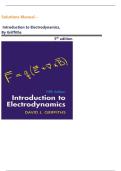
Solutions Manual –
Introduction to Electrodynamics,
By Griffiths
5th edition
,Contents
1 Vector Analysis 4
2 Electrostatics 26
3 Potential 53
4 Electric Fields in Matter 92
5 Magnetostatics 110
6 Magnetic Fields in Matter 133
7 Electrodynamics 145
8 Conservation Laws 168
9 Electromagnetic Waves 185
10 Potentials and Fields 210
11 Radiation 231
12 Electrodynamics and Relativity 262
,Chapter 1
Vector Analysis
Problem 1.1
✒
✣
}
(a) From the diagram, |B + C| cos ✓3 = |B| cos ✓1 + |C| cos ✓2 . Multiply by |A|.
|A||B + C| cos ✓3 = |A||B| cos ✓1 + |A||C| cos ✓2 . |C| sin θ2
So: A·(B + C) = A·B + A·C. (Dot product is distributive)
Θ2
Similarly: |B + C| sin ✓3 = |B| sin ✓1 + |C| sin ✓2 . Mulitply by |A| n̂. Θ3 ✯
|A||B + C | sin ✓3 n̂ = | A|| B| sin ✓1 n̂ + | A|| C| sin ✓2 n̂.
} ✲A
|B| sin θ
Θ1
If n̂ is the unit vector pointing out of the page, it follows that ` ˛¸ x` ˛¸ x 1
|B| cos θ1 |C| cos θ2
A⇥(B + C) = (A⇥B) + (A⇥C). (Cross product is distributive)
(b) For the general case, see G. E. Hay’s Vector and Tensor Analysis, Chapter 1, Section 7 (dot product) and
Section 8 (cross product)
Problem 1.2 C
✻
The triple cross-product is not in general associative. For example,
suppose A = B and C is perpendicular to A, as in the diagram. ✲A=B
Then (B⇥C) points out-of-the-page, and A⇥(B⇥C) points down, ❂
And has magnitude ABC. But (A⇥B) = 0, so (A⇥B)⇥C = 0
B×C ❄
A×(B×C)
A⇥(B⇥C).
Problem 1.3 z✻
p p
A = +1 x̂ + 1 ŷ — 1 ẑ; A = 3; B = 1 x̂ + 1 ŷ + 1 ẑ; B = 3.
p p ✣B
A·B = +1 + 1 — 1 = 1 = AB cos ✓ = 3 3 cos ✓ ) cos ✓ = 13 . θ
✲Y
✓ = cos—
1 1
3 ⇡ 70.5288○ ❲
✰ A
X
Problem 1.4
The cross-product of any two vectors in the plane will give a vector perpendicular to the plane. For example,
we might pick the base (A) and the left side (B):
A = —1 x̂ + 2 ŷ + 0 ẑ; B = —1 x̂ + 0 ŷ + 3 ẑ.
, x̂ ŷ ẑ
. .
⇥ .— .
A B = . 11 20 3 0 = 6 x̂ + 3 ŷ + 2 ẑ.
.
This has the right direction, but the wrong magnitude. To make a unit vector out of it, simply divide by its
Length: —
p
|A⇥B| = 36 + 9 + 4 = 7. n̂ = A⇥B = 67 x̂ + 73 ŷ + 72ẑ .
|A⇥B|
Problem 1.5
. x̂ Ŷ ẑ .
A⇥(B⇥C) = . Ax Ay Az .
.( Bycz — bzcy ) (bzcx — bxcz ) (bxcy — bycx .)
— — —
= x̂[A y (b x c y b y c x ) A z (b
(i’ll just check the x-component; the othersz c x bx cz )]go
+ the + ẑ() way)
ŷ() same
= x̂(ay bx cy — ay by cx — az bz cx + az bx cz ) + ŷ() + ẑ().
B(A·C) — C(A·B) = [Bx (ax cx + ay cy + az cz ) — Cx (ax bx + ay by + az bz )] x̂ + () ŷ + () ẑ
= x̂(ay bx cy + az bx cz — ay by cx — az bz cx ) + ŷ() + ẑ(). They agree.
Problem 1.6
A⇥(B⇥C)+B⇥(C⇥A)+C⇥(A⇥B) = B(A·C)—C(A·B)+C(A·B)—A(C·B)+A(B·C)—B(C·A) = 0.
So: A⇥(B⇥C) — (A⇥B)⇥C = —B⇥(C⇥A) = A(B·C) — C(A·B).
If this is zero, then either A is parallel to C (including the case in which they point in opposite directions, or
one is zero), or else B·C = B·A = 0, in which case B is perpendicular to A and C (including the case B = 0.)
Conclusion: A⇥(B⇥C) = (A⇥B)⇥C () either A is parallel to C, or B is perpendicular to A and C.
Problem 1.7
= (4 x̂ + 6 ŷ + 8 ẑ) — (2 x̂ + 8 ŷ + 7 ẑ) = 2 x̂ — 2 ŷ + ẑ
p
= 4+4+1= 3
ˆ = = 2 2
— 3 ŷ + 31ẑ
3 x̂
Problem 1.8
(a) Āy B̄y + Āz B̄z = (cos $Ay + sin $Az )(cos $By + sin $Bz ) + ( —sin $Ay + cos $Az )( —sin $By + cos $Bz )
= cos2 $ayby + sin $ cos $(aybz + azby) + sin2 $azbz + sin2 $ayby — sin $ cos $(aybz + azby) +
cos $azbz
2
= (cos2 $ + sin2 $)ayby + (sin2 $ + cos2 $)azbz = ayby + azbz. X
(b) (Ax)2 + (Ay)2 + (Az)2 = ⌃3 Aiai = ⌃3 ⌃J= Rijaj ⌃
3 3 Rikak = ⌃j,k (⌃irij Rik) Aj Ak.
i=1 i=1 1 k=1
⇢
This equals Ax2 + A2y + A2zprovided ⌃3i=1 R R = if jj =
01 if k
6=k
ij ik
Moreover, if R is to preserve lengths for all vectors A, then this condition is not only sufficient but also
Necessary. For suppose A = (1, 0, 0). Then ⌃j,k (⌃i rijrik) ajak = ⌃i Ri1Ri1, and this must equal 1 (since we
WantA x2 +A y2 +A z2 = 1). Likewise, ⌃i=1
3 R R = ⌃3 R R = 1. To check the case j 6= k, choose A = (1, 1, 0).
i2 i2 i=1 i3 i3
Then we want 2 = ⌃j,k (⌃i rijrik) ajak = ⌃i Ri1Ri1 + ⌃i Ri2Ri2 + ⌃i Ri1Ri2 + ⌃i Ri2Ri1. But we already
know that the first two sums are both 1; the third and fourth are equal, so ⌃i Ri1Ri2 = ⌃i Ri2Ri1 = 0, and so
on for other unequal combinations of j, k. X In matrix notation: R̃R = 1, where R̃ is the transpose of R.
Introduction to Electrodynamics,
By Griffiths
5th edition
,Contents
1 Vector Analysis 4
2 Electrostatics 26
3 Potential 53
4 Electric Fields in Matter 92
5 Magnetostatics 110
6 Magnetic Fields in Matter 133
7 Electrodynamics 145
8 Conservation Laws 168
9 Electromagnetic Waves 185
10 Potentials and Fields 210
11 Radiation 231
12 Electrodynamics and Relativity 262
,Chapter 1
Vector Analysis
Problem 1.1
✒
✣
}
(a) From the diagram, |B + C| cos ✓3 = |B| cos ✓1 + |C| cos ✓2 . Multiply by |A|.
|A||B + C| cos ✓3 = |A||B| cos ✓1 + |A||C| cos ✓2 . |C| sin θ2
So: A·(B + C) = A·B + A·C. (Dot product is distributive)
Θ2
Similarly: |B + C| sin ✓3 = |B| sin ✓1 + |C| sin ✓2 . Mulitply by |A| n̂. Θ3 ✯
|A||B + C | sin ✓3 n̂ = | A|| B| sin ✓1 n̂ + | A|| C| sin ✓2 n̂.
} ✲A
|B| sin θ
Θ1
If n̂ is the unit vector pointing out of the page, it follows that ` ˛¸ x` ˛¸ x 1
|B| cos θ1 |C| cos θ2
A⇥(B + C) = (A⇥B) + (A⇥C). (Cross product is distributive)
(b) For the general case, see G. E. Hay’s Vector and Tensor Analysis, Chapter 1, Section 7 (dot product) and
Section 8 (cross product)
Problem 1.2 C
✻
The triple cross-product is not in general associative. For example,
suppose A = B and C is perpendicular to A, as in the diagram. ✲A=B
Then (B⇥C) points out-of-the-page, and A⇥(B⇥C) points down, ❂
And has magnitude ABC. But (A⇥B) = 0, so (A⇥B)⇥C = 0
B×C ❄
A×(B×C)
A⇥(B⇥C).
Problem 1.3 z✻
p p
A = +1 x̂ + 1 ŷ — 1 ẑ; A = 3; B = 1 x̂ + 1 ŷ + 1 ẑ; B = 3.
p p ✣B
A·B = +1 + 1 — 1 = 1 = AB cos ✓ = 3 3 cos ✓ ) cos ✓ = 13 . θ
✲Y
✓ = cos—
1 1
3 ⇡ 70.5288○ ❲
✰ A
X
Problem 1.4
The cross-product of any two vectors in the plane will give a vector perpendicular to the plane. For example,
we might pick the base (A) and the left side (B):
A = —1 x̂ + 2 ŷ + 0 ẑ; B = —1 x̂ + 0 ŷ + 3 ẑ.
, x̂ ŷ ẑ
. .
⇥ .— .
A B = . 11 20 3 0 = 6 x̂ + 3 ŷ + 2 ẑ.
.
This has the right direction, but the wrong magnitude. To make a unit vector out of it, simply divide by its
Length: —
p
|A⇥B| = 36 + 9 + 4 = 7. n̂ = A⇥B = 67 x̂ + 73 ŷ + 72ẑ .
|A⇥B|
Problem 1.5
. x̂ Ŷ ẑ .
A⇥(B⇥C) = . Ax Ay Az .
.( Bycz — bzcy ) (bzcx — bxcz ) (bxcy — bycx .)
— — —
= x̂[A y (b x c y b y c x ) A z (b
(i’ll just check the x-component; the othersz c x bx cz )]go
+ the + ẑ() way)
ŷ() same
= x̂(ay bx cy — ay by cx — az bz cx + az bx cz ) + ŷ() + ẑ().
B(A·C) — C(A·B) = [Bx (ax cx + ay cy + az cz ) — Cx (ax bx + ay by + az bz )] x̂ + () ŷ + () ẑ
= x̂(ay bx cy + az bx cz — ay by cx — az bz cx ) + ŷ() + ẑ(). They agree.
Problem 1.6
A⇥(B⇥C)+B⇥(C⇥A)+C⇥(A⇥B) = B(A·C)—C(A·B)+C(A·B)—A(C·B)+A(B·C)—B(C·A) = 0.
So: A⇥(B⇥C) — (A⇥B)⇥C = —B⇥(C⇥A) = A(B·C) — C(A·B).
If this is zero, then either A is parallel to C (including the case in which they point in opposite directions, or
one is zero), or else B·C = B·A = 0, in which case B is perpendicular to A and C (including the case B = 0.)
Conclusion: A⇥(B⇥C) = (A⇥B)⇥C () either A is parallel to C, or B is perpendicular to A and C.
Problem 1.7
= (4 x̂ + 6 ŷ + 8 ẑ) — (2 x̂ + 8 ŷ + 7 ẑ) = 2 x̂ — 2 ŷ + ẑ
p
= 4+4+1= 3
ˆ = = 2 2
— 3 ŷ + 31ẑ
3 x̂
Problem 1.8
(a) Āy B̄y + Āz B̄z = (cos $Ay + sin $Az )(cos $By + sin $Bz ) + ( —sin $Ay + cos $Az )( —sin $By + cos $Bz )
= cos2 $ayby + sin $ cos $(aybz + azby) + sin2 $azbz + sin2 $ayby — sin $ cos $(aybz + azby) +
cos $azbz
2
= (cos2 $ + sin2 $)ayby + (sin2 $ + cos2 $)azbz = ayby + azbz. X
(b) (Ax)2 + (Ay)2 + (Az)2 = ⌃3 Aiai = ⌃3 ⌃J= Rijaj ⌃
3 3 Rikak = ⌃j,k (⌃irij Rik) Aj Ak.
i=1 i=1 1 k=1
⇢
This equals Ax2 + A2y + A2zprovided ⌃3i=1 R R = if jj =
01 if k
6=k
ij ik
Moreover, if R is to preserve lengths for all vectors A, then this condition is not only sufficient but also
Necessary. For suppose A = (1, 0, 0). Then ⌃j,k (⌃i rijrik) ajak = ⌃i Ri1Ri1, and this must equal 1 (since we
WantA x2 +A y2 +A z2 = 1). Likewise, ⌃i=1
3 R R = ⌃3 R R = 1. To check the case j 6= k, choose A = (1, 1, 0).
i2 i2 i=1 i3 i3
Then we want 2 = ⌃j,k (⌃i rijrik) ajak = ⌃i Ri1Ri1 + ⌃i Ri2Ri2 + ⌃i Ri1Ri2 + ⌃i Ri2Ri1. But we already
know that the first two sums are both 1; the third and fourth are equal, so ⌃i Ri1Ri2 = ⌃i Ri2Ri1 = 0, and so
on for other unequal combinations of j, k. X In matrix notation: R̃R = 1, where R̃ is the transpose of R.