
A&P Final Exam
Study online at https://quizlet.com/_6ynd0
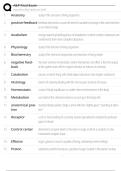
1. Anatomy study of the structure of living organisms
2. positive feedback feedback that tends to cause the level of a variable to change in the same direction
as an initial change
3. Anabolism energy-requiring building phase of metabolism in which simpler substances are
combined to form more complex substances
4. Physiology study of the function of living organisms
5. Biochemistry study of the chemical composition and reactions of living matter
6. negative feed- the most common homeostatic control mechanism; net effect is that the output
back of the system shuts off the original stimulus or reduces its intensity
7. Catabolism process in which living cells break down substances into simpler substances
8. Histology branch of anatomy dealing with the microscopic structure of tissues
9. Homeostasis a state of body equilibrium or stable internal environment of the body
10. Metabolism sum total of the chemical reactions occurring in the body cells
11. anatomical posi- standard body position; body is erect with feet slightly apart; "standing at atten-
tion tion"
12. Receptor a cell or nerve ending of a sensory neuron specialized to respond to particular
types of stimuli
13. Control center determines set point which is the level or range at which a variable is to be
maintained; analyzes input
14. Effector organ, gland, or muscle capable of being activated by nerve endings
15. Proton subatomic particle that bears a positive charge; located in the atomic nucleus
, A&P Final Exam
Study online at https://quizlet.com/_6ynd0
16. Neutron uncharged subatomic particle; found in the atomic nucleus
17. Electron negatively charged subatomic particle; orbits the atom's nucleus
18. Atom, (element) smallest particle of an elemental substance that exhibits the properties of that
element; composed of protons, neutrons, & electrons
19. Molecule particle consisting of 2 or more atoms joined together by chemical bonds
20. Organelle small cellular structures (ribosomes, mitochondria, & others) that perform specific
metabolic functions for the cell as a whole
21. Cell structural unit of all living things
22. Tissue a group of similar cells & their intercellular substance specialized to perform
a specific function; primary tissue types of the body are epithelial, connective,
muscle, & nervous tissue
23. Organ a part of the body formed of 2 or more tissues & adapted to carry out a specific
function
24. Organ System a group of organs that work together to perform a vital body function
25. Organism the living animal (or plant), which represents the sum total of all its organ systems
working together to maintain life
26. Sagittal (mid & a longitudinal (vertical) plane that divides the body or any of its parts into right &
para) left portions
27. Frontal (coronal) longitudinal (vertical) plane that divides the body or an organ into anterior &
posterior parts
28. Transverse a plane running from right to left, dividing or an organ into superior & inferior
parts
, A&P Final Exam
Study online at https://quizlet.com/_6ynd0
29. pH unit the measure of the relative acidity or alkalinity of a solution
30. ionic bond chemical bond formed by electron transfer between atoms
31. Monosaccharide literally, one sugar; building block of carbohydrates; e.g., glucose
32. Disaccharide literally, double sugar; e.g., sucrose, lactose
33. Buffer chemical substance or system that minimizes changes in pH by releasing or
binding hydrogen ions
34. covalent bond chemical bond created by electron sharing between atoms
35. Polysaccharide literally, many sugars, a polymer of linked monosaccharides; e.g., starch, glycogen
36. Glycerol a modified simple sugar (a sugar alcohol); a building block of fats
37. Acid a substance that releases hydrogen ions when in solution; a proton donor
38. hydrogen bond weak bond in which a hydrogen atom forms a bridge between 2 electron-hungry
atoms; an important intramolecular bond
39. fatty acid linear chains of carbon & hydrogen atoms (hydrocarbon chains) with an organic
acid group at 1 end; a constituent of fat
40. nucleic acids class of organic molecules that includes DNA & RNA
41. Base a substance capable of binding with hydrogen ions; a proton acceptor
42. Anion an ion carrying 1 or more negative charges & therefore attracted to a positive pole
43. Organic pertaining to carbon-containing molecules, such as proteins, fats, & carbohy-
drates
44. Inorganic com- chemical substances that do not contain carbon, including water, salts, & many
pound acids & bases
Study online at https://quizlet.com/_6ynd0
1. Anatomy study of the structure of living organisms
2. positive feedback feedback that tends to cause the level of a variable to change in the same direction
as an initial change
3. Anabolism energy-requiring building phase of metabolism in which simpler substances are
combined to form more complex substances
4. Physiology study of the function of living organisms
5. Biochemistry study of the chemical composition and reactions of living matter
6. negative feed- the most common homeostatic control mechanism; net effect is that the output
back of the system shuts off the original stimulus or reduces its intensity
7. Catabolism process in which living cells break down substances into simpler substances
8. Histology branch of anatomy dealing with the microscopic structure of tissues
9. Homeostasis a state of body equilibrium or stable internal environment of the body
10. Metabolism sum total of the chemical reactions occurring in the body cells
11. anatomical posi- standard body position; body is erect with feet slightly apart; "standing at atten-
tion tion"
12. Receptor a cell or nerve ending of a sensory neuron specialized to respond to particular
types of stimuli
13. Control center determines set point which is the level or range at which a variable is to be
maintained; analyzes input
14. Effector organ, gland, or muscle capable of being activated by nerve endings
15. Proton subatomic particle that bears a positive charge; located in the atomic nucleus
, A&P Final Exam
Study online at https://quizlet.com/_6ynd0
16. Neutron uncharged subatomic particle; found in the atomic nucleus
17. Electron negatively charged subatomic particle; orbits the atom's nucleus
18. Atom, (element) smallest particle of an elemental substance that exhibits the properties of that
element; composed of protons, neutrons, & electrons
19. Molecule particle consisting of 2 or more atoms joined together by chemical bonds
20. Organelle small cellular structures (ribosomes, mitochondria, & others) that perform specific
metabolic functions for the cell as a whole
21. Cell structural unit of all living things
22. Tissue a group of similar cells & their intercellular substance specialized to perform
a specific function; primary tissue types of the body are epithelial, connective,
muscle, & nervous tissue
23. Organ a part of the body formed of 2 or more tissues & adapted to carry out a specific
function
24. Organ System a group of organs that work together to perform a vital body function
25. Organism the living animal (or plant), which represents the sum total of all its organ systems
working together to maintain life
26. Sagittal (mid & a longitudinal (vertical) plane that divides the body or any of its parts into right &
para) left portions
27. Frontal (coronal) longitudinal (vertical) plane that divides the body or an organ into anterior &
posterior parts
28. Transverse a plane running from right to left, dividing or an organ into superior & inferior
parts
, A&P Final Exam
Study online at https://quizlet.com/_6ynd0
29. pH unit the measure of the relative acidity or alkalinity of a solution
30. ionic bond chemical bond formed by electron transfer between atoms
31. Monosaccharide literally, one sugar; building block of carbohydrates; e.g., glucose
32. Disaccharide literally, double sugar; e.g., sucrose, lactose
33. Buffer chemical substance or system that minimizes changes in pH by releasing or
binding hydrogen ions
34. covalent bond chemical bond created by electron sharing between atoms
35. Polysaccharide literally, many sugars, a polymer of linked monosaccharides; e.g., starch, glycogen
36. Glycerol a modified simple sugar (a sugar alcohol); a building block of fats
37. Acid a substance that releases hydrogen ions when in solution; a proton donor
38. hydrogen bond weak bond in which a hydrogen atom forms a bridge between 2 electron-hungry
atoms; an important intramolecular bond
39. fatty acid linear chains of carbon & hydrogen atoms (hydrocarbon chains) with an organic
acid group at 1 end; a constituent of fat
40. nucleic acids class of organic molecules that includes DNA & RNA
41. Base a substance capable of binding with hydrogen ions; a proton acceptor
42. Anion an ion carrying 1 or more negative charges & therefore attracted to a positive pole
43. Organic pertaining to carbon-containing molecules, such as proteins, fats, & carbohy-
drates
44. Inorganic com- chemical substances that do not contain carbon, including water, salts, & many
pound acids & bases

