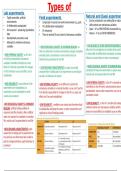
Lab experiments
Types of
•
•
Tightly controlled, artificial
environments
IV deliberately manipulated
• Experiments
Field experiments
Conducted in natural real world environments e.g. park
Natural and Quasi experimen
•
•
Can be conducted in any setting (lab or natura
Little control over extraneous variables
• IV is deliberately manipulated
• DV measured – producing Quantitative • • Quasi – IV is a PRE-EXISTING characteristic e.g
DV measured
data • • Natural – IV is an EVENT/EXPERIENCE
There is minimal (if any) control of extraneous variables
• Standardised procedures used
• Attempts to minimise extraneous
variables + HIGH ECOLOGICAL VALIDITY & MUNDANE REALISM: as + CAN BE USED TO STUDY SENSITIVE RESEARCH Q
they’re conducted in natural environments and ppts complete allow for the investigation of variables that would
+ HIGH INTERNAL VALIDITY: as IV is the everyday tasks, so behaviour is more natural and can or impossible to deliberately manipulate, meaning
only thing manipulated, Extraneous therefore be generalised to real life ethical to conduct them in these circumstances
variables controlled, therefore its more
likely IV is directly responsible for changes + LOW DEMAND CHARACTERISTICS: as ppts are usually + HIGH ECOLOGICAL VALIDITY & MUNDANE REAL
on DV, therefore cause and effect can be unaware they’re taking part in an experiment so wont figure conducted in Natural environments or given every
established out aim, so behaviour is natural natural and can be generalised to real life
+ HIGH RELIABILITY: as procedures in lab -LOW INTERNAL VALIDITY: as its difficult to control the -LOW INTERNAL VALIDITY: as the IV is naturally oc
experiments are standardised, so extraneous variables in a natural situation, so we can’t say the sometimes a one off event, and procedures may n
experiment can be replicated to check IV is directly responsible for changes in the DV, so cause and standardised, means other researchers can not rep
results are consistent effect can’t be easily established consistent results
-LOW ECOLOGICAL VALIDITY & MUNDANE -LOW RELIABILITY : conditions are natural and therefore hard -LOW RELIABILITY : as the IV is not directly manipu
REALISM: artificial setting unlikely to to standardise and keep the same, so other researchers can’t minimal control over extraneous variables which c
represent real life situation, often artificial replicate to check if findings match means its more difficult to establish cause an effec
tasks not required to complete in everyday
life, results can’t be generalised to real life
-HIGH DEMAND CHARACTERISTICS: ppts
aware they’re taking part in experiment so
may pick up cues that reveal aim, leads to
ppts to change behaviour, ppts behaviour is
unnatural
, Repeated Measures
Experimental
Design
• Involves using the SAME people in each • Designs
Independent Groups Design Matched pairs Design
Involves using different people in each
condition of the IV and comparing the groups
• Involves using Different participants in each conditio
but participants in one condition a matched with pa
condition of the IV
• Every ppt does BOTH conditions of an performance the other condition on important key variables that
IV • Half ppt does condition A, half does condition to the investigation E.G.gender, age.
B (control) • Participants are matched in pairs, and then each pai
+ PARTICIPANT VARIABLES ARE so that one individual does condition A and all the in
CONTROLLED FOR: this is because the same + LESS CHANCE OF DEMAND CHARACTERISTICS : does condition B
ppt takes part in both conditions, so there This is because participants take part in one
are no individual differences in factors like condition and so are unaware of what is being + LESS CHANCE OF DEMAND CHARACTERISTICS, INDIVID
age, gender, intelligence. This means the DV manipulated. This means the DV is unlikely to be DIFFERENCES AND PRACTICE EFFECTS : This is because p
is not affected by participant variables, so affected by the participants working out the aim of only take part in one condition. Therefore they are LESS l
any difference between conditions is likely the study and changing their behaviour, so only guess the aim of the study and change their behaviour, a
to be down to the IV difference between conditions is likely to be down behaviour is not altered as a result of practice/tiredness/
to the IV Also, because participants are similar in each condition, t
-DEMAND CHARACTERISTICS : This is fewer differences between the groups. This means that t
because participants take art in both -LESS CHANCE OF ORDER EFFECTS : This is because unlikely to be affected by factors other than the IV
conditions so they become aware of what participants only take part in one condition of the
has been manipulated. This means the DV is experiment. This means the DV is unlikely to be -MATCHED PAIRS ARE EXTREMLY DIFFICULT TO ACHIEVE
likely to be affected by participants working affected by tiredness/boredom/practice, so any because it is a very lengthy process too much participant
out the aim of the study and changing their difference between conditions it’s likely to be down become almost a research study in its self and can becom
behaviour. to the IV and time-consuming. This means matched pairs is really u
psychological research as it is less practical
-ORDER EFFECTS: This is because ppts take -INDIVIDUAL DIFFERENCES ARE NOT CONTROLLED
Part in both conditions so performance on FOR: There are individual differences between
the task which is completed the second participants because different participants take part
time is likely to be either improved through in each condition so they will be participant
practice, or worsened through boredom. variability in factors like age, gender, intelligence.
This means the DV is likely to be affected by This means the DV is likely to be affected by
these factors, rather than the IV participant variables, and this may explain why one
However counter balancing can be used as group performed better than the other
a method to overcome this
Types of
•
•
Tightly controlled, artificial
environments
IV deliberately manipulated
• Experiments
Field experiments
Conducted in natural real world environments e.g. park
Natural and Quasi experimen
•
•
Can be conducted in any setting (lab or natura
Little control over extraneous variables
• IV is deliberately manipulated
• DV measured – producing Quantitative • • Quasi – IV is a PRE-EXISTING characteristic e.g
DV measured
data • • Natural – IV is an EVENT/EXPERIENCE
There is minimal (if any) control of extraneous variables
• Standardised procedures used
• Attempts to minimise extraneous
variables + HIGH ECOLOGICAL VALIDITY & MUNDANE REALISM: as + CAN BE USED TO STUDY SENSITIVE RESEARCH Q
they’re conducted in natural environments and ppts complete allow for the investigation of variables that would
+ HIGH INTERNAL VALIDITY: as IV is the everyday tasks, so behaviour is more natural and can or impossible to deliberately manipulate, meaning
only thing manipulated, Extraneous therefore be generalised to real life ethical to conduct them in these circumstances
variables controlled, therefore its more
likely IV is directly responsible for changes + LOW DEMAND CHARACTERISTICS: as ppts are usually + HIGH ECOLOGICAL VALIDITY & MUNDANE REAL
on DV, therefore cause and effect can be unaware they’re taking part in an experiment so wont figure conducted in Natural environments or given every
established out aim, so behaviour is natural natural and can be generalised to real life
+ HIGH RELIABILITY: as procedures in lab -LOW INTERNAL VALIDITY: as its difficult to control the -LOW INTERNAL VALIDITY: as the IV is naturally oc
experiments are standardised, so extraneous variables in a natural situation, so we can’t say the sometimes a one off event, and procedures may n
experiment can be replicated to check IV is directly responsible for changes in the DV, so cause and standardised, means other researchers can not rep
results are consistent effect can’t be easily established consistent results
-LOW ECOLOGICAL VALIDITY & MUNDANE -LOW RELIABILITY : conditions are natural and therefore hard -LOW RELIABILITY : as the IV is not directly manipu
REALISM: artificial setting unlikely to to standardise and keep the same, so other researchers can’t minimal control over extraneous variables which c
represent real life situation, often artificial replicate to check if findings match means its more difficult to establish cause an effec
tasks not required to complete in everyday
life, results can’t be generalised to real life
-HIGH DEMAND CHARACTERISTICS: ppts
aware they’re taking part in experiment so
may pick up cues that reveal aim, leads to
ppts to change behaviour, ppts behaviour is
unnatural
, Repeated Measures
Experimental
Design
• Involves using the SAME people in each • Designs
Independent Groups Design Matched pairs Design
Involves using different people in each
condition of the IV and comparing the groups
• Involves using Different participants in each conditio
but participants in one condition a matched with pa
condition of the IV
• Every ppt does BOTH conditions of an performance the other condition on important key variables that
IV • Half ppt does condition A, half does condition to the investigation E.G.gender, age.
B (control) • Participants are matched in pairs, and then each pai
+ PARTICIPANT VARIABLES ARE so that one individual does condition A and all the in
CONTROLLED FOR: this is because the same + LESS CHANCE OF DEMAND CHARACTERISTICS : does condition B
ppt takes part in both conditions, so there This is because participants take part in one
are no individual differences in factors like condition and so are unaware of what is being + LESS CHANCE OF DEMAND CHARACTERISTICS, INDIVID
age, gender, intelligence. This means the DV manipulated. This means the DV is unlikely to be DIFFERENCES AND PRACTICE EFFECTS : This is because p
is not affected by participant variables, so affected by the participants working out the aim of only take part in one condition. Therefore they are LESS l
any difference between conditions is likely the study and changing their behaviour, so only guess the aim of the study and change their behaviour, a
to be down to the IV difference between conditions is likely to be down behaviour is not altered as a result of practice/tiredness/
to the IV Also, because participants are similar in each condition, t
-DEMAND CHARACTERISTICS : This is fewer differences between the groups. This means that t
because participants take art in both -LESS CHANCE OF ORDER EFFECTS : This is because unlikely to be affected by factors other than the IV
conditions so they become aware of what participants only take part in one condition of the
has been manipulated. This means the DV is experiment. This means the DV is unlikely to be -MATCHED PAIRS ARE EXTREMLY DIFFICULT TO ACHIEVE
likely to be affected by participants working affected by tiredness/boredom/practice, so any because it is a very lengthy process too much participant
out the aim of the study and changing their difference between conditions it’s likely to be down become almost a research study in its self and can becom
behaviour. to the IV and time-consuming. This means matched pairs is really u
psychological research as it is less practical
-ORDER EFFECTS: This is because ppts take -INDIVIDUAL DIFFERENCES ARE NOT CONTROLLED
Part in both conditions so performance on FOR: There are individual differences between
the task which is completed the second participants because different participants take part
time is likely to be either improved through in each condition so they will be participant
practice, or worsened through boredom. variability in factors like age, gender, intelligence.
This means the DV is likely to be affected by This means the DV is likely to be affected by
these factors, rather than the IV participant variables, and this may explain why one
However counter balancing can be used as group performed better than the other
a method to overcome this