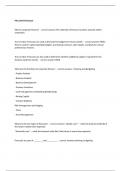
What is a coastal Landscape?
The littoral zone
Is the boundary between the land and sea. It refers to the areas from where the waves start to
interact with the seabed to the point of the very highest storm. This is a very dynamic zone which
means that it is constantly changing.
wherewinda
Offshore- the area of deeper water beyond the point at which waves begin to break. Friction between
the waves and the sea bed may cause some distortion of the wave shape.
Nearshore- the area of shallow water beyond the low tide mark, within which friction between the seabed
and waves distorts the wave sufficiently to cause it to break (breaker zone) there may be a breakpoint
bar between the offshore and nearshore zones
Foreshore- the area between the high tide and the low tide mark
Backshore- the area above the high tide mark, affected by wave action only during major storm events
The littoral zone forms 3 types of landscapes
Rocky coiffed coastline- areas of high relief varying from a few meters to hundreds of metres in
height usually form in areas with resistant geology, in a high energy environment, where erosion is
greater than deposition and big, storm waves. Destructive waves.
Sandy beach coastline- areas of low relief with sand dunes and beaches, that are much flatter. They
usually for in areas with less resistant geology, a low energy environment, where deposition happens
more than erosion and constructive waves
Estuarine coastline- areas of low relief with salt marshes and mudflats
(estuaries). They form in river mouths, where deposition happens more than
erosion, there is a low energy environment and usually in areas of less resistant
rock
Short-term factors impacting littoral zone: Long-term factors impacting littoral zone:
-waves (height, frequency and power) -climate change (changes in storm/season length
-tides -sea level change
-storms (frequency)
-human interaction (building, sediment extraction)
,Dynamic systems
-coasts are continually changing- and so it can be said that they are in a state of dynamic equilibrium
-all systems have inputs, processes and outputs
-meaning any change to one component impacts the rest of the system (removing sand at one end of
the coast will mean more erosion at the other end of the coast
Inputs Processes Outputs
-marine- waves, tides, storm -weathering -erosional landforms
surges -mass movement -depositional landforms
-atmospheric- weather/climate, -transport -coast types
climate change, solar energy -erosion
-land- rock type, structure, -deposition
tectonic activity
-Humans- coastal management
Formation Primary coasts are dominated by land-based processes such as deposition at the coast
processes from rivers or new coastal land formed from lava flows
Secondary coasts are dominated by marine erosion or deposition processes
Relative sea Emergent coasts where the coasts are rising relative to sea level, for example due
level change to tectonic uplift
Submergent coasts are being flooded by the sea, either due to rising sea levels and/
or subsiding land
Tidal range Tidal range varies hugely on coastlines, meaning coasts can be:
-microtidal coasts (tidal range of 0-2m)
-mesotidal coasts (tidal range of 2-4m)
-macrotidal coasts (tidal range >4m)
Wave energy Low energy sheltered coasts with limited fetch and low wind speeds resulting in small
waves
High energy exposed coasts, facing prevailing winds with long wave fetches resulting in
powerful waves
The littoral zone produces a distinctive landscape which can be classified into broad types of similar
coastlines. This can be classified by:
-geology- rocky, sandy, discordant, concordant
-wave energy level- high or low depending on exposure to wave action
-dominance of erosion or deposition-creates distinctive landscapes or erosion or deposition
-sea level changes- emergent or submergent coasts
Classification can be complex as some environments do not easily fit into a classification system
Fetch- the distance ocean waves have travelled and been created by the wind. The larger the body of
water the longer the fetch
,High energy coastlines Low energy coastlines
Waves- more powerful (destructive) waves, Waves- less powerful (constructive) waves,
calmer conditions, long fetches storm conditions, long fetches
Processes- erosion and transport; sediments Processes- deposition and transport; sediments
-
from eroded land, mass movement and from rivers, longshore drift and nearshore
↑
weathering, supplied by offshore currents currents
Landforms- cliffs, wave-cut platforms,
-
Landforms- beaches, spits, bars, sand dunes,
arches, sea caves, stacks mudflats, salt marshes
General locations- exposed to largest waves, General location- sheltered from large waves;
highland and low land coasts, rocky lowland coasts, coastal plain landscapes
landscape (lands end Cornwall, Atlantic coasts (Skegness, Norfolk coast)
Scotland
.
Valentin classification of coasts 1952-> measures if a coast is growing or retreating
Classifying coasts into advancing and retreating combines shorter-term erosion and deposition with
longer-term changes in sea level and land level. Resistant geology can also reduce erosion, slowing
the rate by which coasts retreat
Advancing coast (land gaining)
Z ~an A
e
X Emerging coast
Emergence
Outbuilding coast
Eroding coast
Erosion Deposition
Holderness
- Nile delta Egypt
coastline ~
Im
,
Submergence per year
med sea
Submerging coast
R Z
↓
Retreating coast (sea gaining)
SE/SW
England
Sinking 8 5cm
.
a year
, Geology and coastal morphology
Factors affecting rate of erosion
Wave type and breaking point- steep, high energy waves erode more. Waves that break near cliff erode
more
Fetch- determines how much energy the waves build up
Sea bed depth & profile- steep-sloping sea bed= late breaking waves= more erosive power
Coastline shape- headlands attract energy due to refraction of waves
Beach presence- beaches absorb wave energy and protect from erosion. Steep narrow beaches protect
flat waves, flat wide beaches protect from high energy waves. Shingle beaches are also effective at
dissipating powerful waves
Human impacts- removal of material (such as sand/shingle) for building= more erosion, building coastal
defences or beach replenishment= less erosion
Geology- generic average structure of the earth in large bands. How the most common rocks are laid
out (Concordant vs discordant)
Lithology- the specific type and qualities of rocks. Physical composition, colour and texture. Includes
permeability and resistance to Edison of a zoomed in specific space
Unconsolidated- boulder clay
There’s no which thing as hard and soft rock. Use high, medium, low resistance rock
Uk rocks resistant to erosion
↑
Pillow lava (igneous) Erodes 0.001mm a year
Granite pebbles (igneous) Erodes 1-3mm a year
Beach slate (metamorphic) Erodes 1cm a year
Resistance
Chalk (sedimentary) Erodes 2-10cm a year Erodes 2-3m
on a Erodes 4-9m on
Unconsolidated material- till, sand and gravel (sedimentary) normal a stormy year
year
Concordant Discordant
Straight line coastlines (cliffs of Wonky coastlines (bays and headlands), less
Dover)-all one rock type -> chalk resistant (swanage Bay, Dorset)
↓ ↓ ↓ I
waves ware. -
Differential erosion
Sedimentary layer
Parallel
Mud stone layer
Igneous layer
Igneous layer
rock
Mud stone layer bands
Sedimentary layer
Perpendicular
rock bands
The littoral zone
Is the boundary between the land and sea. It refers to the areas from where the waves start to
interact with the seabed to the point of the very highest storm. This is a very dynamic zone which
means that it is constantly changing.
wherewinda
Offshore- the area of deeper water beyond the point at which waves begin to break. Friction between
the waves and the sea bed may cause some distortion of the wave shape.
Nearshore- the area of shallow water beyond the low tide mark, within which friction between the seabed
and waves distorts the wave sufficiently to cause it to break (breaker zone) there may be a breakpoint
bar between the offshore and nearshore zones
Foreshore- the area between the high tide and the low tide mark
Backshore- the area above the high tide mark, affected by wave action only during major storm events
The littoral zone forms 3 types of landscapes
Rocky coiffed coastline- areas of high relief varying from a few meters to hundreds of metres in
height usually form in areas with resistant geology, in a high energy environment, where erosion is
greater than deposition and big, storm waves. Destructive waves.
Sandy beach coastline- areas of low relief with sand dunes and beaches, that are much flatter. They
usually for in areas with less resistant geology, a low energy environment, where deposition happens
more than erosion and constructive waves
Estuarine coastline- areas of low relief with salt marshes and mudflats
(estuaries). They form in river mouths, where deposition happens more than
erosion, there is a low energy environment and usually in areas of less resistant
rock
Short-term factors impacting littoral zone: Long-term factors impacting littoral zone:
-waves (height, frequency and power) -climate change (changes in storm/season length
-tides -sea level change
-storms (frequency)
-human interaction (building, sediment extraction)
,Dynamic systems
-coasts are continually changing- and so it can be said that they are in a state of dynamic equilibrium
-all systems have inputs, processes and outputs
-meaning any change to one component impacts the rest of the system (removing sand at one end of
the coast will mean more erosion at the other end of the coast
Inputs Processes Outputs
-marine- waves, tides, storm -weathering -erosional landforms
surges -mass movement -depositional landforms
-atmospheric- weather/climate, -transport -coast types
climate change, solar energy -erosion
-land- rock type, structure, -deposition
tectonic activity
-Humans- coastal management
Formation Primary coasts are dominated by land-based processes such as deposition at the coast
processes from rivers or new coastal land formed from lava flows
Secondary coasts are dominated by marine erosion or deposition processes
Relative sea Emergent coasts where the coasts are rising relative to sea level, for example due
level change to tectonic uplift
Submergent coasts are being flooded by the sea, either due to rising sea levels and/
or subsiding land
Tidal range Tidal range varies hugely on coastlines, meaning coasts can be:
-microtidal coasts (tidal range of 0-2m)
-mesotidal coasts (tidal range of 2-4m)
-macrotidal coasts (tidal range >4m)
Wave energy Low energy sheltered coasts with limited fetch and low wind speeds resulting in small
waves
High energy exposed coasts, facing prevailing winds with long wave fetches resulting in
powerful waves
The littoral zone produces a distinctive landscape which can be classified into broad types of similar
coastlines. This can be classified by:
-geology- rocky, sandy, discordant, concordant
-wave energy level- high or low depending on exposure to wave action
-dominance of erosion or deposition-creates distinctive landscapes or erosion or deposition
-sea level changes- emergent or submergent coasts
Classification can be complex as some environments do not easily fit into a classification system
Fetch- the distance ocean waves have travelled and been created by the wind. The larger the body of
water the longer the fetch
,High energy coastlines Low energy coastlines
Waves- more powerful (destructive) waves, Waves- less powerful (constructive) waves,
calmer conditions, long fetches storm conditions, long fetches
Processes- erosion and transport; sediments Processes- deposition and transport; sediments
-
from eroded land, mass movement and from rivers, longshore drift and nearshore
↑
weathering, supplied by offshore currents currents
Landforms- cliffs, wave-cut platforms,
-
Landforms- beaches, spits, bars, sand dunes,
arches, sea caves, stacks mudflats, salt marshes
General locations- exposed to largest waves, General location- sheltered from large waves;
highland and low land coasts, rocky lowland coasts, coastal plain landscapes
landscape (lands end Cornwall, Atlantic coasts (Skegness, Norfolk coast)
Scotland
.
Valentin classification of coasts 1952-> measures if a coast is growing or retreating
Classifying coasts into advancing and retreating combines shorter-term erosion and deposition with
longer-term changes in sea level and land level. Resistant geology can also reduce erosion, slowing
the rate by which coasts retreat
Advancing coast (land gaining)
Z ~an A
e
X Emerging coast
Emergence
Outbuilding coast
Eroding coast
Erosion Deposition
Holderness
- Nile delta Egypt
coastline ~
Im
,
Submergence per year
med sea
Submerging coast
R Z
↓
Retreating coast (sea gaining)
SE/SW
England
Sinking 8 5cm
.
a year
, Geology and coastal morphology
Factors affecting rate of erosion
Wave type and breaking point- steep, high energy waves erode more. Waves that break near cliff erode
more
Fetch- determines how much energy the waves build up
Sea bed depth & profile- steep-sloping sea bed= late breaking waves= more erosive power
Coastline shape- headlands attract energy due to refraction of waves
Beach presence- beaches absorb wave energy and protect from erosion. Steep narrow beaches protect
flat waves, flat wide beaches protect from high energy waves. Shingle beaches are also effective at
dissipating powerful waves
Human impacts- removal of material (such as sand/shingle) for building= more erosion, building coastal
defences or beach replenishment= less erosion
Geology- generic average structure of the earth in large bands. How the most common rocks are laid
out (Concordant vs discordant)
Lithology- the specific type and qualities of rocks. Physical composition, colour and texture. Includes
permeability and resistance to Edison of a zoomed in specific space
Unconsolidated- boulder clay
There’s no which thing as hard and soft rock. Use high, medium, low resistance rock
Uk rocks resistant to erosion
↑
Pillow lava (igneous) Erodes 0.001mm a year
Granite pebbles (igneous) Erodes 1-3mm a year
Beach slate (metamorphic) Erodes 1cm a year
Resistance
Chalk (sedimentary) Erodes 2-10cm a year Erodes 2-3m
on a Erodes 4-9m on
Unconsolidated material- till, sand and gravel (sedimentary) normal a stormy year
year
Concordant Discordant
Straight line coastlines (cliffs of Wonky coastlines (bays and headlands), less
Dover)-all one rock type -> chalk resistant (swanage Bay, Dorset)
↓ ↓ ↓ I
waves ware. -
Differential erosion
Sedimentary layer
Parallel
Mud stone layer
Igneous layer
Igneous layer
rock
Mud stone layer bands
Sedimentary layer
Perpendicular
rock bands